
It’s almost inevitable. When people discover I’m a member of a search and rescue team, the conversation quickly pivots to the simple, yet profound, question: “Why?”
And yet, that simple question is the hardest one to answer. I know the “why” in my heart, a deep, resonant certainty that doesn’t rely on words. But trying to verbalize it often feels like translating a foreign language that I never encountered before. Our reference points are simply too different to bridge that gap easily. For most, rescue work is something seen on the evening news or a dramatic documentary, a world that exists somewhere between adrenaline and heroism. But for those of us who live it, it’s something far quieter.
The Gauntlet of Commitment
Before you even step foot in the field, you have to prove you deserve the chance. Joining a search and rescue team is not an impulsive decision. It’s a commitment forged in rigor.
The process is long, detailed and intentionally challenging: a meticulous application, a thorough background check and a grilling interview with team leadership. There are always hard questions: “What do you bring to the team?”, “How do you handle stress?”, but the one that hangs heaviest in the air is always, “Why do you want to join?”
That last one, the why, always stops me cold. There isn’t a simple answer.
You quickly realize that search and rescue is a crucible for ambition. The best candidates, the ones who genuinely make a difference, are not seeking fame, fortune and power. Search and rescue is the last place for such ego-driven pursuits. Those ambitions are burned away by the cold reality of the mission.
Search and rescue is about helping people who may never know your name and who will probably never remember your face, but whose lives you may change in ways that neither of you can fully understand.
This path is defined by the absolute inverse of glamor: anonymity, self-sacrifice and altruism. You are not the hero in the headline. You are the silent often unseen force, working to ensure someone else gets the headline of hope.

In the Dark, We Stand
So, if it’s not for recognition, then what is it for?
When I honestly try to articulate the reason, my thoughts land on phrases like “to pay it forward” and “to pay it back”. Perhaps it’s a deep, human instinct to rebalance the scales of fortune. Maybe it’s a simple acknowledgment that, given the right circumstances, any one of us could be the one lost or in peril.
But the truth may be simpler and harder. The purest answer lies in this plain, absolute truth: someone has to be there.
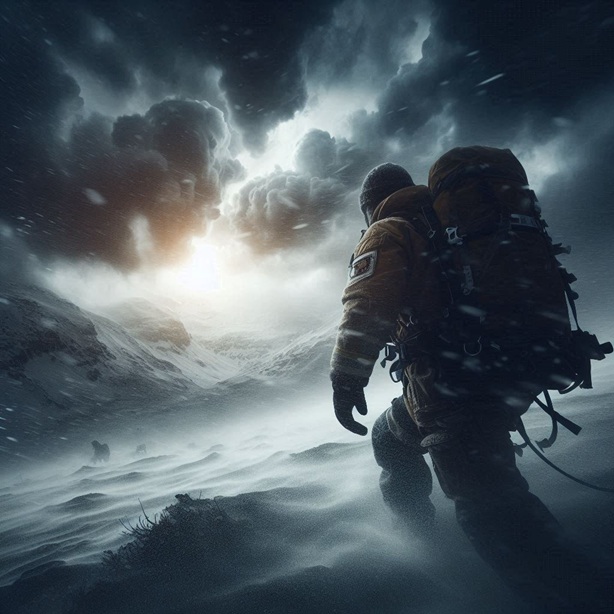
Someone has to step into the dark, into the gathering storm, into the teeth of the cold, when the light’s gone and the wind cuts through the layers that no longer matter. Someone has to step into the uncertainty when everyone else turns back, to go out into the night for a person who can’t come back on their own. Someone has to carry the heavy pack, face the difficult terrain and push through exhaustion, simply because there are people out there who have no other hope. Someone has to look into the void and say, “Not yet. Not on my watch.”
Search and rescue isn’t about the callouts or the missions. It’s about faith. Not the kind tied to a church or a creed, but the faith that human life has intrinsic worth. That compassion, even when unseen, matters. That showing up, even when the outcome is unclear, is still the right thing to do.
There’s a moment every responder faces, somewhere between exhaustion and resolve, when you realize that the mission isn’t just about finding someone else. It’s also about finding yourself, the version of you that still believes in goodness, in perseverance, in the simple, stubborn refusal to let go of another human being.
For me, that’s why I serve. Not for the organization. Not for the patch. Not even for the stories.
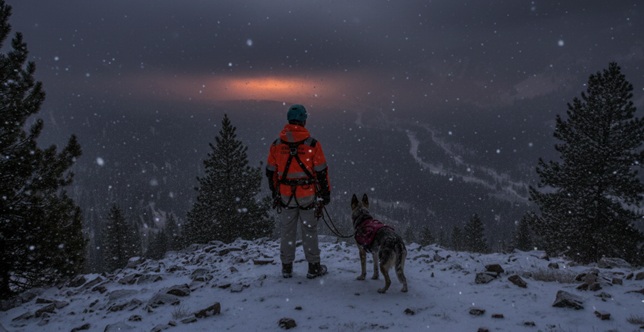
I serve for the promise that no one should be left behind, not in the wilderness, not in the cold, not in the confusion of a moment gone wrong. I serve because the world still needs people willing to walk toward the cry in the dark, simply because it’s there.
The call to serve in search and rescue is not a grand, dramatic shout. It’s a quiet call to duty. It’s about showing up when life is at its worst, offering a hand and making the world, one rescue at a time, a better and safer place. It’s about being that last beacon of light when all others have failed. And for me, there is no greater purpose.
Maybe that’s not an answer that fits neatly in an interview. But it’s the truth. And in the end, it’s the only “why” that ever matters. Because when the call comes, I still believe someone should answer.
Discover more from Tales of Many Things
Subscribe to get the latest posts sent to your email.