
I can’t let the cultural wonder known as “Groundhog Day” pass by without a comment.
The idea behind the celebration is an odd Old World carryover rooted in European weather lore, specifically from the German custom of Candlemas. Originally, if the sun shone on the feast of Candlemas, the “snow and wind would come again”. Somewhere along the line, it was decided that a clergy led liturgy wasn’t nearly as reliable as a hibernating badger.
When German immigrants arrived in Pennsylvania and discovered a shocking shortage of badgers, they did what any practical people would do: they grabbed the nearest large squirrel and promoted it to meteorologist, a move that remains one of the most questionable promotion decisions in the history of HR.
Thus was born the grand scientific principle that if a groggy, overfed rodent sees his shadow on February 2, winter will last six more weeks. If he doesn’t, spring will come early.
For reasons that remain unclear, this theory has survived longer than bloodletting with leeches.
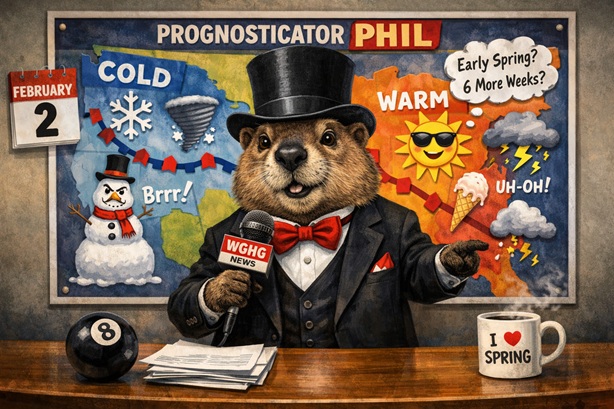
Enter the Legend: Punxsutawney Phil
By far the most famous of these furry forecasters is Punxsutawney Phil, who has been making annual predictions since 1887. You’d think 139 years of experience would result in a finely honed skill set.
You would be wrong.
Phil’s accuracy rate hovers around 35% to 39%, depending on how you crunch the numbers. In other words, Phil is statistically worse than flipping a coin. You’re playing Russian Roulette with four of the six chambers carrying a live round!
Actual meteorologists, using things like satellites, physics and basic arithmetic, average around 80% to 90% accuracy for short-term forecasts. Even the much-maligned Farmer’s Almanac, which blends historical trends with proprietary “secret formulas”, typically lands around 50% to 55% accuracy. While still slightly “wizard adjacent”, it’s a far cry from “did the rodent get spooked by his own outline?”
So in the hierarchy of predictive power we have:
- Professional meteorology
- The Farmer’s Almanac
- Guessing
- Asking a toddler
- Punxsutawney Phil
Phil isn’t just worse than a coin flip. He’s anti-accurate. If he says “winter”, you should probably pack a swimsuit and double your gym time to get your body in shape for the beach. Yet somehow Phil gets the national TV contract, which potentially says less about Phil and more about television.
The Ethics of Using Animals as Weather Apps
There has been a lot of debate about old traditions and beliefs and the general use of animals as prognosticators and entertainers. Even Barnum & Bailey finally retired their elephants, realizing that audiences prefer human acrobats who actually signed a waiver. SeaWorld eventually admitted that maybe whales shouldn’t have desk jobs, either.
But every February we still drag a sleepy groundhog out of bed, shove a tiny top hat on his head and ask him to explain atmospheric dynamics.
Occasionally this goes poorly.
A particularly tragic example is Staten Island Chuck, who in 2009 bit New York City Mayor Michael Bloomberg, arguably the only time a groundhog has engaged in successful political activism. Five years later, Mayor Bill de Blasio, perhaps anticipating another attack, dropped Chuck (technically “Charlotte” at the time) on the ground during the ceremony. The animal died several days later. The Staten Island Zoo didn’t publicly disclose the death for months and a necropsy later attributed it to “acute internal injuries consistent with a fall”.
Which is to say that our adorable cultural tradition has occasionally resembled a very small, very awkward episode of Game of Thrones.
So when you see naked PETA demonstrators waving signs that read things like:
- “Meteorology Without Groundhogs!”
- “Stop Exploiting Rodents for Ratings!”
- “Six More Weeks of Dignity!”
- “End the Shadows of Oppression!”
- “Your Shadow is Not a Career Path!”
…you have to admit, they might have a point.
The moral?
If your tradition requires a mayor to handle a terrified animal like a greasy football, maybe it’s time to move to an app. Preferably one that doesn’t require a helmet and a rabies waiver. Maybe we shouldn’t base seasonal planning on whether a confused animal gets startled by its own shadow. Or that of a politician.
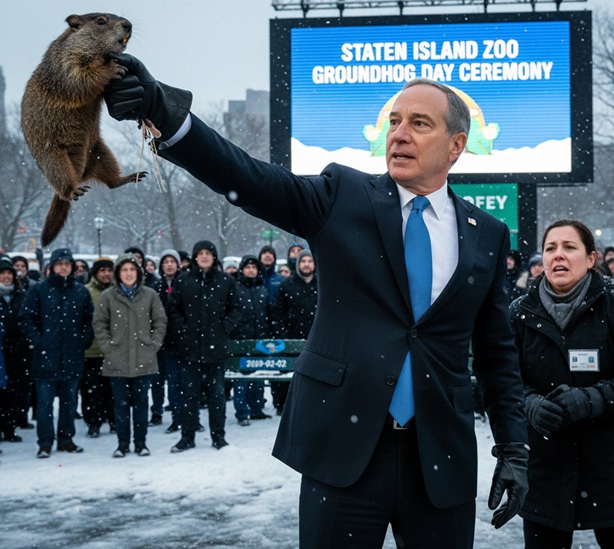
Why Do We Keep Doing This?
And yet, despite being weird, unscientific and occasionally hazardous to small mammals, Groundhog Day refuses to die.
Why?
The short answer: Because it’s fun.
The practical answer: Because humans are hard-wired to crave certainty in a chaotic universe.
We’d rather believe a groundhog has a direct line to the jet stream than admit that spring is a fickle concept controlled by complex atmospheric thermodynamics which we can’t influence.
It’s folklore disguised as community theater. It’s a cheerful bit of collective nonsense that gives us something to talk about in the dreariest part of winter. It’s (usually) harmless pageantry with marching bands, goofy costumes and the comforting illusion that spring might be right around the corner.
In other words, Groundhog Day isn’t about meteorology at all.
It’s about hope with a tail.
Rocky Mountain Region Prognosticators
Here in the Rocky Mountain region, we’ve wisely diversified our portfolio. The good news is that all of our local prognosticators are not live animals, although the taxidermized one is clearly straddling the line between “morbid” and “haunted” (and possibly filing its own OSHA complaints).
| Prognosticator | Type | Location | Prediction |
| Stormy Marmot | Plush toy | Aurora, CO | Early Spring |
| Flatiron Freddy | Taxidermized marmot | Boulder, CO | Early Spring |
| Lander Lil | Prairie dog statue | Lander, WY | Early Spring |
This sunny consensus puts the Rocky Mountain region in direct conflict with Punxsutawney Phil, who saw his shadow and doom-scrolled us into six more weeks of winter.
So, we have a standoff.
On one side: a groggy rodent with a 35% accuracy rate.
On the other side: a plushie, a bronze statue and a stuffed corpse.
Let’s be honest, someone is going to walk away from this with egg on their face. But when the dust clears, ask yourself: Who do you trust? The animal trying to get the rest of his winter nap or the stuffed toy that hasn’t blinked since 2006? I know where I’m placing my bets.
Of the regional prognosticators, only Stormy Marmot has a website and I’ll admit I’ve genuinely enjoyed the anthropomorphic humor posted there. If we’re going to rely on imaginary expertise, we might as well get good jokes out of it. At least Stormy knows he’s a prop.
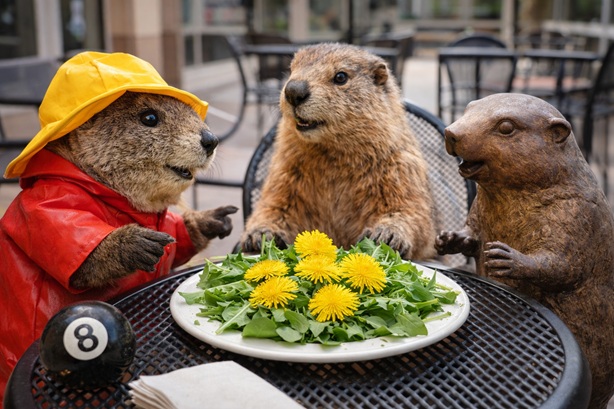
So What’s the Final Verdict?
Groundhog Day is the participation trophy of holidays, a glorious collision of folklore, wishful thinking and civic tradition, when we all agree to pretend that an animal shadow is a meteorological data point. It’s not science. It’s not meteorology. It’s not even particularly logical.
But it is charming.
And in a world that takes itself far too seriously, maybe there’s room for one day a year when we all pretend a woodland creature is in charge of the climate.
If the groundhog is right, he’s a genius. If he’s wrong, he’s a groundhog. It’s the only job in the world where you can be wrong 65% of the time and still be the most popular guy in Pennsylvania.
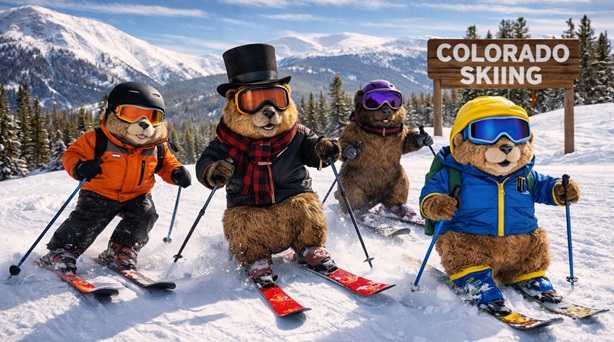
Just don’t plan your ski trips around it.
Discover more from Tales of Many Things
Subscribe to get the latest posts sent to your email.