
It’s not quite Halloween. There are no ghosts, no monsters, no spooky hauntings, no plastic skeletons on the lawn, no “fun-size” candy bars clogging the pantry and no neighbors dressed as inflatable dinosaurs, at least not in the costume aisle sense. But today carries its own cultural chill.
It’s Friday the 13th, a date that carries a weight almost as heavy as October 31st.
And this year, 2026, is one of those banner years when we get not one, not two, but three opportunities to be irrationally nervous about an otherwise perfectly ordinary date on the calendar. If you suffer from paraskevidekatriaphobia, a clinical fear of this specific date, you’re probably considering a very long nap until 2027.
Somewhere, a ladder just shuddered.
So why are we still so fascinated by superstition? Why do otherwise sensible, smartphone-carrying, GPS-navigating, science-trusting adults suddenly hesitate to board a plane, sign a contract or walk under scaffolding simply because the number 13 showed up next to the word “Friday”? And why are we still checking over our shoulders for black cats (which, as we’ve discussed before, are just purr-fectly normal)?
More importantly, why, in the 21st century, do we cling to beliefs that have been tested, retested and found to have roughly the same predictive power as a Magic 8 Ball?

The Evolutionary “Oops”: We are Pattern-Seeking Missiles
From a scientific perspective, superstition isn’t a sign of a weak mind. It’s a byproduct of a very successful survival strategy. Our ancestors survived because they were masters of pattern recognition.
Humans are spectacularly good at noticing patterns. In fact, we are so good at it that we frequently invent patterns where none exist, such as the Power of Three and the Completeness of Seven.
This evolved ability kept our ancestors alive. If you’re a prehistoric human and you assume that the rustling in the bushes might be a tiger, you survive long enough to pass on your genes. If you assume it’s just the wind and you’re wrong… well, your contribution to the gene pool ends abruptly.
Statisticians call this a Type I Error, a false positive. Evolutionary psychologists argue that our brains are wired to make this kind of error on purpose. Our brains would rather find a pattern where none exists than miss a pattern that could kill us. Over time, this “better safe than sorry” hardware started connecting dots that weren’t there:
- I wore these socks and my team won.
- I saw a raven and then I stubbed my toe.
- It’s Friday the 13th, so the financial markets will tank.
Superstition is basically instinct wearing a modern suit.
Our brains crave cause and effect. Something bad happens on a particular day? Clearly the day must be cursed. A black cat crosses your path and later you stub your toe? Congratulations, you just created personal mythology.
The cat, statistically speaking, is innocent. But superstition doesn’t care about statistics. We simply use it as an excuse to build a bias.

The Illusion of Control: Fear We Choose vs. Fear We Inherit
As we explored in our look at the curious case of safe fear, humans actually enjoy a controlled dose of anxiety. But real-life uncertainty? That, we hate.
Superstitions offer a weird kind of comfort. If you believe that the number 13 is unlucky, you have a “rule” you can follow to stay safe. You avoid the 13th floor, you don’t seat 13 people at dinner and you stay home on Friday the 13th. It gives us an illusion of control in a world that is fundamentally chaotic and indifferent (but not malicious) to our plans.
There’s an odd paradox at the heart of all this. On Halloween we pay good money to be terrified. We stand in line to walk through haunted houses, watch horror movies and willingly let actors in clown masks chase us with fake chainsaws. We actually enjoy controlled fear, fear with guardrails. It gives us a jolt of adrenaline without any real risk.
Friday the 13th is the low-calorie version of that same experience.
It’s fear with plausible deniability. We get to feel a little thrill, a little unease, without committing to full-blown ghosts and goblins. No costumes required, just a calendar and a slightly raised eyebrow.
The Weird History of an Ordinary Number
The number 13 didn’t always have bad press.
Some cultures considered it lucky. Others considered it sacred. But somewhere along the way, thanks to Norse myths, biblical dinner parties and a long series of historical coincidences, 13 got stuck with a terrible public relations team.
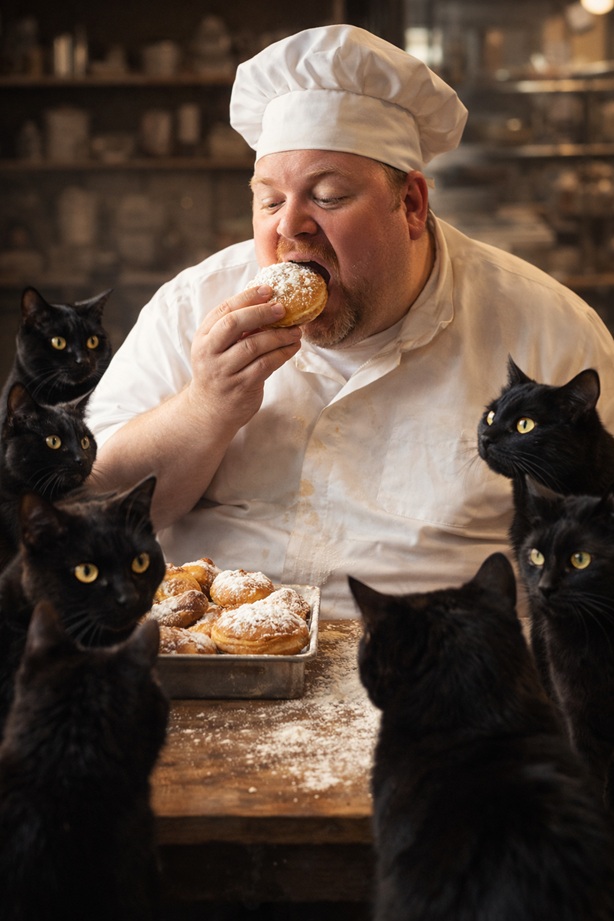
No one shuns a “baker’s dozen”. It’s unlucky only for the baker, but only because he lacks the willpower to avoid eating the worst looking pastry of the bunch.
Add in the fact that Friday was already considered unlucky in parts of medieval Europe and eventually the two teamed up like a dysfunctional superhero duo: Captain Anxiety and the Number of Doom.
The result? Triskaidekaphobia, the fear of the number 13. Yes, there’s an actual clinical term for it. Humans will invent a word for anything if given enough coffee and Greek prefixes.
But here’s the scientific reality:
- More accidents do not happen on Friday the 13th.
- Planes do not crash more often.
- Stock markets do not mysteriously collapse.
- And ladders remain statistically indifferent to the day of the week.
The universe, it turns out, does not consult the Gregorian calendar before deciding whom to inconvenience, because the calendar itself is a human invention to help keep track of time. For humans, not for the universe.
Magical Thinking in a Digital Age
What’s fascinating is that superstition hasn’t faded with technology. If anything, it’s adapted.
We carry supercomputers in our pockets, consult satellites to find the nearest pizza place and argue with digital assistants about the weather, yet many of us still:
- knock on wood
- avoid saying certain things out loud
- hold our breath passing cemeteries
- and secretly feel relieved when the elevator skips from floor 12 to floor 14
We know better.
And yet… we don’t.
Because superstition isn’t about logic. It’s about control.
When life feels random and unpredictable, believing that we can influence outcomes with tiny rituals such as lucky socks, favorite pens and specific pre-game routines gives us the comforting illusion that chaos is negotiable, that we actually have a way of manipulating entropy itself.

The Scientific Cure for Superstition
The antidote to magical thinking isn’t mockery. It’s curiosity.
Instead of asking, “Is Friday the 13th unlucky?” a scientist asks:
- Compared to what?
- According to which data?
- Over what time period?
- With what control group?
And once you start asking those questions, superstition begins to look less like destiny and more like a very persistent urban legend that would never pass a scientific journal peer review.
That doesn’t mean we have to drain all the fun out of it. A little playful superstition is harmless. Tossing salt over your shoulder won’t change your life, but it might make dinner more entertaining if some of it lands on Uncle Ed’s coffee cake.
Just don’t reorganize your entire existence around the superstition of the date.
So, as we face the first of our three Friday the 13th encounters of 2026, take a deep breath. The “bad luck” you’re feeling is likely just confirmation bias, the tendency to remember the one time you dropped your toast on a Friday the 13th, while forgetting the other 364 days when your toast mysteriously escaped your grasp and took flight.
Science tells us there is no magic in the date. There is no curse in the number. But our “belief engine” is still idling in the background, looking for tigers in the grass.

So What Should We Do Today?
Enjoy it.
Treat Friday the 13th the same way you treat a horoscope: amusing, occasionally spooky, but not a reliable life strategy. Enjoy the “safe fear” of the day. Watch a slasher movie, avoid a ladder if it makes you feel better, but remember, the most dangerous thing about Friday the 13th is usually just the traffic caused by everyone else being nervous.
It’s okay to pet a black cat, spill some salt or break a mirror (okay, maybe don’t break a mirror — those things are expensive!).
And remember that the scariest thing about today isn’t bad luck.
It’s realizing that 2026 still has two more of these on the calendar and that plenty of otherwise rational people will treat them like cosmic alignment events.

Discover more from Tales of Many Things
Subscribe to get the latest posts sent to your email.