
I dread talking politics. In the current climate, saying “good morning” can feel like a partisan statement. No matter what I say, I risk offending half the room, and in a world where we’ve forgotten how to bridge the “Space Between Us”, that’s a heavy lift.
A friend recently sent me two links that were so statistically hilarious from a scientific perspective that I couldn’t resist writing about them.
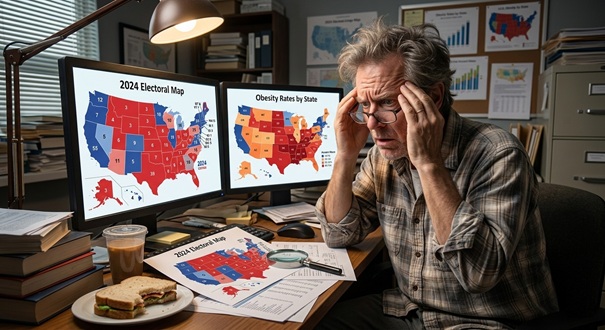
One link was to a freshly published article by Visual Capitalist mapping obesity rates across the United States. The other from Wikipedia summarizing the results of the 2024 United States presidential election.
On the surface, you can’t help but engage the idea. The most fit states (California, Colorado, Hawaii, Massachusetts, New Jersey, New York, Vermont) are all deep blue. Opposite them are the least fit states (Alabama, Arkansas, Indiana, Louisiana, Mississippi, Tennessee, West Virginia) and they just happen to be deep red. The numbers clearly dance together. Lined up, the maps just snap into place. But these are statistical averages, not personal judgments about individuals.
His conclusion? If a candidate wants to win, they should stop buying TV ads and start legislating (or de-legislating) McDonald’s. Forget the stump speech. Just manage the fries.
Fast food is just a convenient symbol here, not the sole driver of national health outcomes or votes, but the correlation creates a trail of questions.
On the surface, food in politics is a funny argument. It’s a hilarious punchline that’s waiting to be noticed by a late night comedian. And it carries heavy scientific humor. Not because it’s malicious. Not because it’s partisan. But because it’s such a clean textbook example of how the human brain desperately wants correlation to mean causation.
And that’s where things get interesting.
There is a deep universal desire for politicians to just shut up and do their jobs and the idea of “The Cheeseburger Constituency” is a great visual. But scientifically, we are standing at a dangerous intersection of politics and data. We have to ask the hard question: Is this causation or just a really weird correlation?
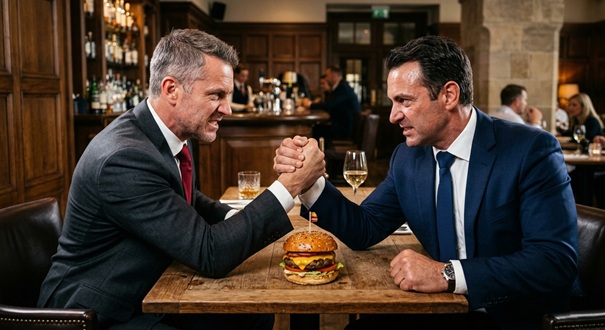
The Allure and Seduction
Our brains are “pattern-seeking missiles”. We love a good story. If rustling grass usually meant predator, you didn’t wait for a peer review. You ran.
So when we see that states with higher Republican vote percentages also tend to have higher obesity rates, our brains light up:
- “Aha.”
- “There’s something there.”
- “That can’t be random.”
We’re gathering the low hanging fruit, fully convinced that we will not be taking a bite of the apple that Eve handed to Adam.
Our internal storyteller starts spinning a web. We think: “Maybe conservative life is more rural, involving more driving and less walking?” or “Maybe liberal areas have more kale smoothie shops per capita?” It’s tempting, but in science there is a famous warning: Correlation is not causation. Just because two things move in the same direction doesn’t mean one caused the other. For example, ice cream sales and shark attacks are highly correlated. Does eating a rocky road cone make you taste better to a Great White? No. They both just happen to increase during the summer.
Patterns alone are not explanations.

Why People Vote the Way They Do (It’s Not the Calories)
Political scientists will tell you that people choose “Red” or “Blue” based on a staggering array of variables:
- Urban vs. rural residence
- Income level
- Religious participation
- Education
- Economic anxiety
- Cultural identity
- Family tradition
- Media environment
- Policy priorities (taxes, regulation, social issues, national security, etc.)
Voting behavior is not a single variable equation. It’s a multi-dimensional social phenomenon. Reducing that to “calories in, ballots out” would be like explaining orbital mechanics using only gravity and ignoring velocity. You might gesture in the right direction, but you won’t land a spacecraft.
Obesity rates, likewise, are not personality tests. Doctors will tell you that obesity is a tangled web that correlates with:
- Genetics
- Food access and cost
- Walkability and infrastructure
- Climate
- Income distribution
- Healthcare access
- Education
- Occupational patterns
- Cultural food traditions
A rural agricultural state with long driving distances and limited public transit will produce different lifestyle patterns than a dense coastal city with walkable neighborhoods and high produce availability.
Neither environment is morally superior. They are structurally different.
And structural differences create statistical differences.
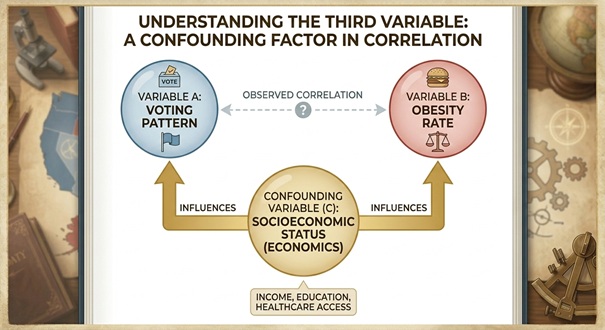
The “magic” of the data my friend sent lies in Confounding Variables. Many of the states with high obesity rates also happen to be states with higher poverty rates or lower access to specialized healthcare. Those same economic factors also influence how people vote. The steak and the ballot are both being pushed by a third, invisible hand: Economics.
To argue that political identity causes weight, or vice versa, would be saying that because people wear coats, they cause blizzards. Or that putting on a bikini attracts a hurricane.
The moment you introduce that third variable, the narrative shifts from blame to complexity. And complexity is less satisfying than a late night comedy punchline.
The Scientific “Wait a Minute”
Now, is it funny to say politicians should stop talking and regulate fast food?
Sure. It’s satire-adjacent. It pokes fun at performative politics. It expresses frustration with rhetoric over action.
But the scientific move would be:
- Define the hypothesis precisely.
- Control for confounding variables.
- Examine longitudinal data.
- Separate cultural patterns from biological outcomes.
- Avoid moral conclusions from statistical associations.
Without that discipline, we’re just rearranging spreadsheets into stories we already prefer.
As scientists, we have to be the “buzzkills” at the party. When we see a correlation that fits our personal biases, that is exactly when we should be the most skeptical.
If we assume the “Cheeseburger Theory” is true, we miss the actual harder truths about why our country is divided and why our health is declining. We settle for a punchline instead of a solution.
The Real Lesson
The deeper issue isn’t obesity.
It isn’t voting.
It isn’t even politics.
It’s epistemology.
First impressions are powerful. They feel decisive. Clean. Elegant. But science exists precisely because first impressions are often wrong. Correlation is a starting point, a flag that says, “This might be worth studying.” It is not a verdict.
Science requires us to be critical, not just of the data, but of our own desire for the data to be simple. When we collapse the two, we turn data into ammunition instead of understanding. And that’s true whether we’re talking about public health, economics, crime, education or elections.
If we want better conversations, especially in politically charged territory, we need to tolerate something uncomfortable: The truth is usually more complicated than the joke.
Science doesn’t eliminate humor. It just insists that before we legislate the Big Mac, we check whether the Big Mac was actually driving the vote or whether we just noticed two lines on a chart leaning in the same direction.
The world is messy. People are complicated. And while it’s perfectly okay to have a laugh at the idea of a “Big Mac Swing State” (Illinois, Nevada, New Mexico, North Carolina, Pennsylvania), we should remember that the “Space Between Us” isn’t measured in pounds or poll numbers. It’s measured in how much effort we put into understanding the real reasons behind the numbers.
So, the next time you see a map that seems to explain everything about your “opponents”, take a breath. Look for the “Shark Attack” logic. And feel free to enjoy a burger or a kale salad while you do it. Just don’t expect it to change the leader of the free world. At least not in terms of ideology. It may be a factor in the waistband.
Patterns are easy. Causation is earned. And that difference matters.
No causal claims were harmed in the making of this analysis.
Discover more from Tales of Many Things
Subscribe to get the latest posts sent to your email.