
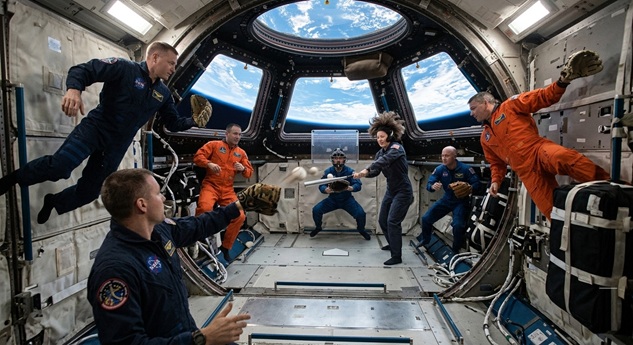
After I wrote about losing gravity, I was asked a great follow-up question: if the Earth is massive object warping the fabric of spacetime and pulling everything toward it, why do astronauts appear like they’re floating in a giant expensive fish tank?
If the curvature of space is still there, shouldn’t they just … “thud”?
The answer is surprisingly simple and a little counterintuitive.

The Perpetual Miss
The secret to weightlessness in Low Earth Orbit isn’t that gravity has “run out”. Objects in Low Earth Orbit aren’t free from gravity at all. In fact, gravity at the altitude of the International Space Station is still about 90% as strong as it is on the ground.
What’s really happening is that the spacecraft, the astronauts and everything inside the space station are in a perpetual state of freefall.
Imagine throwing a baseball. It travels in a curved path and eventually hits the ground. Now imagine throwing it faster. It travels farther before hitting the ground. If you could throw it fast enough, about 17,500 miles per hour, the curve of the ball’s fall would match the curve of the Earth beneath it. It would keep falling, but never hit the ground. That’s orbit.
The International Space Station isn’t “defying” gravity. It is falling toward the center of the Earth at a terrifying speed, but it’s moving forward so quickly that the surface of the planet curves away beneath it at the same rate that gravity pulls it down. The result is a continuous fall around the planet. In effect, the space station is moving forward so fast that it consistently misses the planet.
And because everything inside the station is falling at exactly the same rate, the “weight” disappears. It’s the ultimate “glitch” in the system: weightlessness is just the feeling of falling without ever hitting the floor. This is a critically important element in understanding how orbital mechanics work.
It is also important to stress that while you may be weightless in space, you are not massless and your mass still influences things in your immediate vicinity. Think of it this way: the Earth is effectively weightless as it orbits the Sun. It is in a perpetual freefall towards the sun, but moving quickly enough to keep missing it. At the same time, Earth’s mass is not being negated. Even while “weightless” in its fall around the Sun, the Earth still exerts gravity on you as you walk across its surface.
Straight Lines in a Crooked Universe
From a relativity perspective, this is even more elegant. In curved spacetime, objects in freefall are actually following the straightest possible path available to them, what physicists call a geodesic. So paradoxically, an orbiting spacecraft isn’t being “forced” into a curved path. It’s following the natural geometry of spacetime shaped by Earth’s mass.
When you are on the space station, you aren’t “turning” in a circle because of a “pull”. You are traveling in the straightest possible path through a universe that has been bent into a curve. To the astronaut, they are flying straight. To the universe, they are circling the drain of Earth’s gravity well. That’s a perspective through the lens of relativity.
Faking It: The Vomit Comet
Of course, while we can’t turn gravity off, we’ve gotten pretty good at faking its absence and its presence. You don’t have to go to space to experience this “glitch”.
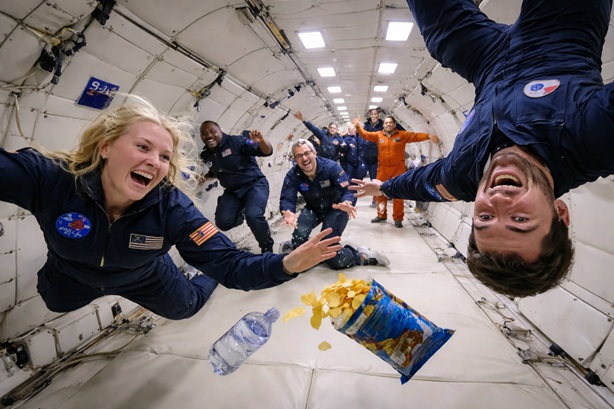
NASA’s famous KC-135A aircraft, affectionately known as the “Vomit Comet”, creates brief periods of weightlessness by flying in a carefully controlled arc. The plane climbs steeply, then noses over into a downward trajectory that matches the acceleration of gravity. For about 20 to 30 seconds at a time, everyone inside is in freefall together, just like in orbit. For those few seconds, you have successfully faked the absence of gravity. Loose objects hover, water forms floating spheres and your inner ear starts filing complaints.
At least until the plane pulls up, at which point gravity introduces itself again with twice the normal force as you enter the next arc. And thus the name “Vomit Comet”.
Do It Yourself: The Spin Cycle
On the flip side, if we can “fake” a loss of gravity, we can also “fake” its presence. We do this through centrifugal force using acceleration, particularly through rotation.
- At the county fair:
If you’ve ever been on a spinning amusement park ride, the “Gravitron”, where you’re pressed against the wall, you’ve experienced artificial gravity firsthand. As the ride spins, your body wants to continue moving in a straight line, but the wall forces you into a circular path. Your body resists that change and that resistance feels like a force pressing you outward. - In the lab:
In a laboratory, centrifuges use this same principle to separate materials by density, spinning samples so that heavier components are forced outward more strongly than lighter ones. - Among the stars:
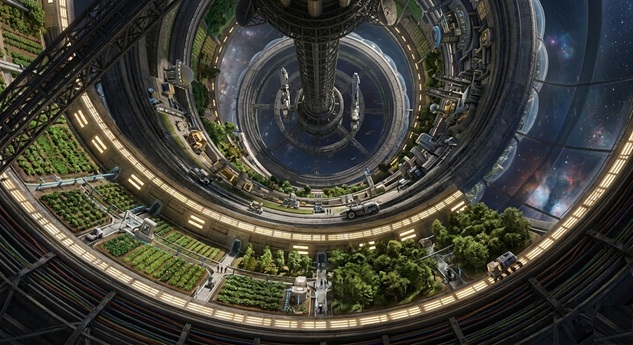
In space the same idea has long been proposed for interstellar spacecraft. Theoretical generational spacecraft designed to travel to distant worlds will likely be massive rotating cylinders. By spinning the ship, the “outward” push would create a simulated gravity on the inner hull, allowing humans to live for decades without their bones turning into sponges from the lack of traditional gravity.
None of these are gravity in the traditional sense. It’s acceleration. But to your body, it feels the same.
The Invisible Anchor
All of this leads to a strange realization that gravity is both one of the most powerful forces shaping our existence and one of the most invisible.
We don’t see it. We don’t hear it. We rarely even think about it. But it defines “up” and “down”, anchors our bodies, governs the motion of planets and quietly orchestrates everything from the fall of a dropped cup to the orbit of the Moon. The one exception might be a falling cat, but that’s an article for another day.
We often think of gravity as burden, especially when hiking up a hill or climbing stairs, but gravity is critical to our existence. It keeps our atmosphere from leaking into the vacuum of space. It keeps our blood from pooling in our heads. It provides the “resistance” our bodies need to stay strong.
Gravity is the invisible inhale and exhale of the cosmos. We don’t notice it until it changes, yet it is the silent hand that ensures the “straight line” we are traveling today stays firmly attached to the ground beneath our feet. Like breathing, gravity is so constant that it fades into the background.
We can simulate its absence. We can imitate its effects. We can ride along its curves through spacetime. But we can not escape the fact that gravity is not just something we experience. It’s something we are fundamentally embedded within.
And perhaps that’s the most humbling part: even as we reach into space, we’re still falling, just very, very carefully.

Discover more from Tales of Many Things
Subscribe to get the latest posts sent to your email.