
I’ve recently been invited to participate in a transformation initiative at work. At a large company, opportunities like this don’t come from raising your hand. They come from being tapped on the shoulder. Senior leadership looks across the organization and division vice presidents handpick individuals they believe can help shape the company’s future.
By all measures, it’s an honor, a massive commitment and, frankly, the most exciting “second job” I’ve ever had. Being selected out of hundreds without ever applying is both humbling and energizing.
The initiative will require a couple of days each week through the end of the year, on top of my regular responsibilities, but it’s the kind of opportunity you don’t hesitate to accept. It’s not just more work. It’s a front row seat to change.

The Ubiquitous Wave
And change is exactly what this moment is about. The goal? To figure out how we navigate the massive wave currently hitting every shore on the planet: Artificial Intelligence.
We live in a world where everything has already changed multiple times over. The automobile reshaped distance. The computer reshaped productivity. The internet reshaped information. The smartphone reshaped daily life.
Now we’re on the cutting edge of the next wave: artificial intelligence.
Even if you consider yourself “a little Amish” and vow never to touch the stuff, it touches you.
AI is already woven into the fabric of our lives. It helps route our bank transactions, recommend what we buy, filter what we read and even decide which articles appear in our social feeds. If you found this blog through social media, there’s a good chance AI helped guide you to it.
AI is here. We aren’t escaping it, but more importantly, we shouldn’t want to.
Fear, Predators and Tools
Even if you never “use” AI directly, it uses you, quietly, constantly and pervasively.
There’s a natural reaction to that: fear.
Fear that AI will take over the world.
Fear that it will take jobs.
Fear that it will fundamentally alter the landscape of society.
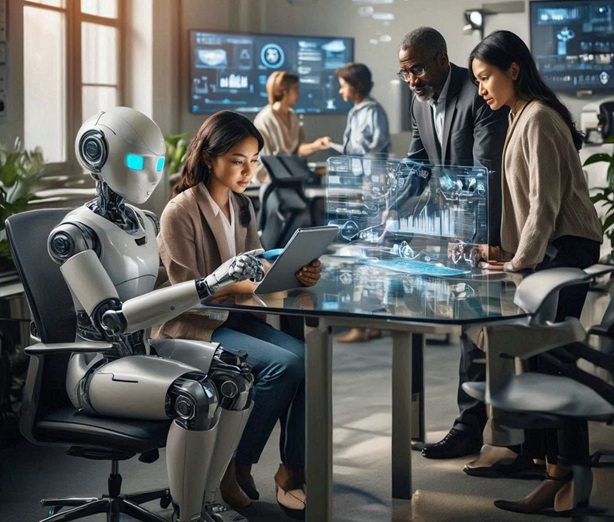
I hear the whispers of fear as I walk the corridors of society. People worry about AI as if it’s an invasive species, a predator destined to take our jobs or turn our reality into a scene from The Terminator.
Some of those fears aren’t entirely unfounded. Some organizations will ruthlessly try to push the boundaries of what this technology can do while cutting costs. But it’s important to ground the conversation in reality.
AI is not an invasive species or a predator. It’s a tool. Its purpose isn’t to replace the craftsman. It’s to take the burdensome repetitive sanding off our plates, so we can focus on the architecture, on more complex, creative and meaningful work. We aren’t headed for The Matrix. We’re not heading toward science fiction dystopias. We’re not building sentient overlords. What we are building is leverage.

History Doesn’t Repeat, But It Rhymes
Still, the idea of AI as an invader is worth examining. Not literally, but philosophically. Mark Twain once observed that history doesn’t repeat itself, but it does rhyme. To understand AI, we have to listen to the stanzas of the past.
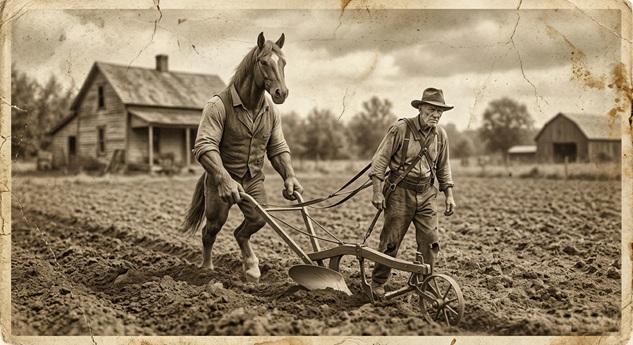
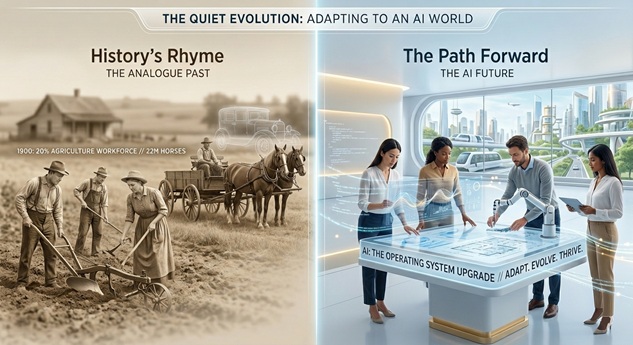
In 1900, there were nearly 22 million horses in the United States, serving a population of just over 76 million people. Horses powered transportation, agriculture and commerce. Then the automobile arrived.
Today, horses haven’t disappeared, but they’ve been recontextualized. There are now fewer than 7 million of them in a country of more than 340 million people. Yet we don’t see herds of displaced homeless horses wandering suburbia. Society adjusted. The role of the horse changed. Horse breeders are no longer aiming to pull your wagon. Most people who own horses do so out of their love for the animal.
The same pattern appears in human labor. Around 1900, roughly 20% of the U.S. workforce was employed in agriculture. Today, it’s less than 1%. Yet we don’t have a permanent 19% unemployment rate. Those workers didn’t vanish. They weren’t “deleted”. They transitioned. Entirely new industries, which didn’t even have names in 1900, emerged to absorb them.
This is the rhythm of progress.
The Blade of the Cutting Edge
So what does that tell us about AI?
It tells us that this isn’t an extinction event. It’s an evolution.
Some individuals and some companies will be early adopters, standing on the very blade of the cutting edge, being willing to experiment, to fail and to learn quickly. They are all in to buy back their time.
Others will take a more cautious approach, watching from a distance and learning from the early mistakes, waiting to see how many people bleed on that edge before they step forward.
And some, for whom change is simply too heavy a lift, will resist outright, hoping the wave passes them by.
It won’t.
Change never asks for permission.
And while change is uncomfortable, sometimes even disruptive, it is also where growth happens. Some people chase it. Some adapt to it. Some fight it. But eventually, everyone is touched by it.
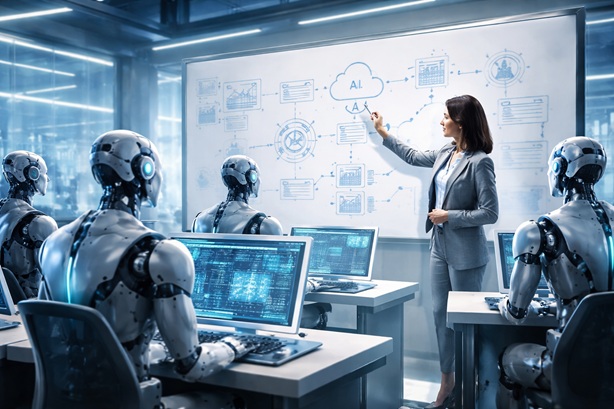
What’s important to remember is that we are not being replaced by technology. We are augmenting ourselves with it.
In many ways, this moment feels less like replacing the human and more like upgrading the operating system we run on. The capabilities expand. The interface changes. The expectations evolve.
The Scars of Stagnation
History is full of reminders of what happens next.
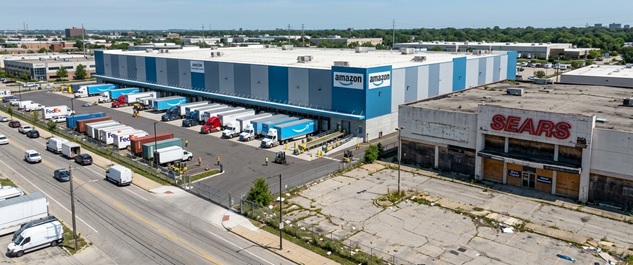
Companies that adapt thrive. Those that hesitate struggle, then fail. Companies that fail to recognize the “rhyme” of history leave scars on the landscape.
Sears built an empire on catalogs, only to be overtaken by digital commerce driven by Amazon. Blockbuster dominated physical media distribution and owned the weekend, only to be replaced by Netflix’s streaming binge nights. Eastman Kodak actually invented the digital camera, but lacked the faith to kill their own film business.
Transformation doesn’t wait for comfort. It rewards action in a world where inaction is equivalent to where the dinosaurs are today. Inaction doesn’t pause the game. It removes you from it. Analog thinking can not survive in a digital world.
The Path Forward
Today, we stand on the edge of another shift, one that rhymes clearly with the past. And for the first time, I’m not just observing it from a distance. I’ve been invited into the room where the questions are being asked and the answers are being shaped.
The world is changing and we have to change with it. We aren’t replacing ourselves. We are leveraging a new power to do things we previously didn’t have the “bandwidth” to imagine.
That’s both exciting and humbling. Amazing people fostered change ahead of me. Now I am offered an opportunity to guide our future path.
The world isn’t ending. It’s evolving.
AI doesn’t represent a break from history. It represents its continuation. Another tool. Another shift. Another moment where we are asked to rethink how we work, how we create and how we define value.
The difference this time is the speed.
Change that once took decades now unfolds in years, sometimes months. That compresses not just the timelines, but also the decisions. It demands that individuals and organizations become more intentional, more adaptable and more willing to experiment.
We don’t need to have all the answers today. In fact, we won’t. But we do need to ask better questions:
- Where can this technology remove friction?
- Where does human judgment still matter most?
- How do we combine the strengths of both?
The future won’t belong to AI alone and it won’t belong to those who reject it outright. It will belong to those who learn to work alongside it, who understand its strengths, respect its limitations and use it as a multiplier rather than a replacement.
We are not spectators in this transition. We are participants.
And like every transformation before it, this one will reshape the landscape, not by erasing what came before, but by building on top of it.
The question isn’t whether the world will change.
It’s whether we’re willing to change with it.
As I step into this transformation initiative, I’m not looking for ways to make us “robotic”. I’m looking for ways to make us more human by offloading the tasks that robots do better than we ever can. We are fundamentally embedded in this new reality. We can’t go back to the horse and buggy and honestly, why would we? The road ahead is faster, smarter and wide open. We’re building our tomorrow.
Discover more from Tales of Many Things
Subscribe to get the latest posts sent to your email.