
It turns out my grammar makes purists twitch. If you didn’t notice anything wrong with my sentence structure, you’re probably a fairly normal person who slept through your high school English class. No judgment. Truly. Some of the happiest people I know have never once argued about punctuation.
But recently I was called out for not using the Oxford comma.
And here’s the uncomfortable truth: I don’t think heavy punctuation makes a person any more articulate. It just makes you more “punctuated”.
And while we’re stepping on sacred ground, I also don’t think indentation and spacing magically make poetry more profound, either, though with April being Poetry Month, I’ll revisit that particular brand of chaos in my next installment.
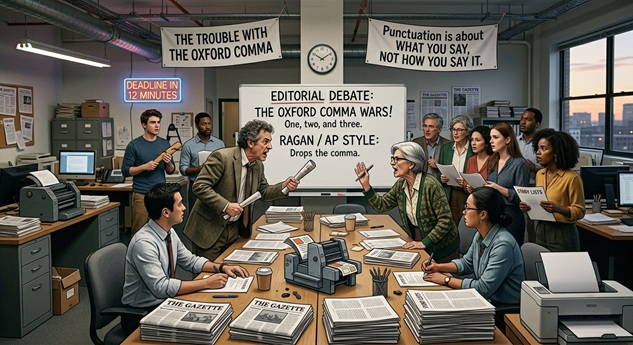
But today, we need to talk about the “Style Wars” and why people get weirdly tribal about it. Punctuation isn’t about what you say, but how you say it. In the world of professional writing, there are two major camps: the Bookish/New York Times Style (mostly Chicago Manual of Style) and the Ragan/Associated Press (AP) Style.
On a most basic level, the Bookish style is literary and traditional. It challenges you by saying, “I own a fountain pen.” Ragan is journalistic and efficient. It’s the “we have a deadline in 12 minutes” style.
They’re not exactly enemies, but they definitely side-eye each other across the room.

The Key Deltas: Why the Fight is Real
The biggest (and pettiest) battleground is the Oxford (or Serial) comma, but the stylistic rift goes much deeper. Here is how the two schools usually square off:
| Feature | Bookish / NYT | Ragan / AP |
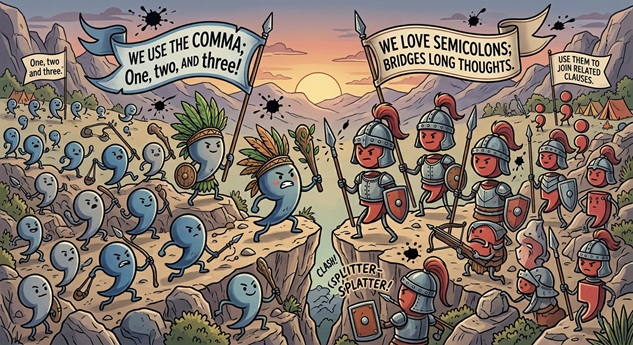
| The Comma | Uses the Oxford Comma (One, two, and three). | Drops the final comma (One, two and three). |
| Semicolons | Loves them; uses them to bridge long, complex thoughts. | Avoids them. Better to just start a new sentence. |
| Dashes | Uses the “em-dash”—with no spaces around it. | Uses the “em-dash” — with spaces on both sides. |
| Numbers | Spells out more numbers, especially in narrative writing. | Numerals for 10 and above (save that space!). |
| Emphasis | Uses italics for book titles and emphasis. | Uses “quotes” or bold. No italics in the AP world. |
Why the difference? It really comes down to intent. The Bookish style was designed for books and journals where precision and “slow reading” are the goals. It’s supposed to be like savoring a good meal. The Ragan/AP style was born on the loud, cramped floors of newsrooms. Every millimeter of ink costs money and every extra comma is a waste of capital. That ink quickly adds up. Ragan was built for speed, efficiency and saving the publisher a nickel on each page.
Then There’s … Whatever It Is I Do
My writing, if we’re being honest, is a bit of a stylistic mutt.
To make things more fun, my style is a quirky assortment of both Bookish and Ragan. It makes purists uncomfortable, but that’s how I grew up. I call it the Coyle/Anderson/Hayes Style, named after the gauntlet of teachers who hammered their specific brand of logic into my brain. Each had some strong opinions.
In my world, grammar isn’t a rulebook. It’s a seasoning. Here’s how we “modulate flavor” in the C/A/H style:
- The Over-Literal Comma: To me, a comma in a list means “and”. When you write “red, white, and blue,” you’re actually saying “red and white and and blue.” It’s redundant. Pick a side: the comma or the word. Spit it out. Don’t stutter.
- The Flavor Modulator: Commas are descriptive delimiters. “Bob, a tall lanky man, walked through the door.” If you want a fast story, just drop the appositive and you’ll have “Bob walked through the door.” But if you want color commentary? You drop in the “tall lanky man” between the commas. It’s like a parenthetical aside, but classier. An appositive is comma delimited and can be removed without damaging the sentence.
- The “But” Rule: The “but” almost always has a comma in front of it. “I wanted to go to the movies, but I had to finish my homework first.” It’s the breath you take before the excuse, because contrast deserves a pause.
- Logical Punctuation: Quotes depend on what you’re quoting. This is where I really lose the purists. If I say, “The street fair was a ‘zoo’.” the period goes at the end of the sentence outside the ‘zoo’ quote. Why? Because “zoo” does not a sentence make. However, if my friend told me, “The street fair was a zoo.” the period belongs inside the quote. If it’s a full sentence, it earns its punctuation. It’s logical, even if it makes an editor cry. You’re not punctuating a zoo. You’re punctuating the sentence that it is in.
- The Title Toss-up: “The Trouble with the Oxford Comma” vs “The trouble with the Oxford comma.” This is “Title Case” versus “Sentence case”. One feels like a grand announcement, the other like a casual conversation. I want my titles to scream out loud! Bookish takes the title case. Ragan relaxes with sentence case. Same idea. Different tribes. Choose your fighter.

Survival of the Fittest (Grammar)
These differences didn’t appear out of thin air. They evolved from context:
- Newspapers needed speed, clarity and efficiency
- Books and essays prioritized tone, rhythm and voice
- Teachers passed down their preferences like family recipes
What we’re left with today isn’t the one “correct” way to write. It’s a toolbox. And like any toolbox, the right tool depends on the job.
When you read my blogs, you’re seeing a digital archaeological dig. You’ll find a little Bookish/NYT, a little Ragan/AP and a whole lot of Coyle/Anderson/Hayes trauma, which I somehow survived through graduation, despite their wildly different rules.
Writing is personal. I learned that in my school paper days. I’ve come out the other side believing that the best style isn’t the one that follows the most rules. It’s the one that communicates the most clearly and in the most engaging way.
Writing styles aren’t cages. They are lenses. In the professional world there is always an editor who scowls and fixes your style of choice. In my life the editor is inspiration and you will catch that every now and again my style will slip, because a different English teacher whispers the rule in my ear as I write.
Whether you are a minimalist AP devotee or a maximalist Oxford Comma warrior, the goal is the same: communicate clearly.
You can use the Oxford comma.
You can reject it.
You can mix styles like a grammatical DJ.
But if your reader:
- understands you
- enjoys the ride
- and doesn’t have to reread every sentence
…you’re doing it right. It’s okay if your “quirky assortment” of style does its job.
At the end of the day, writing isn’t about commas, semicolons or whether your title capitalizes “with”. It’s about communication. And if your words land the way you intended, you’ve already won the war. Even if you lost the comma battle.
So, sorry to the person who called me out. I’m not missing a comma. I’m just modulating my flavor. And skipping the stutter.
Discover more from Tales of Many Things
Subscribe to get the latest posts sent to your email.