
After exploring why gravity doesn’t “turn off” and why astronauts in low Earth orbit are really just falling forever, we can finally follow that idea to its natural conclusion: what happens when you keep falling all the way to the Moon?
That’s exactly what Artemis II is designed to do.
This mission isn’t just to orbit Earth. It is designed to leave Earth behind, arc around the Moon and return home, tracing a path shaped not by engines alone, but by the invisible architecture of gravity itself.
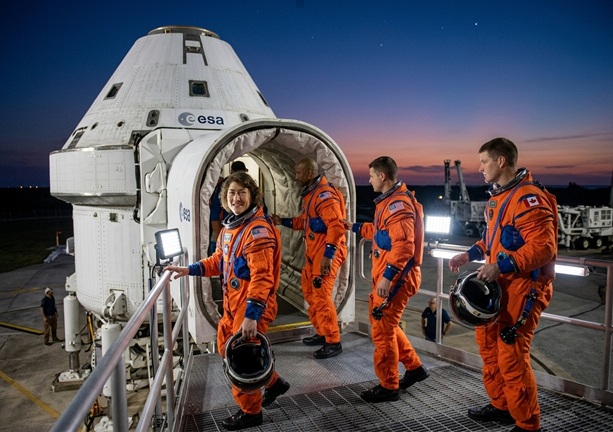
When the four astronauts of Artemis II — Reid Wiseman, Victor Glover, Christina Koch and Jeremy Hansen — rocketed away from Earth, they weren’t just passengers on a ship. They were participants in a high-stakes game of gravitational billiards.
There is No Line Where Gravity Stops
A common misconception is that a spacecraft leaves Earth’s gravity, travels through weightless space and then enters the Moon’s gravity. That’s not how physics works.
Gravity from both Earth and Moon, and even the Sun, is always present. What changes is which influence dominates.
At any point in space, your motion is determined by the combined gravitational pull of multiple bodies. Near Earth, Earth wins. Near the Moon, the Moon takes over. In between, it’s a delicate tug-of-war.
This region is governed by what physicists call the three-body problem, one of the most famously complex problems in physics. There is no simple, closed-form solution, only approximations, simulations and very clever mission design.
As the Orion spacecraft climbs away from Earth, Earth’s gravity is constantly pulling back on it, trying to drag it home. To get to the Moon, Orion must reach a high enough velocity to “climb” out of Earth’s deep gravitational well.
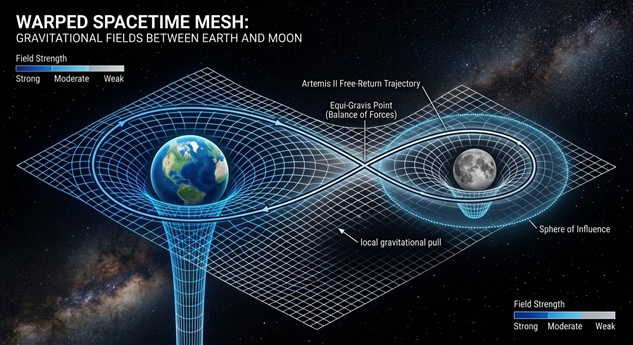
But about three-quarters of the way to the Moon, something subtle happens. There is no visible line, no dramatic crossing, but the balance of influence begins to shift. The pull of Earth weakens with distance, while the pull of the Moon grows stronger. At a point sometimes described as an “equi-gravis” region, where those forces are comparable, the spacecraft’s path begins to tip. It doesn’t stop or hover. It doesn’t switch tracks. But from there on, the Moon’s gravity takes the lead role in shaping the journey.
At this specific coordinate in space, the pull from the massive, but distant, Earth and the pull from the smaller, but much closer, Moon are exactly equal. For a split second, the astronauts are truly balanced between worlds. One inch further and the Moon’s gravity becomes the dominant force. The spacecraft stops “climbing” away from Earth and begins “falling” toward the Moon.
Falling Sideways, All the Way to the Moon
Just like astronauts aboard the International Space Station are falling around Earth, Artemis II is falling along a much longer path, but instead of a circle, it follows a stretched out arc called a translunar trajectory. Instead of using massive amounts of fuel to brake and enter lunar orbit, Orion is aimed to fly around the far side of the Moon.
As Orion entered the Moon’s “Sphere of Influence”, the Moon’s gravity hooked the spacecraft, swinging it behind the lunar disk. This gravitational “slingshot” redirects the ship’s path 180 degrees. Like a boomerang, the Moon’s gravity does the hard work of turning the ship around and throwing it back toward Earth. If the engines were to fail completely the moment they left Earth’s orbit, gravity alone would ensure the crew returned home. It is a masterpiece of orbital mechanics that treats gravity not as an obstacle, but as a propellant.
Here’s what’s really happening:
- The spacecraft fires its engines to gain enough speed to escape a stable Earth orbit.
- It doesn’t “fly” to the Moon. It falls outward, slowing as Earth’s gravity pulls it back.
- As it climbs out of Earth’s gravitational well, the Moon’s influence grows stronger.
- Eventually, the Moon bends the spacecraft’s path around it.
- Then the process reverses and Earth pulls the spacecraft back home.
At no point is gravity absent. The spacecraft is always falling, just along a path that connects two worlds.
The Balance: Cosmic Saddle Points
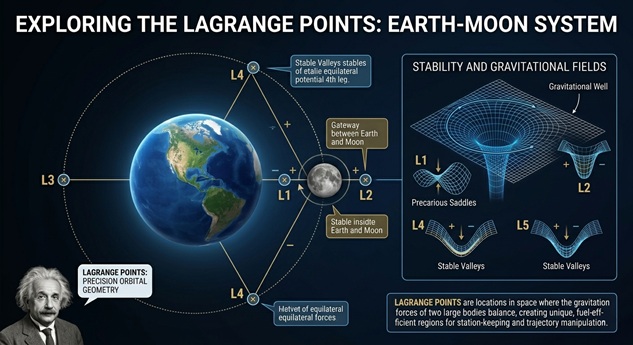
Between Earth and Moon lie special regions called Lagrange points, where gravitational forces and orbital motion balance out.
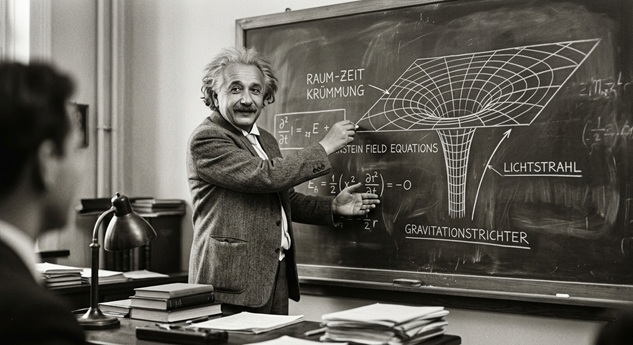
These are not parking spots in the traditional sense. They’re more like precarious mountain passes in a landscape made of gravity. The height of the “peaks” is proportional to the gravitational influence in the three-body problem.
Near these points, a spacecraft can:
- Drift with minimal fuel use
- Transition between Earth dominated and Moon dominated motion
- Exploit gravitational geometry instead of using brute force
Even when Artemis II doesn’t stop at a Lagrange point, its trajectory is shaped by the same underlying physics.
Why This Matters (Beyond the Cool Factor)
While Apollo proved we could get to the Moon, Artemis II sets out to prove that we can live there. This mission is the “stress test” for the systems that will eventually take humans to Mars. Let’s be honest, sending humans around the Moon is inherently cool, but technologically, it’s a vital bridge to the future.
- Mastering the Gravity Map
Moving between celestial bodies isn’t like driving on a road. It’s like sailing on shifting currents you can’t see. By practicing gravity assists and station keeping near Lagrange points, we are learning to use gravity as a propellant rather than an obstacle. If we can’t navigate the Earth-Moon gravitational dance perfectly, we have no hope of surviving the complex gravitational web of the inner solar system. - The Deep-Space “Stress Test”
Everything changes once you leave the protective cocoon of Earth. Unlike the International Space Station, which sits safely within Earth’s magnetic field, Artemis II takes humans into the harsh radiation of deep space. This mission validates that our life support, shielding and high speed communication can handle the real environment of the solar system where rescue is no longer a few hours away. - The Geological “Human Touch”
Artemis II takes humans further from Earth than ever before, surpassing the record set by Apollo 13. By observing the lunar far side and the Orientale Basin with human eyes, we gain geological context and real time decision making that satellites and rovers simply can not replicate. - The Mars Blueprint
NASA isn’t just sending a spacecraft around the Moon. It’s developing the infrastructure for a permanent human presence on another planet. From testing the heat shield in orbital reentry to managing long duration life support, every mile of the Artemis II voyage is a rehearsal for the first footprints on the Red Planet.
Escaping the Well
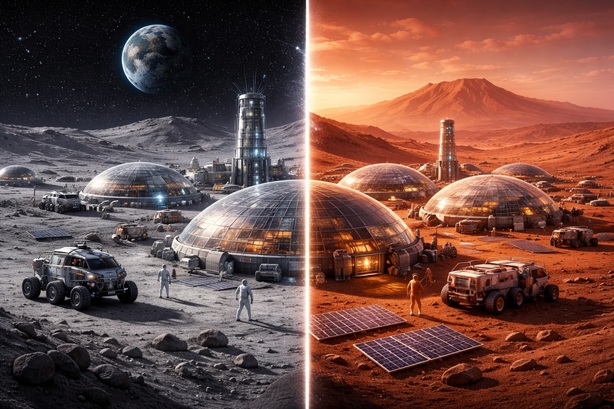
Earth’s gravity is often described as a well and that’s a useful metaphor. The deeper you are, the harder it is to climb out. Reaching orbit is like climbing halfway up the walls. Going to the Moon is like stepping onto the rim.
Every mission like Artemis II teaches us how to climb more efficiently, not by fighting gravity, but by working with it, because here’s the deeper truth: gravity is not just a constraint. It’s a roadmap.
The same invisible force that keeps us bound to Earth also provides the pathways to leave it. And if we can learn to navigate those pathways, if we can move from one gravitational well to another with precision and confidence, then the leap from Earth to Moon becomes the first step in something much larger.
Paving the Road to the Stars
Escaping the gravitational well of Earth is the hardest thing humanity has ever done. Writer Robert Heinlein once famously said, “Once you get to Earth orbit, you’re halfway to anywhere in the solar system.” The well is deep and heavy, but once we learn to balance on the edge of it, to move from Earth’s influence to the Moon’s, the rest of the universe begins to open up.
Going to space is important because it forces us to solve the “impossible” problems. The technologies we develop to keep four humans alive while they are being slung through a vacuum at 25,000 miles per hour are the same technologies that will eventually solve energy, recycling and resource scarcity problems on Earth.
But more importantly, leaving the well changes our perspective. When the Artemis II crew looks out their window and sees the Earth as a “swirling blue marble” and the Moon as a looming world of craters, they remind us that gravity isn’t just a force that keeps our feet on the ground. It is the thread that connects all things in the cosmos. By learning to pull on that thread, we aren’t just visiting the Moon. We are finally learning how to walk among the stars.
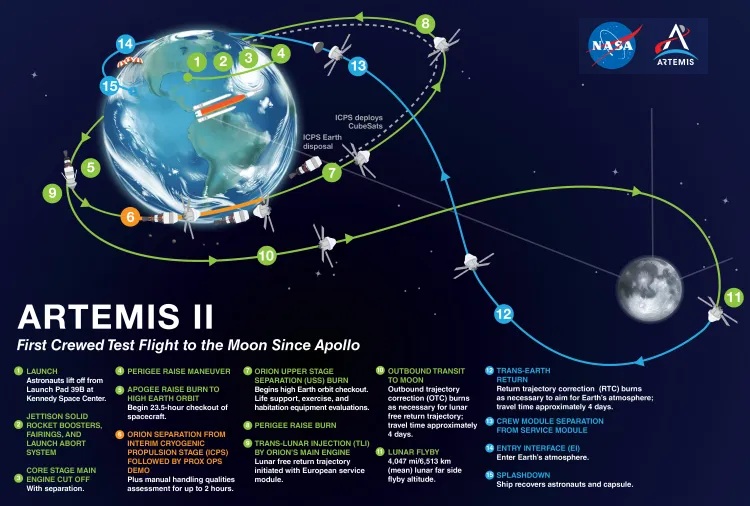
Artemis II mission, courtesy of NASA.
Discover more from Tales of Many Things
Subscribe to get the latest posts sent to your email.