
When it comes to search and rescue messaging, I usually talk about twisted ankles and lost hikers, but in a year where winter simply didn’t show up, search and rescue has a different battlefield: the wildfire.
Members of search and rescue don’t fight fires, but when a bad fire season hits, it changes everything about how we operate and how people get into trouble. In a record dry year like 2026, we share the same battlefield with the fire service.
This year, the warning signs started early.
This winter was a historic outlier for the Rocky Mountain region. In Colorado, multiple analyses described the 2025–2026 winter season as one of the warmest and driest on record, with prolonged periods of above average temperatures and dramatically reduced snowfall. By April 1, statewide snowpack had fallen to a fraction of normal in many basins with conditions being widely described as among the worst in recorded history, rivaling benchmark drought years like 1977 and 1981. In some areas snowpack dropped to near 20–30% of average.
To put that in perspective, some basins are at levels seen only once or twice in the last half-century. We aren’t just in a dry spell. We are operating in a historic deficit.
This snowpack is a “state of emergency” level statistic. It’s a an operationally alarming number.
Across the West, the winter of 2025–2026 ranked among the warmest on record, continuing a long term warming trend. In parts of the Rocky Mountain region, average winter temperatures have risen roughly 2–4°F over the past few decades. Snowpack, the natural reservoir the West depends on, has been inconsistent and, in many basins, significantly below average.
That matters.
Low snowpack doesn’t just mean less water. It means dry fuels earlier, longer fire seasons and fires that behave more aggressively. Historically, the fire season had a start and an end. Increasingly, it does not. What used to be a few high risk months is now a nearly year-round concern and the weather patterns are bringing back the echoes of the recent past, dry seasons resulting in massive fast moving fires with destructive potential we’ve seen before: Waldo Canyon (2012), Black Forest (2013), Pine Gulch (2020), East Troublesome (2020), Cameron Peak (2020), Marshall (2021). In fires like the Waldo Canyon Fire and Marshall Fire, entire neighborhoods changed in hours, not days.
In a “snow drought” this severe, the fire season doesn’t just start early. It arrives with a level of intensity that can overwhelm traditional emergency response systems. When that happens, the search and rescue mission pivots to large-scale evacuation support.
From a search and rescue perspective, the biggest problem isn’t the fire itself. It’s the chaos that hampers our ability to find and help people.
When things go bad, emergency services, including SAR, are slowed down by predictable human behavior: waiting too long, poor communication and small oversights that become big problems under stress.
So here’s how to think about wildfire preparedness through a search and rescue lens.
- The “Early Exit” Rule
One of the most common and most dangerous patterns we see is delay. People are often trapped because they were waiting for an official “go” order to evacuate.
The reality:
In fast-moving grass or timber fires, conditions can change faster than alerts can be issued. Cell towers fail. Dispatch systems get overloaded. Fire spread can outpace notifications. And by the time the alert hits your phone, the main road may already be a bottleneck.
Pets and Livestock:
If you have animals, plan for them now. People delay evacuation for pets and livestock more than anything else and that delay is where rescues turn into recoveries.
We know pets are family. Your evacuation plan has to include them. Have carriers, leashes and transport plans ready, not buried in a closet when smoke is already in the air.
The SAR takeaway:
If you see smoke, smell fire or feel uneasy, leave. You don’t need permission to make a good decision.
From our side, it is significantly easier and safer for us to “clear” an empty house than to perform a high risk rescue while a fire front is advancing.
- Make Yourself Findable
When SAR teams move through a threatened area, we’re not just looking for people. We’re trying to clear locations quickly. If we are searching a neighborhood to ensure everyone is out, visibility is the difference between a 30 second check and a 10 minute delay.
Visibility is everything.
Light it up:
If you evacuate, leave interior and exterior lights on. In heavy smoke, a lit structure stands out. A dark one is a black hole that we have to investigate manually.
Leave a note:
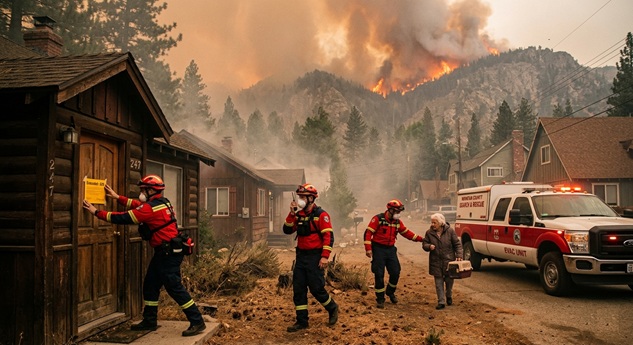
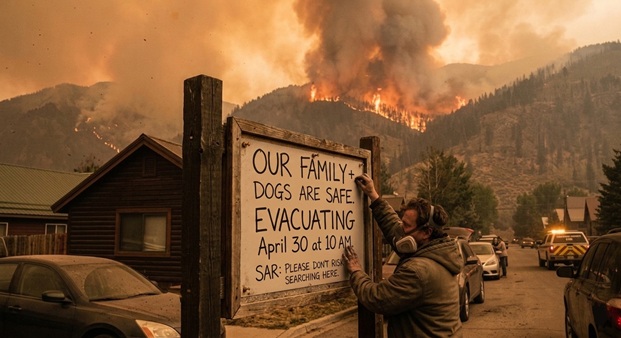
Tape a simple message to your front door: “Family + dog evacuated 4/30 @ 10:00 AM”
That single note can save critical minutes and keep teams moving instead of committing to a full search of your home. It allows us to move to the next house immediately.
Address visibility:
Check your house numbers today. If the numbers aren’t reflective and visible from the road at night or in smoke, you are effectively invisible to responders. With all the technology we carry, none of it matters if we can’t see your address in the dark or through thick smoke.
- Communication Logistics
Communication failures create a huge portion of the SAR workload during disasters.
Designate an out-of-area contact:
Pick one person outside your region, someone who would not be affected by the incident, to act as your family’s coordination point. Local-to-local calls may fail, but local-to-long-distance often go through.
Text, don’t call:
SMS messages require less bandwidth and are far more likely to get through when networks are overloaded. They can “queue up” to send the second a sliver of signal becomes available.
A ten word text can prevent a multi-hour search.
- Gear for the “New” Fire Calendar
With the fire calendar now effectively year-round, your “Go Bag” needs specific preparedness items to reflect the risk.
Clothing matters:
Most outdoor gear is polyester or nylon. Synthetic fabrics can melt to your skin under high heat. Pack wool or 100% cotton in your go bag.
Respiratory protection:
Smoke inhalation, not fire, is the primary cause of injury and death in wildfires. Keep professional grade N95 or, ideally, P100 masks in your home and vehicle, not just for the fire, but also for the weeks of hazardous air quality that follow.
The Half-Tank Rule:
Never let your gas tank drop below half during high-risk periods. Evacuation traffic in mountain passes can turn a 20 minute drive into a 6 hour crawl. Running out of fuel in a fire zone is a scenario emergency services see more often than you’d think.
- If You’re Trapped
This is worst case, but it happens.
Find a fuel break:
Move to areas with little or no vegetation, such as a large rock scree, a parking lot or a plowed field.
If you are trapped in a vehicle, park in the largest clear area available, close all windows and stay on the floor. Do not leave the vehicle unless you have a clear, non-combustible path to a safer area.
Stay low:
Air is cooler and cleaner closer to the ground. Stay as low as possible.
Avoid uphill runs:
Fire moves faster uphill. Move laterally (sideways to the fire) or downhill when possible.
The Bigger Picture
The trend lines are clear: warmer winters, earlier snowmelt, longer dry periods. Whether you frame that as climate variability or long-term climate change, the operational reality is the same:
More fire.
Less predictability.
Higher risk to people who are unprepared.
Search and rescue doesn’t control those conditions, but we see the consequences up close.
Wildfires don’t create brand new problems. They expose the ones we already had: lack of planning, hesitation, small decisions deferred too long.
In a year where the mountains have lost their snow and the forests are primed to burn, our relationship with the land has to change. We can’t rely on “the way it used to be”.
Taking the extra minute isn’t about fear. It’s about friction.
It’s the minute you take now, checking your address visibility, topping off your tank, packing the right gear, that removes hours of danger down the road.
And in a fast-moving fire, hours are something you may not have. When the first domino falls, you won’t have a minute to spare, so #TakeTheExtraMinute now.
Take the extra minute before you need it, because in 2026, the best rescue is the one that never has to happen.
Discover more from Tales of Many Things
Subscribe to get the latest posts sent to your email.