
(April 14: The Day We Celebrate Planck’s Constant: 4.14 x 10⁻¹⁵ eV*s)
Today is World Quantum Day, a concept that probably ranks somewhere between “International Paperclip Appreciation Day” and “Bring Your Houseplant to Work Day”. After all, unless you’re a theoretical physicist, your daily routine — commuting, shopping, doomscrolling, watching sports or lounging on the beach — rarely involves pondering the spooky behavior of subatomic particles.
And yet, the fundamental physics we celebrate today run the world behind the scenes. It underpins every technological leap and every moment of existential dread in our modern universe. It’s the invisible operating system beneath everything from chemistry to computer chips. To understand why April 14 matters, we need to talk about cats, choices and why your favorite sci-fi movies are both brilliant and absolutely wrong.
If you’re reading this while sipping coffee, scrolling on a smartphone or (let’s be honest) watching a cat video on a device that relies on quantum tuned transistors, you’re already a participant in the quantum world. World Quantum Day is the one day a year we all get a free pass to ask, “What is a quantum … thing?” without feeling like we’ve walked into a lecture hall by mistake.
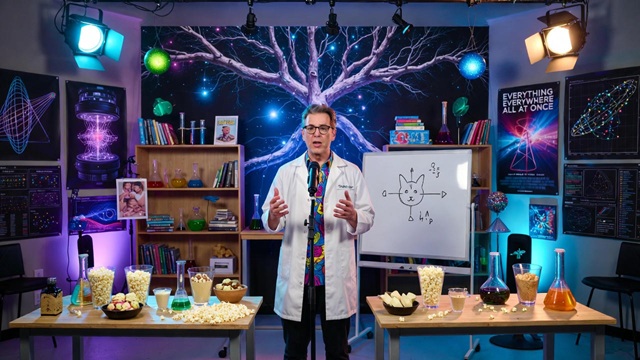
Pop Culture’s Take: Fact vs. Fiction
Most people’s first exposure to anything “quantum” is not through textbooks, but through movies and shows that gleefully use the word quantum as a magic spell.
A surprisingly accurate modern example is Everything Everywhere All at Once (2022). It takes the scientifically legitimate idea of superposition and multiple possible outcomes and turns it into a kaleidoscopic story about choices, identity and the cosmic absurdity of life. These are the most philosophically accurate fictional takes. They understand that reality branches based on personal choice. The genius lies in using the multiverse to explore the “weight of regret” and the life you left behind. Quantum physics has rarely had a better PR campaign.
Other works take more liberties.
- Back to the Future (1985-1990) and The Flash (2023) use quantum talk as justification for time travel paradoxes. Fun, yes. Accurate, not especially. They toy with time travel, loosely inspired by quantum possibilities, but they’re more about paradoxes than particles.
- Sliders (1995–2000) presents technologically assisted travel between alternate universes. This classic show was based on traversing parallel, choice-based worlds. Theoretically plausible, provided you have a highly advanced, temperamental and likely fictional interdimensional timer. It’s speculative, but at least conceptually tied to physics interpretations like the multiverse.
- Quantum Leap (1989-1993, 2022-2023), despite its name, is a time hopping, consciousness swapping fantasy that has roughly the same relationship to quantum science as a goldfish has to astrophysics. It’s really about moral time travel adventures. (Though we all secretly wish Sam Beckett would leap back to fix a few of his own choices to prevent this series.)
For readers, Blake Crouch’s Dark Matter offers one of the better attempts to fictionalize quantum branching events without completely sacrificing scientific dignity. It’s fast, clever and raises excellent “what if?” questions that look at who we become and how we become that person.
If you’re looking for science-friendly entertainment for World Quantum Day, check your favorite streaming service for Everything Everywhere All at Once and Sliders and pick up a copy of Dark Matter. These will get you closest to the mark. Popcorn and ice cream are optional, but highly recommended. You have my permission to grab both. You’re doing this in the name of cutting edge science, after all.

The Many-Worlds Interpretation: Multiplied by Infinity
In everyday language, “quantum” is shorthand for “tiny, discrete packet of energy”. Think of it as the universe’s way of saying, “You can’t have half a photon. You get the whole thing or nothing at all.” This discreteness leads to the strange phenomena we call superposition and entanglement.
In 1957 physicist Hugh Everett III asked something radical: What if quantum events don’t “collapse” into one outcome at all?
Instead, he suggested the Many-Worlds Interpretation (MWI), which says:
- Quantum systems evolve smoothly according to quantum laws.
- When an event has multiple possible outcomes, all outcomes occur, but in different, non-interacting branches of reality.
In Everett’s view, the universe doesn’t “split” because someone looks at something. Branching is simply a natural consequence of quantum evolution.
Why do people love this idea?
Because it feels like physics’ answer to life’s biggest questions:
- What if I had chosen the other path?
- What if one small event had gone differently?
- Is there a version of me who didn’t send that embarrassing email?
In the MWI framework, every possible version of events exists somewhere. It’s the ultimate expression of the “road not taken”, multiplied by the number of roads humanity has ever walked.
And this makes sense for science, too. Superpositions are not discarded. They have to be acknowledged as outcome probabilities. It’s critical in understanding our universe. And your car insurance. Just ask your actuary.
Quantum Choice and Probability: Weird Science Bending Your Mind
Quantum physics is notoriously unintuitive, so let’s use simple examples. Be mindful that they are macroworld examples and as such don’t translate cleanly into quantum uncertainty, but they are legitimate considerations in the resolution of a quantum wave.
Example 1: Flipping a Coin
A coin has two classical outcomes: heads or tails. In quantum mechanics, before the measurement, a system can exist in a superposition, a combination of all possible states.
Your coin is not literally in a quantum superposition (unless you are flipping it inside a superconducting vacuum chamber), but it’s a helpful metaphor. Only when you open the box (or, in this case, catch the coin) does the wavefunction “collapse” into a single outcome.
The multiverse repercussions of a coin flip are probably minor, unless you were foolishly using the coin to make a major decision in your life.
Example 2: Rolling a Die
A traditional die has six outcomes. In the metaphorical multiverse, that’s six possible branches from “advance to free parking” in Monopoly to “you lose your shirt in Vegas”.
Again: classical dice are not quantum objects, but the analogy helps capture how branching works in probability space.
Example 3: You, the Most Improbably Specific Outcome of All
Here the metaphor stretches, but the underlying idea still works:
Each human is the result of one sperm out of 80 to 300 million, contributed by a man, and one egg out of hundreds of thousands, contributed by a woman. Statistically, that’s a probability so small it may as well be cosmic coincidence.
You’re not literally the result of a quantum branching event (fertilization is biochemical, not quantum), but the feeling of extreme improbability is real. On a purely random scale, you are the result of one of 24 trillion combinations. In the multiverse there’s you and there are your 23,999,999,999,999 multiverse siblings, give or take a few billion.
The Many‑Worlds Interpretation takes this literally: every quantum event spawns a new branch of reality. No collapse, no mystery. Just an ever‑growing tree of infinite possibilities.

The Cat, The Box and The Science of Maybe
One of the most accessible, and slightly barbaric, introductions to quantum weirdness is superposition, popularized by Erwin Schrödinger’s famous thought experiment in 1935.
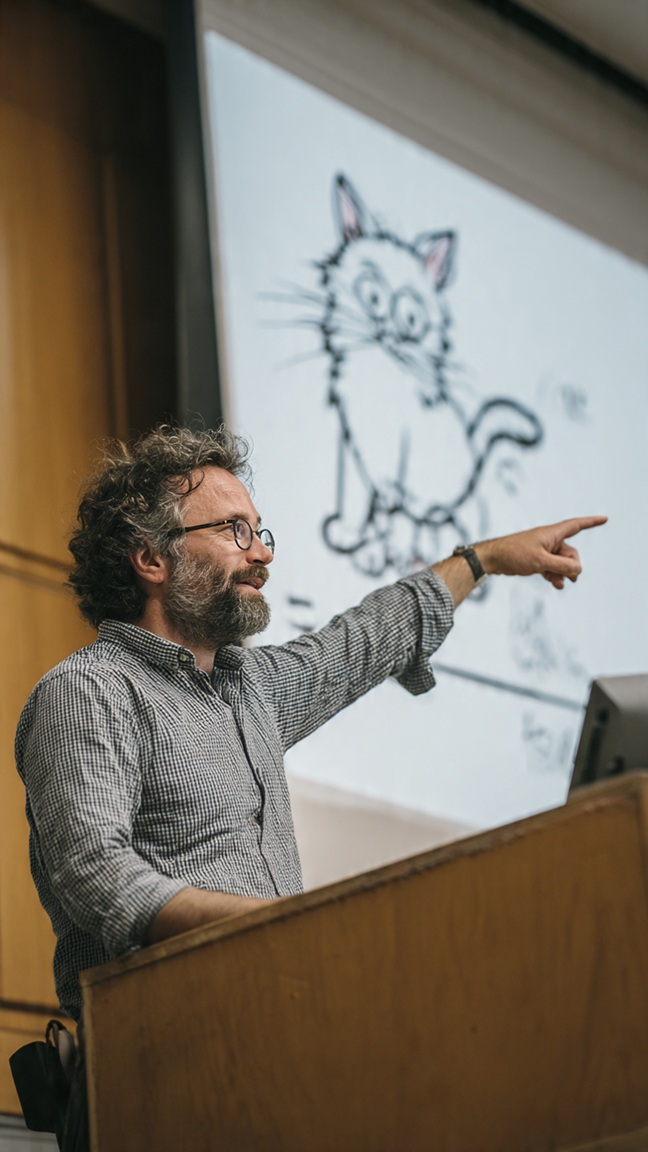
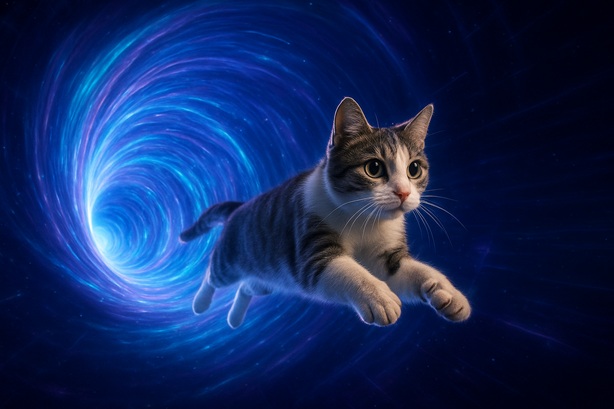
In Schrödinger’s grim scenario, a cat is locked in a box with a device that has a 50/50 chance of releasing poison. Before you open the box, the cat is, quantum mechanically speaking, both alive and dead. It exists in a superposition of states.
The act of opening the box forces the quantum wave to resolve. You are effectively measuring the system and that’s when the universe finally says, “Okay, fine, it’s alive,” or, well, it’s that other thing. It’s morbid. It’s dramatic. It’s scientifically important. And it’s a great reminder that quantum behavior governs microscopic particles, not domestic pets, although my cat would argue that point.
Think about it: you’ve been in thousands of these unresolved states. Walking out of a high-stakes job interview? You are simultaneously employed and unemployed until the phone rings. Buying a mystery melon at the grocery store? It is both perfectly ripe and inexplicably rotten until you cut it open. Turning in your class paper? You either aced it or your teacher’s red marker notes make it look like someone was trying to wipe down a bloody crime scene. It’s the ultimate scientific FOMO. In life, uncertainty feels quantum. And sometimes, humorously cruel.
In this experiment, Schrödinger merely asked how we evaluate an unknown. Everett’s answer two decades later was that everything is true as all quantum outcomes occur in different branches.
Quantum Physics in the Real World: Where It Actually Does Matter
Beyond inspiring movies and existential dread, quantum science is profoundly practical.
Quantum computers achieve enormous speed-ups by using qubits, which can exist in blended states of 0 and 1 and interact through interference to explore many possibilities at once. A qubit lives in a superposition, a kind of quantum smoothie of probabilities. Quantum algorithms use this, plus interference, to chew through problems that would turn a classical computer into a smoking ruin.
This technology enables breakthroughs such as:
- Medicine and Materials: We can accurately simulate molecular behavior, something classical computers can not do. This means designing new drugs, materials (like better solar cells) and catalysts will move from decades of trial-and-error to days of digital simulation.
- Unbreakable Security: Quantum Key Distribution (QKD) uses entangled particles to transmit information. If an eavesdropper tries to look, they instantly collapse the superposition and the parties know they’ve been compromised. This creates truly unhackable passwords for finance and defense (and your favorite porn site).
- Global Optimization: Quantum computers can run optimization algorithms that would take a classical computer longer than the age of the universe to solve. Imagine navigation systems that account for every vehicle and pedestrian at rush hour or finding the most efficient logistics for a global supply chain.
Quantum mechanics is not magic. It’s math, physics and engineering. But its applications will quietly reshape everything from medicine to climate forecasting to cybersecurity. It’s also the only place where you can be on time and late simultaneously. Until you check your watch.

So Why Celebrate World Quantum Day?
Because quantum physics:
- Underpins the technologies we use daily
- Shapes the research that drives the future
- Challenges our assumptions about reality
- Inspires creativity in art, fiction and philosophy
- Reminds us that the universe is far stranger and far more beautiful than our instincts suggest
Most importantly, quantum physics is proof that even the smallest things can have unimaginably large effects and, in a world where tiny actions ripple across time, that’s a pretty good lesson for being human, too.
On World Quantum Day, we celebrate the fact that the tiniest, weirdest laws of physics, the ones dealing with “maybe” and “simultaneously”, are about to deliver the “definitely” of our future. It’s not just a day for scientists. It’s a day for anyone who relies on a better battery, a new medicine or a secured bank account. The physics of tomorrow is quantum and it starts today.
So, whether you’re watching Everything Everywhere All at Once for the third time, flipping a coin to decide if dinner is Mexican or Chinese or just marveling at the fact that your smartphone works because of quantum engineered chips, take a moment to appreciate the bizarre, beautiful layer of reality that underpins everything, even the popcorn you are (maybe) eating.
Happy World Quantum Day! No actual quantum particles were harmed in the writing of this blog, but Schrödinger’s cat did file for a restraining order.

Bonus sidebar, for those of you still struggling with the math:
In Sliders the solution to stepping through dimensions boiled down to the following formula:
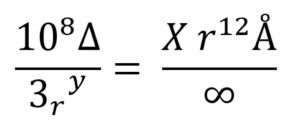
Let’s break it down, for fun.
Δ (delta) usually represents a change in energy, time or other measured quantity. It’s not possible to tell what this is without units, although we know it’s multiplied by 108, which resolves to 100,000,000. Definitely not orthodox as 108 is not a well known constant. It’s just a multiplier. This is essentially a random scaling factor. Physics formulas sometimes contain large constants, but they’re derived from unit conversions or physical constants. This one is neither. It’s just big for dramatic effect. Let this be a lesson for you to always include units in your work, at least to get partial credit.
3ry is also odd. In scientific notation, a variable followed by a subscript is a label or an index, used to differentiate that specific variable from others, without changing its value or mathematical meaning. Because the variable is a constant, the notation is meaningless, other than we elevate it to the power of “y”, which is a variable. Elevating the constant to the power of “y” adds drama, but no scientific credibility.
“X” is a traditional “unknown” in a formula, but normally shown as a lower case “x”. “r” is a radius (here in Angstroms, ) and r12 may possibly have a topical scientific purpose. The Lennard-Jones potential is an archetypal mathematical model used extensively in computational chemistry and physics to approximate the intermolecular potential energy between two non-bonding particles. Lennard–Jones is what you use when you want to model whether two atoms are politely ignoring each other or violently repelling one another, which, ironically, is also the plot of most Sliders episodes. It’s potentially topical, but ultimately meaningless in this case, because…
∞ is infinity and as your divisor gets incrementally larger, you start to asymptotically approach zero with infinity itself giving you the zero result.
The only reasonable way to balance the equation is to have our Δ (delta) be zero. That way the numerator is zero and the left side of the equation will collapse to zero. Dividing zero by anything will always be zero.
And all of that will make the formula trivially useless. So, if you know what Colin Mallory was aiming for here, I’d love to get in on the secret. I just know that you can’t abort the timer, so maybe that’s the Δ (delta) and the secret to making the world run.
Quantum physics doesn’t care which version of you you’re rooting for. Every possible ‘you’ gets a MWI branch and the universe weighs them all equally, which, mathematically speaking, is a division by infinity that collapses back to zero. Nature is indifferent, but physics? Physics is still fun.
Discover more from Tales of Many Things
Subscribe to get the latest posts sent to your email.