
My wife and I are currently on a hunt. Not for a house or a car. We are in the market for a new bank. Our regional bank was recently absorbed by a much larger national institution and with that came a familiar pattern: higher fees, lower returns and the subtle suggestion that we should feel grateful for the privilege of letting them hold our money.
But here’s the thing, at 0.01% interest, a meager one dollar per $10,000 on deposit per year, it’s hard to call it “interest” at all. If anything, after the account fees, it feels like we’re paying for storage. You’re already holding my money hostage. At the very least, you shouldn’t charge me additional ransom. At 0.01%, the bank isn’t a financial engine. It’s just a very expensive high-security mattress.
So, we’ve been bank shopping, but during our search, I encountered something far more unsettling than low rates and high fees. The Airlock.

Welcome to the Mantrap, Please Stand Still
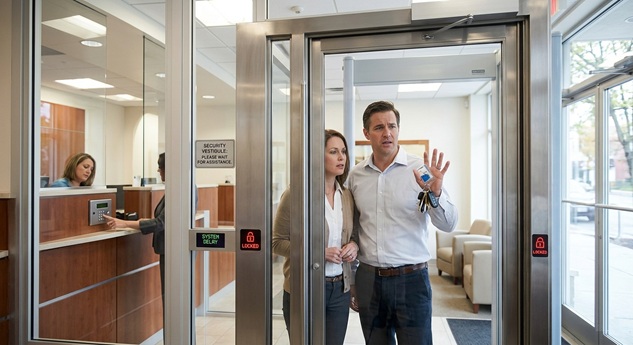
I walked into one of the banks on our research list, located in a beautiful upper-middle-class neighborhood. Immediately something felt off. The entryway looked slightly unusual: framed and enclosed. Then it buzzed. The doors locked.
Just like that, I was contained. Instead of a friendly “hello”, I entered a prison cell.
There I stood, in a secured glass vestibule, waiting to be assessed, contemplating oxygen levels. A teller, having evaluated my criminality, eventually buzzed me through, but the moment had already landed: before I could even speak to a human about becoming a customer, I had been flagged, paused and held.
All because I was carrying keys, a concealed deadly weapon.
The Technology Behind the Experience
What I encountered is called a security vestibule or, more bluntly, a mantrap. It’s a controlled entry system with two interlocking doors and a highly sensitive metal detector. If the system detects enough metal, it locks the door until an employee intervenes.
From a purely functional standpoint, it’s doing exactly what it’s supposed to do:
- Prevent weapons from entering
- Stop multiple people from slipping in together
- Create a barrier against robbery attempts
To be fair, these systems aren’t designed with customers in mind first. They’re designed for employee safety, liability and insurance realities.
It’s efficient. It’s effective. And it’s deeply unfriendly to the people who pay the bills.
Guilty Until Proven Innocent
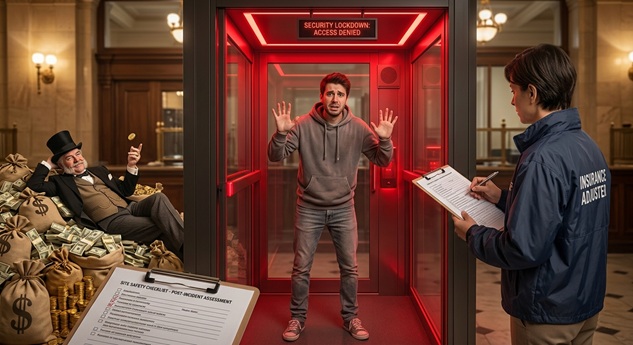
Standing in the mantrap, I half expected a robotic voice to ask me to “Please remove all liquids and gels” before I could ask about a basic checking account.
In a world where credibility is king, this experience felt like a deposition before the first date. First impressions matter, even in security.
Now, I understand safety concerns. I’ve spent enough time in environments where risk management matters to appreciate that not all threats are hypothetical. But walking into a business, intending to give them your money, only to be met with a locking mechanism and a silent judgment system creates a very specific emotional response.
It doesn’t feel like service.
It feels like suspicion.
In that moment, the message wasn’t “Welcome”. It was “Prove it”.
Banks often claim these measures are for safety, but as a potential customer, it signals two very negative things:
- Lack of Trust: The institution treats every person as a criminal until they are frisked by a sensor and vetted by a teller.
- The Fortress Paradox: By hardening the building into a fortress, the bank ironically signals that they are insecure. It suggests that the neighborhood is dangerous, even when it isn’t, or that their internal security is so flawed they have to resort to “shot first, ask questions later” architecture.
There’s also something more subtle at play.
Walking into that vestibule creates an immediate power imbalance. There is a unique kind of vulnerability in being trapped in a glass box while a stranger with a button decides if you look ‘liquid’ enough to enter. The institution controls movement. The customer waits for permission. It’s not aggressive, but it is unmistakable. It feels less like entering a partnership and more like clearing a hurdle.
And when you’re deciding where to keep your money, that matters. You trust partners, not interrogators.
If a bank feels the need to physically contain and screen every person entering the building, what does that say? Even in a perfectly safe, upper-middle-class neighborhood, the optics suggest risk. High risk. Enough risk to justify turning the front door into a checkpoint.
The more a place hardens itself against threats, the more it signals that threats must be everywhere. Whether that perception is accurate doesn’t matter, because perception is the experience.
The Cost of “Hardening the Target”
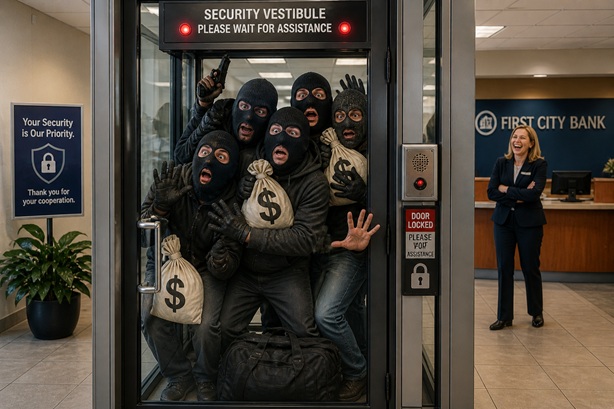
In a broader sense, this resembles what’s often called “hostile architecture”. While it might lower the bank’s insurance premiums or satisfy a corporate security checklist, it destroys the “friendly neighborhood bank” vibe.
You are essentially weighing whether the convenience of a banking product is worth the indignity of the entry process.
There is a fundamental power imbalance when you have to beg to be let into a building where you intend to give them your hard earned money.
The Trust Trade-Off
There’s a fundamental tension here: security versus experience.
Most banks rely on softer deterrents: cameras, layout design, maybe a visible security presence. This system removes ambiguity. It assumes nothing. It verifies everything. But in doing so, it also erodes something else: trust.
The interaction becomes transactional before it ever begins. You are not a customer walking in. You are a threat variable being assessed.
And that has consequences.
Is This Normal?
For some banks, yes. Certain institutions have standardized these systems across multiple locations, regardless of neighborhood conditions.
But they’re far from universal.
- Credit unions tend to favor open, approachable layouts
- Most large banks use less visible (and less intrusive) security measures
- Many rely on surveillance and response rather than prevention at the door
Which makes the airlock stand out even more when you encounter it.
So… A Deal Breaker?
Maybe. But not because the technology is wrong. Because the experience is.
Banking is, at its core, about trust. You’re asking customers to place their money, their personal information and a piece of their financial identity in your hands. That relationship starts the moment they walk through the door.
Or in this case, the moment the door decides whether to let them in.
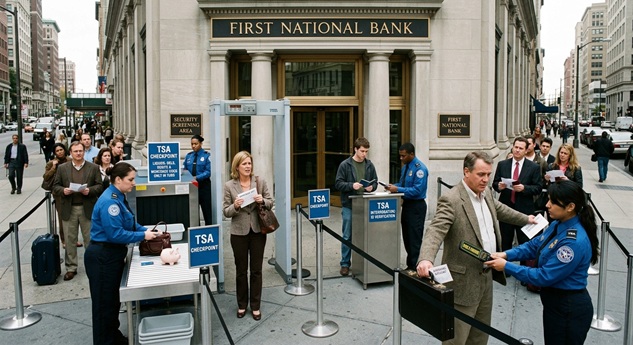
In the digital age, most banks are incredibly secure behind the scenes. If I’m looking for a partner to manage my family’s future, I want to walk into a lobby, not a TSA screening.
For me, being treated like a potential threat before I’ve even said hello is a difficult place to start that relationship. If a bank doesn’t trust me to walk through their front door with my car keys, why should I trust them with my life savings?
There are plenty of places willing to take my money. The question is simple: do I want a bank that protects its people or one that treats its customers like a problem to be solved before they even walk inside?
If the relationship starts with a locked door, it’s hard to believe it gets more open from there.
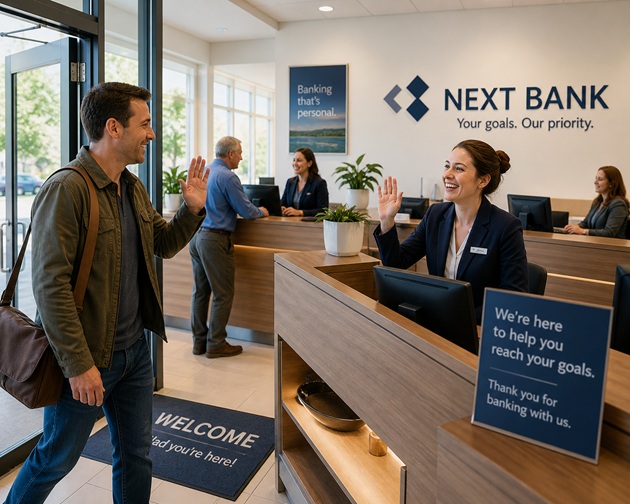
At the next bank on the list, the door opened without hesitation. A teller looked up, smiled and said hello. No sensors. No delay. Just human interaction.
It was a small thing, but it made the conversation feel a lot simpler.
Discover more from Tales of Many Things
Subscribe to get the latest posts sent to your email.