
History rarely repeats itself perfectly, but it often rhymes in chilling ways. We often look back at the giants of the past and wonder how a civilization so advanced, so structured and so dominant could simply dissolve. No collapse comes overnight and history has a way of whispering warnings long before civilizations are willing to listen.
For centuries, historians have debated the fall of the Western Roman Empire. Some blame military overexpansion. Others point to corruption, political instability, economic collapse or moral decay. The reality is that civilizations rarely die from a single wound. Empires usually collapse from a thousand small compromises that accumulate over generations.
But one theory has always fascinated me because it feels disturbingly modern. The Romans may have slowly poisoned themselves. And two thousand years later, we may be doing exactly the same thing to ourselves with plastic.

Rome’s Invisible Problem: A Civilization Poisoned by Progress
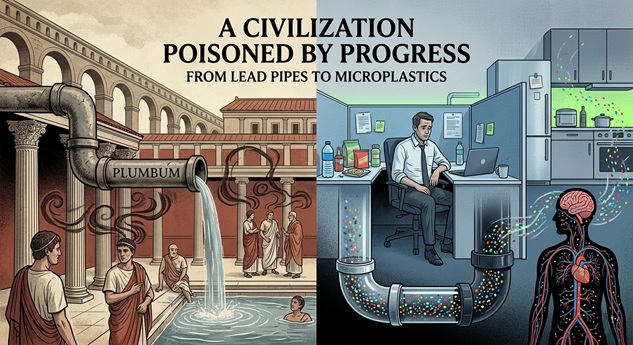
The theory that lead poisoning contributed to the fall of Rome is controversial, but it is far from fringe fantasy. The Romans were masters of engineering and their crown jewel was the aqueduct system. To bring water into the homes of the elite and into public baths, they used lead pipes.
In fact, the Roman world used lead extensively:
- Water pipes
- Cooking vessels
- Cosmetics
- Wine production
- Food storage
- Plumbing systems
It should be no surprise that the English word “plumbing” comes from the Latin plumbum, the word for lead.
Roman engineers were brilliant. They created the modern conveniences of their time. But their infrastructure also introduced chronic exposure to a potent neurotoxin they did not fully understand. Lead accumulated in their bodies, slowly.
Acute lead poisoning is obvious. Chronic lead poisoning is subtle. It affects:
- cognition
- impulse control
- fertility
- mood
- memory
- cardiovascular health
- childhood development
And perhaps most importantly for a civilization, it impairs executive function.
Proponents of this theory suggest that the Roman “ruling class” essentially suffered a multi-generational decline in mental faculty. Some historians argue that Roman aristocrats may have received especially high doses because of a sweetener called sapa, created by boiling grape juice in lead vessels. The acid in the grapes reacted with the metal, creating lead acetate, literally “sugar of lead”.
When the people making the decisions for an empire are suffering from brain fog and impulse control issues, the administrative and military structure begins to crumble from the top down.
The wealthy may have unknowingly marinated themselves in neurological damage. They didn’t know their “modern” plumbing was a slow-acting poison. They mistook a toxic convenience for a permanent triumph of engineering.
Now, to be fair, lead pipes alone probably did not cause the collapse of Rome. Many Roman water systems developed mineral coatings that reduced exposure over time. And empires are too complicated to explain with a single toxin.
But the larger point remains compelling. A civilization can normalize chronic environmental poisoning long before it understands the consequences.
That idea feels painfully familiar today.
The Plastic Age: The Nanoparticle Revolution
Fast forward 2,000 years. We don’t use lead pipes anymore, but we have created something arguably more insidious because it is nearly impossible to filter out.
Our civilization’s miracle material is not lead. It’s plastic.
Plastic is everywhere because it solved countless problems:
- cheap manufacturing
- sterile medical equipment
- food preservation
- lightweight transportation
- modern electronics
- water resistance
- industrial efficiency
Modern civilization would barely function without it. The ubiquity of plastic is the lead of our era. It is in our clothes, our food packaging and our tires. Recent studies have found that a single liter of bottled water can contain an average of 240,000 detectable plastic fragments.
But that’s only the tip of the iceberg when it comes to plastic. The real specter of this modern convenience is much more terrifying. There is growing evidence that we are only beginning to understand the biological cost of saturating our environment with plastic particles.
While microplastics are small, nanoplastics are small enough to pass through the intestines and lungs directly into the bloodstream. From there, they can cross the blood-brain barrier and even the placenta.
Microplastics and nanoplastics have now been found in drinking water, oceans, rainwater, human blood, lungs, placentas, breast milk, arteries, testicular tissue. That list alone should probably alarm us, as a society, more than it does. We are not merely surrounded by plastic anymore. We are incorporating it into ourselves. We are effectively stuffed with synthetic polymers that our biology has no way to process.
And unlike a visible pollutant, nanoplastics are especially concerning because they are small enough to cross biological barriers inside the body. Researchers are still trying to determine the long-term consequences, but early findings increasingly suggest links to:
- inflammation
- endocrine disruption
- fertility problems
- cardiovascular disease
- immune dysfunction
- neurological effects
In other words, we may be conducting a civilization-scale biology experiment without informed consent. And like the Romans, we are only beginning to suspect the cost after building an entire society around the material.

Why the Parallel Matters
The Roman comparison matters because the danger is not simply toxicity. The danger is normalization. That is how civilizations sleepwalk into disaster.
Rome normalized lead because:
- it was useful
- profitable
- technologically advanced
- culturally integrated
We normalize plastic for exactly the same reasons.
And the truly unsettling part is that environmental toxins rarely produce dramatic Hollywood-style collapses. Civilizations don’t usually wake up one morning and suddenly fall over.
Instead, they experience:
- slightly lower fertility
- slightly worse cognition
- slightly more chronic illness
- slightly higher aggression
- slightly weaker resilience
- slightly more institutional dysfunction
Tiny degradations.
Across millions of people.
Over generations.
The result is not cinematic apocalypse. It is slow erosion. A civilization becoming incrementally less capable of sustaining itself. If we change nothing, we are essentially following the Roman roadmap to a gradual decline in public health and societal resilience.
If our global population continues to accumulate plastic at the current rate, we risk facing a future of diminished human capacity. If future research confirms significant biological impacts from microplastics, they could contribute to trends that already concern public health researchers, including fertility challenges and chronic inflammatory disease. These issues will strain our social and economic systems to the breaking point.
A civilization is only as strong as the health and mental clarity of its people. If we are collectively clogged by our own waste, the complex systems we rely on, global trade, technological maintenance and governance, will eventually falter, not from a single invasion, but from a thousand internal fractures.
The Hard Truth: The Economics of Collapse
Modern society has developed a dangerous habit. If something is profitable enough, we assume we will solve the consequences later. But history suggests otherwise.
Civilizations are remarkably good at:
- detecting immediate threats
- ignoring slow-moving ones
Especially when the slow-moving threat is economically convenient.
Lead made Rome wealthier before it made Rome weaker. Plastic has unquestionably made modern life more efficient, affordable and scalable.
The question is whether we are accumulating biological and societal costs faster than we are willing to acknowledge them.
So What Happens If We Change Nothing?
Probably not an overnight collapse. That is not how systems fail.
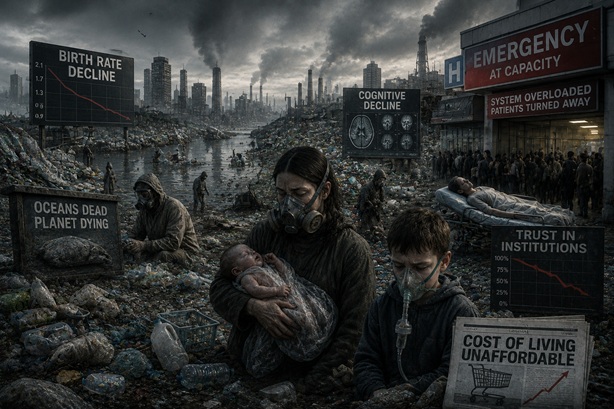
The more realistic scenario is a gradual degradation of public health and societal resilience:
- rising chronic disease
- fertility decline
- mounting healthcare burdens
- cognitive impacts
- environmental instability
- increasing distrust in institutions
- widening economic strain
Not because plastic is a cartoon villain, but because biology always sends an invoice eventually.
And if microplastics are significantly affecting human health, then future historians may look back at us the same way we look at Rome: astonished that an advanced civilization kept poisoning itself despite mounting evidence.
A Thoughtful Way Forward: Engineering an Exit
We are at a crossroads, but unlike the Romans, we actually have the science to see the threat before the empire falls. Avoiding disaster requires more than just “recycling”. It requires a fundamental redesign of our relationship with materials.
The answer is not panic. And it certainly is not pretending we can eliminate plastic overnight. Modern civilization is too dependent on it. The answer is intelligent adaptation before crisis forces adaptation upon us.
That means:
- reducing unnecessary single-use plastics
- improving filtration systems
- investing in biodegradable materials
- modernizing waste management
- regulating industrial discharge
- funding long-term health studies
- redesigning packaging culture
- developing safer manufacturing standards
But perhaps even more importantly, we need to recover the ability to think generationally. Ancient Rome often optimized for immediate luxury and political stability while underlying systems weakened. Modern civilization frequently does the same thing.
A healthy civilization asks:
- What are we normalizing?
- What invisible costs are accumulating?
- What are we leaving to our children?
- What systems are convenient now but corrosive later?
Those are not anti-technology questions. They are survival questions.
The Hopeful Part
The Romans did not fully understand lead toxicity. We do not have that excuse. For the first time in history, humanity has the scientific tools to detect slow-moving environmental threats before they become irreversible. That matters enormously.
History is not destiny. Parallels are warnings, not prophecies. Civilizations collapse when they lose the ability to respond to reality. They survive when they are willing to confront uncomfortable truths early enough to change course.
The fall of Rome was a tragedy of ignorance. Our fall would be a tragedy of apathy. We have the data, we have the history and we still have the time to change what’s flowing through our pipes.

Discover more from Tales of Many Things
Subscribe to get the latest posts sent to your email.