
My recent article on the evolution of life expectancy generated a fascinating series of questions that I will attempt to address in the coming weeks. One reader pointedly asked about the historical U.S. life expectancy chart.
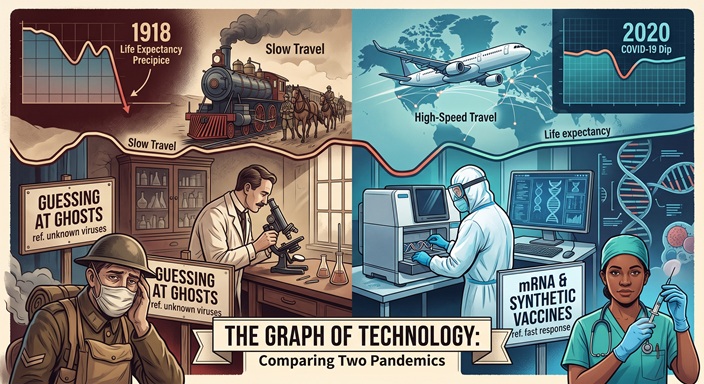
If you look at the line mapping American life expectancy over the last century, it resembles a relatively steady uphill climb, interrupted by two distinct craters. The first is a massive vertical precipice in 1918 where life expectancy plunged more than 15 years. The second is a noticeable, yet significantly shallower dip during COVID, starting in 2020. It slipped only 2.4 years.
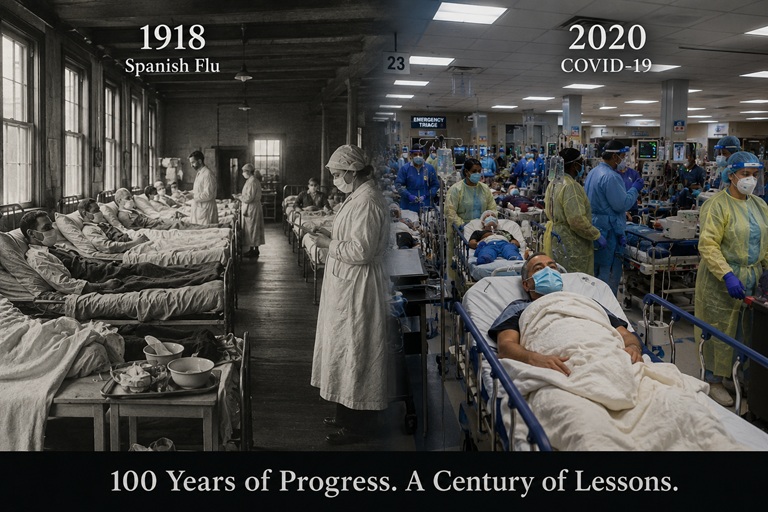
The visual contrast leads to an obvious question: was the Spanish Flu really that much worse than COVID-19? And that’s a great question, because comparing these two events is akin to comparing apples and oranges. Round fruit, yes, but that’s about where the parallels end.
The short answer is that we don’t know for certain, but not for the reason most people assume. The better answer requires us to stop looking exclusively at the virus and start looking at the technology of the times. The comparison only makes sense when you understand the medical technology, public health knowledge and travel patterns of the two eras.
The Geography of a Name
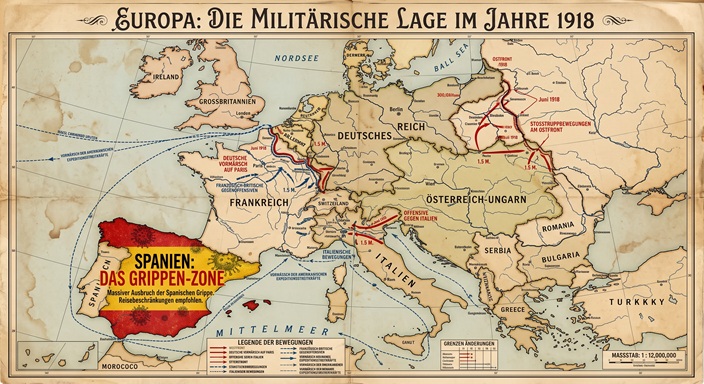
First, let’s clear up the historical branding. The 1918 influenza pandemic struck during the height of World War I. Total war requires total control over morale. The major combatants — the United States, Britain, France and Germany — censored their press heavily. No one wanted to publish headlines admitting that a microscopic pathogen was taking out entire frontline regiments and crippling domestic factories. It was viewed as a dangerous admission of weakness.
Spain, however, was neutral and Spanish newspapers reported openly on the epidemic. They had no wartime censors looking over their shoulders. They were more than happy to report on the massive, devastating pandemic sweeping across Europe. As a result, the disease became known as the “Spanish Flu”, not because Spain caused it, but because Spain talked about it.
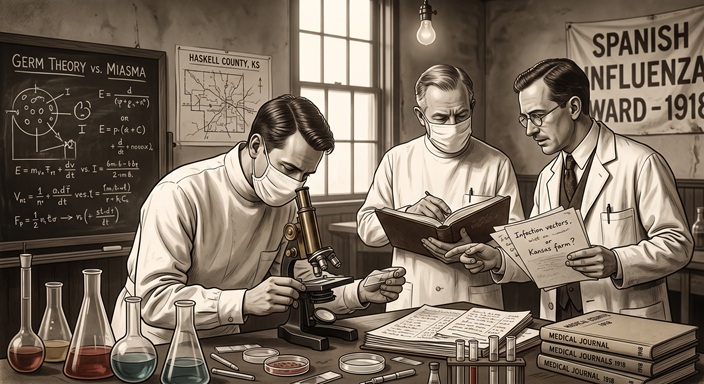
Although the true origin of the pandemic remains debated, many modern epidemiologists believe the pandemic actually originated on a poultry farm in Haskell County, Kansas. By all rights, history should have called it the American Flu, but wartime public relations is a powerful shield.
Fighting an Invisible Enemy
The real differentiator between 1918 and 2020 wasn’t the biology of the pathogens. It was the state of human knowledge. To understand why the life expectancy dip was so steep, it helps to remember what medicine knew in 1918.
Back in the late 1910s, medical science was operating in what we would now consider the dark ages of virology. Yes, bacteria had been discovered by Antonie van Leeuwenhoek all the way back in 1676, but it took humanity another two hundred years just to firmly establish the Germ Theory of Disease.
Viruses were even more elusive. While researchers like Dmitri Ivanovsky and Martinus Beijerinck identified the existence of filterable, non-bacterial pathogens in the 1890s, no human being had ever actually seen a virus. The human influenza virus wouldn’t be isolated until 1933, and viruses could not even be directly visualized until the electron microscope arrived in 1931.
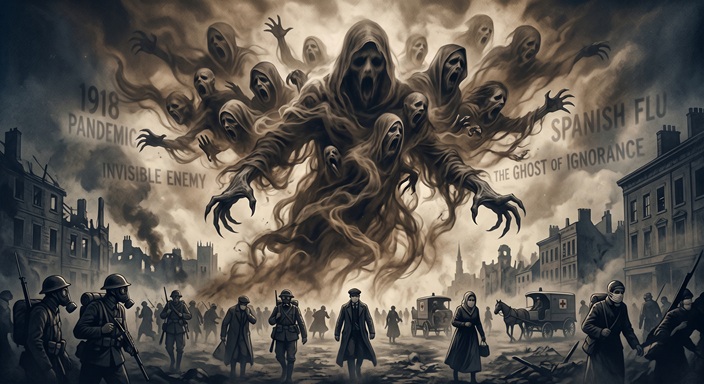
In 1918 society was trying to fight a ghost.
People believed loved ones were getting sick due to a chaotic mix of incorrect bacterial theories, lingering pre-modern medical beliefs about bad air (miasma) and wild wartime conspiracy theories about German biological agents. Scientifically, these ideas were only marginally more advanced than the medieval belief that evil spirits or planetary alignments were responsible for human illness. You can not easily treat, let alone prevent, an enemy that you can not define.
In practical terms, medicine was fighting a deadly respiratory virus without antibiotics for secondary infections, without antiviral drugs, without vaccines and without a clear understanding of viral transmission.
The Fluffy Math of “Worse”
So, when we look at the raw data, was 1918 truly worse than 2020? The answer is a highly nuanced “yes and no”.
Let’s look at the numbers. Historians estimate that roughly one in three people worldwide were infected by the 1918 flu. By contrast, some epidemiological models suggest that up to seven in ten people eventually caught a variant of COVID-19. That means the modern virus successfully infected more than twice as many people proportionally.
However, look at the global mortality rates. The case fatality rate for the 1918 flu is estimated to be between 2.7% and 5.4%. For COVID-19, the overall infection fatality rate settled somewhere between 0.1% and 0.4%. That is a full order of magnitude lower.
Does this mean the 1918 influenza virus was inherently harder to overcome or that COVID-19 was fundamentally easier to transmit? Not necessarily. There are many other factors involved in quantifying what happened.
Consider how the physical world has changed. Travel in 1918 was a slow, arduous, complex logistical puzzle involving steam powered trains and steam powered ocean liners. Most everyday citizens simply did not have far away places to go. Today, global recreation and corporate commerce are deeply and irreversibly entrenched in high speed travel. On any given day, global commercial aviation alone moves between 12 and 15 million people across continents.
The 1918 flu ultimately spread around the globe, but it did so at the speed of steamships and railroads rather than jet aircraft. Propagation suffered because infected people simply couldn’t move fast enough to beat their own incubation periods. Conversely, a modern pathogen can board a plane in Asia and land in Chicago before the passenger even develops a scratchy throat.
The Ultimate Safety Patch
The final deciding factor is our capacity to react. In 1918 there was no vaccination option. There were no antivirals. There were no ventilators. No oxygen therapy. No ICU care. Influenza simply had to run its brutal course through the human population until natural herd immunity caught up.
A century later our technological toolkit looked entirely different. When a new threat emerged, we possessed advanced genomic sequencing and mRNA technology. We didn’t even have to wait years to cultivate a weakened virus in chicken eggs. Scientists were able to digitally map the virus’s genetic structure and quickly reverse engineer a synthetic vaccine. This blueprint was mass produced and deployed globally through modern logistical supply chains in a matter of months.
That does not mean the COVID response was perfect, but it does mean the world relied on tools in 2020 and 2021 that simply did not exist in 1918.

The Dip and the Precipice
When you look back at that life expectancy chart, the terrifying precipice of 1918 does not exist in 2020 because the “Spanish Flu” was a fundamentally superior apocalyptic super virus. It reflects the fact that the world in 1918 had far weaker medical knowledge, poorer public health infrastructure, lacked data sharing and possessed almost no effective tools for fighting a viral pandemic.
So was the Spanish Flu really that much worse? In terms of fatality rates, yes. In terms of overall spread, COVID-19 reached far more people. But the steep dip on the life expectancy chart happened largely because 1918 medicine was still in its adolescence and society did not yet understand contagion well enough to respond effectively.
The life expectancy chart is often interpreted as a graph of diseases. In reality, it is also a graph of technology. Every major advance — clean water, sanitation, antibiotics, vaccines, intensive care, genomic sequencing — quietly pushed the line upward. The sharp drop in 1918 reminds us what happened before those tools existed. The smaller drop in 2020 tells us what they prevented.
We tend to look at historical disasters and fear the wrath of nature, but history’s loudest warning isn’t about the severity of the storms we face. It’s about the fragility of the shelters we have built to survive them.
Discover more from Tales of Many Things
Subscribe to get the latest posts sent to your email.