
In response to my recent piece on a civilization poisoned by progress, a reader commented:
“Just as we’ve had better energy options, like sodium ion batteries, there’s been fossil fuels alternatives that are far more sustainable. Just algae tech alone promises a better future for our children. We owe it to them to enforce these transitions.”
It’s an elegant, compelling argument. It struck a chord because it reflects something many of us desperately want to believe: that somewhere out there is a technology capable of solving our environmental problems without requiring us to change the way we live.
When faced with systemic ecological breakdown, we naturally look for a technological silver bullet, a clean, scalable savior that allows us to maintain our modern convenience without the toxic baggage.
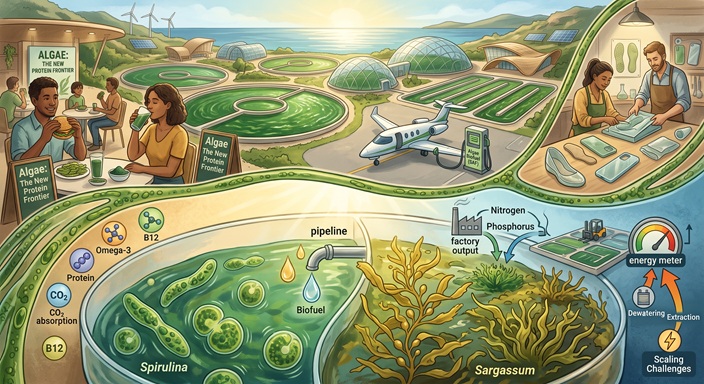
Algae technology often sits at the very top of that wish list. On paper, it sounds almost miraculous: a photosynthetic organism that eats carbon dioxide, grows rapidly without competing for arable land and can be harvested into food, fuel and biodegradable plastic.
When we discover a technology that appears to solve everything, our first instinct is to declare victory, but we have to pause to look under the surface.
Plastic was supposed to save forests by replacing paper and ivory.
Synthetic fertilizers were supposed to end famine.
Fossil fuels powered unprecedented prosperity.
Now many people look at algae with similar excitement.
And honestly? The excitement isn’t entirely misplaced.
Algae may be one of the most versatile biological resources we’ve ever discovered. The question isn’t whether algae can change the world. It’s whether we can learn from history and deploy it wisely.
Algae sounds almost too good to be true. That should make us curious. Not cynical, but curious. History has taught us that technologies promising to solve everything usually come with costs we don’t discover until much later.
To understand whether algae is truly our salvation or simply a well marketed distraction, we need to understand what it can do.

What exactly is algae?
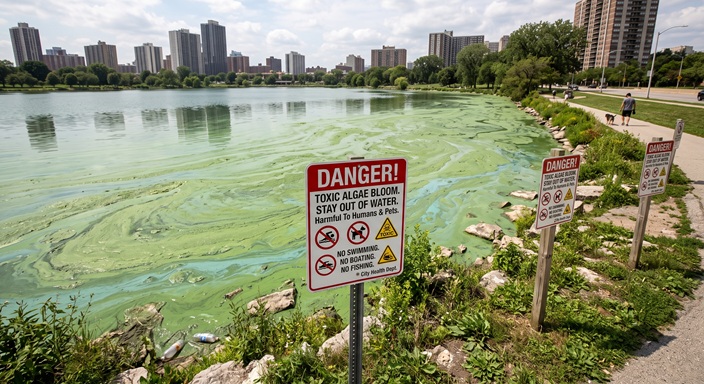
When hearing about algae, most people imagine slimy green ponds with health department signs warning them to keep out.
That’s only one tiny part of the story.
Scientifically, algae is an extraordinarily broad term covering a diverse group of photosynthetic organisms ranging from microscopic single-celled phytoplankton (like Spirulina or Chlorella) to massive multicellular macroalgae (like giant kelp forests, stretching hundreds of feet beneath the ocean).
Unlike terrestrial plants, algae don’t need roots, stems or leaves. Instead of spending energy building complex cellular structures to stand upright against gravity, virtually every cell in an algae organism focuses on two primary functions: absorbing light and reproducing.
They simply use sunlight, carbon dioxide, water and nutrients to grow at astonishing speeds. Some species can double their biomass in less than a day. This makes algae one of the most efficient solar-to-mass converters on the planet.
Collectively, algae produce roughly half of Earth’s oxygen while forming the base of most marine food webs. We’ve barely begun to explore algae’s potential.
Official studies, such as those published on ScienceDirect (on Algae Biodegradation) and research coming out of the University of California, San Diego (on Algae Plastics), highlight just how versatile this organism is across three core pillars.
Food
The world needs more protein. Livestock requires enormous amounts of land, water and feed.
Algae bypass much of that. Spirulina, chlorella and kelp represent some of the most nutrient-dense organisms available. Dried microalgae contains 50% to 70% protein by weight, making it one of the most protein dense food sources known.
Phytoplankton is a primary source of bioavailable Omega-3 fatty acids, which fish only contain because they eat algae, and critical vitamins like B12, iron, antioxidants and essential amino acids.
Unlike cattle, algae don’t require grazing land. Unlike soybeans, they don’t necessarily compete for farmland. Microalgae grows extremely fast, doubling its biomass in matter of hours or days rather than months, and requires no agricultural soil or freshwater reserves. It can be cultivated in saline, brackish or industrial wastewater environments using open raceway ponds or closed photobioreactors.
That doesn’t mean everyone will be eating algae burgers next year. Flavor, texture, consumer acceptance, production costs and scaling remain major challenges.
But the biology is undeniably impressive.

Energy
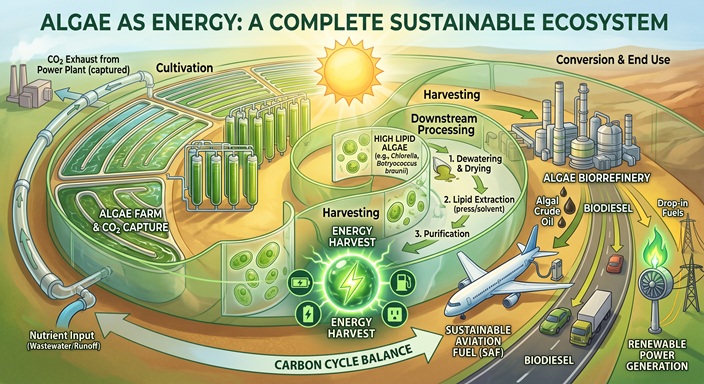
Because many microalgae species store energy internally in the form of lipids and natural oils, they have long been studied as a direct substitute for crude oil.
Extracted algal oils can be refined through standard hydrotreating and cracking processes into drop-in renewable diesel, gasoline and sustainable aviation fuel. Some algae can produce dramatically more oil per acre than traditional oilseed crops like soy or canola. That makes them especially attractive where land is limited.
Algae based fuels can power existing combustion engines, ships and heavy equipment with a significantly lower lifecycle carbon footprint than fossil fuels, as the carbon emitted during combustion was actively pulled out of the atmosphere during growth, rather than extracted from underground reservoirs, potentially approaching carbon neutrality when cultivation, harvesting and processing are powered sustainably.
Unfortunately, growing algae efficiently at industrial scale is still expensive. Harvesting microscopic organisms from water requires significant energy. Maintaining ideal growing conditions isn’t trivial. Producing a barrel of algae biofuel currently costs significantly more than pumping crude oil out of the ground. Scientists and bio-engineers are working on genetic optimization and high throughput photobioreactors to lower harvesting and extraction costs, but economic parity remains an uphill battle.
The promise is enormous. The economics are still catching up.
Plastic
This may be where algae becomes most interesting.
Synthetic plastics are long chains of synthetic polymers derived from petrochemicals, built intentionally to withstand decay, which is precisely why they persist in our ecosystems for centuries, shedding toxic micro- and nanoplastics along the way. Algae offers an elegant, circular alternative.
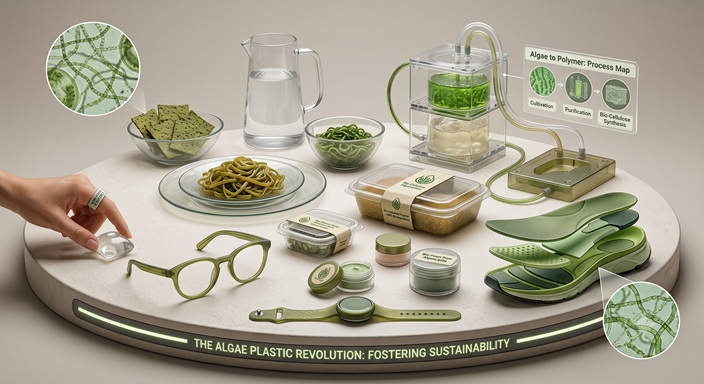
Naturally occurring polymers (such as polyhydroxyalkanoates) can be harvested directly from cultured algae or synthesized from algal starches and unlike “bio-based” plastics that require industrial high heat composting facilities to break down, pure algae-based packaging, straws and cups decompose naturally in standard backyard compost or oceanic environments within months, without leaving the persistent petrochemical microplastics associated with conventional plastics.
Everyday items made with algae tech are already on the market, from single use disposable cutlery, to shock absorbing foam midsoles in athletic shoes, to edible water pods, to marine degradable shopping bags and film packaging.
Considering our growing microplastic crisis, that’s exciting. But it isn’t a complete replacement.
Yet.
Here’s where history becomes important.
Every major technology solves problems.
Every major technology creates new problems.
Algae will be no different.
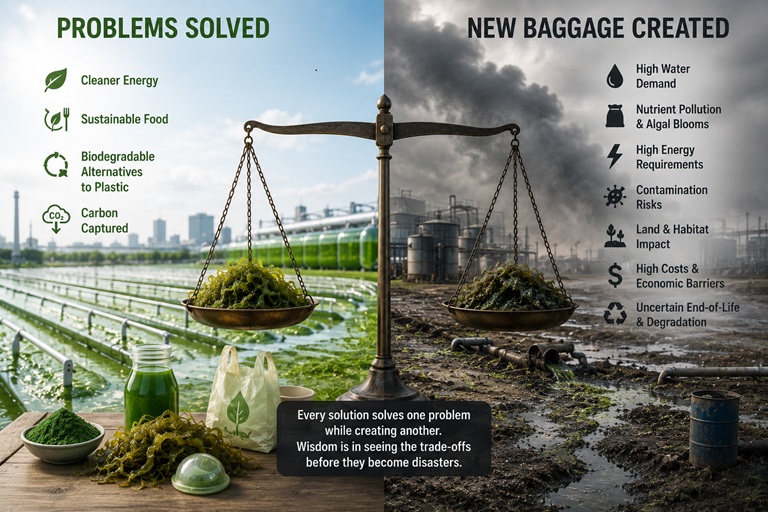
Problems Solved vs New Baggage Created
It is easy to see why advocates want government mandates to force an algae revolution today. Algae directly addresses three of our biggest existential threats: fossil fuel extraction, agricultural deforestation and permanent microplastic pollution.
However, scaling algae from a laboratory novelty to an industrial titan introduces a brand-new set of engineering, environmental and economic trade-offs:
The Energy and Infrastructure Paradox: Growing microalgae efficiently requires massive light exposure. Open air ponds are cheap to build, but suffer from contamination, evaporation and temperature drops. Closed photobioreactors solve contamination, but require colossal amounts of energy, capital and specialized glass/steel infrastructure to pump, circulate and harvest the biomass. To produce algae at a scale that replaces petroleum requires energy inputs that undermine its net-zero premise.
Water, Fertilizer and Land Footprints: While algae don’t require fertile farmland, building the vast raceway ponds required for industrial scale energy or plastic production requires immense physical footprints. Furthermore, algae require heavy inputs of nitrogen and phosphorus to sustain rapid growth. Sourcing these fertilizers at scale risks creating new supply chain bottlenecks or triggering toxic local runoff and oceanic “dead zones” if wastewater isn’t strictly managed.
Drying and Extraction Energy Costs: Algae grows in water, lots of it. The process of separating microalgae cells from water (dewatering) and drying the wet paste to extract lipids or biopolymers is incredibly energy intensive. Until dewatering technology improves drastically, processing algae often consumes more energy than the resulting biofuel or bioplastic delivers.
Large-scale algae cultivation isn’t just an engineering problem. It’s also a biological one. Industrial ponds can become contaminated by competing algae, bacteria, fungi or microscopic grazers that consume the crop. Maintaining a stable, productive ecosystem at industrial scales is often as challenging as designing the equipment itself.
The ultimate trap with solutions like algae tech isn’t that the science is bad. It’s that we treat speculative scaling as a reason to delay action today. Expecting governments or corporate engineering breakthroughs to deploy algae infrastructure overnight to save us tomorrow overlooks the fact that system level transitions take decades to mature.
Lifecycle analysis matters.
A Path to the Future
The lesson isn’t about algae. It’s about us. Plastic wasn’t evil. Lead pipes weren’t chosen because people wanted poisoned children. Coal wasn’t burned because civilization enjoyed pollution. Each technology solved pressing problems that existed at the time. Only later did we discover costs that were invisible during adoption.
Supporting algae technology, sodium-ion batteries and advanced bio-materials is vital for long term industrial transition. But we can not allow the promise of a future miracle to distract us from our immediate choices.
The answer isn’t to reject innovation. It’s to stop pretending any innovation is free.
While bio-engineers work to make algae bioplastics and fuels economically viable, we don’t have to wait for an industrial miracle to reduce our exposure to microplastics right now. Mature, inert materials like glass, stainless steel and cast iron are sitting on our kitchen shelves today.
If algae replaces plastic, fuel or food, we shouldn’t ask only what problems it solves. We should ask what new problems we’re creating while they’re still small enough to fix.
Algae may very well power and package the late 21st century, but until it scales, the best way to protect our households is to rely on what is already proven.
The greatest mistake isn’t creating new technologies. It’s believing they’ll arrive without consequences. Progress isn’t the absence of tradeoffs. It’s learning to recognize tomorrow’s problems before they become tomorrow’s disasters.
Discover more from Tales of Many Things
Subscribe to get the latest posts sent to your email.