
When I recently wrote about our civilization quietly poisoning itself with microplastics, one reader asked a perfectly reasonable question: “If not plastic, then what?”
It’s the right question.
We’ve become so accustomed to plastic that many people can’t imagine life without it. Plastic wraps our food, stores our leftovers, coats our cookware, lines our water bottles, packages our groceries and fills our kitchens. It feels indispensable.
But here’s the uncomfortable truth. Our ancestors did not live in a sterile wasteland, but they did live in a plastic-free one. Synthetic plastics are barely a century and a half old. Mass production is less than half of that. For multiple millennia before the mid-twentieth century, human civilization cooked, stored, traded and ate without a single polymer touching their food.
We didn’t spend thousands of years waiting for petroleum to become our dinner plates. We did it by relying on the crust of the Earth, the elements that are fundamentally inert when they encounter the human metabolism.
Chemistry governs everything that enters the human body. The ideal cookware doesn’t contribute anything to your meal except heat. Glass, ceramics and many metals achieve exactly that because their atoms are locked into exceptionally stable structures that resist reacting with food, digestive acids and enzymes. Plastics are different. They are long chains of synthetic organic molecules that slowly weather, abrade and degrade. We built them to be durable. We didn’t build them to become part of us.

The Deep History: We Already Solved This Problem
Long before plastic, people cooked, stored food and transported water using materials that had one remarkable property: they didn’t become a part of the meal.
Clay pottery dates back more than 20,000 years. Ancient Egyptians stored food in ceramic vessels. The Greeks and Romans cooked with bronze, copper and iron. Glass containers have existed for over two millennia. Cast iron cookware has served kitchens for equally as long. Wooden bowls, bamboo utensils, woven baskets, linen sacks, beeswax wraps and stoneware crocks all accomplished the same tasks we now assign to disposable plastics.
Humanity didn’t just “survive” this way. We built empires, preserved food through brutal winters and summers and advanced culinary arts across every continent. We did it using elements that, if broken or discarded, simply returned to the soil as dust.
Modern plastics didn’t replace these materials because they were better. They replaced them because they were cheaper. These two are not the same thing.
Plastic Was an Engineering Miracle
Let’s be fair, plastic solved real problems.
It’s lightweight, inexpensive, waterproof, moldable into almost any shape and remarkably durable. Those qualities revolutionized medicine, aerospace, electronics, transportation and countless industries.
The irony is that the very property that makes plastic so useful, its durability, is also what makes it problematic.
We created a material designed to last for centuries.
Then we used it to package products that we throw away when they come home from the store.
When Plastic Belongs and When It Doesn’t
Not every piece of plastic is equally concerning. Your patio chair probably isn’t hurting you. Your television remote isn’t quietly seasoning your dinner. Ikea furniture is perfectly safe in the basement. Unless you lick it.
A scratched plastic cutting board, a disposable water bottle left in a hot car or a plastic food container repeatedly heated in the microwave interact directly with what you eat and drink.
That’s a meaningful distinction. The closer a material comes to your digestive system, the higher the standard it should meet.
What Should We Use Instead?
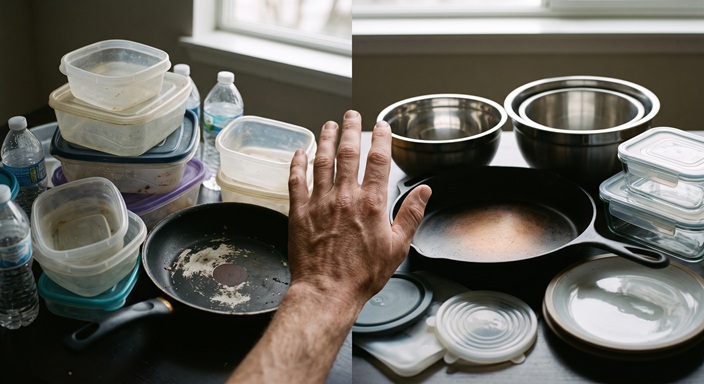
Fortunately, we aren’t searching for futuristic miracle technology. Many of the best alternatives have been sitting in our kitchens for generations.
The Modern Inert Trinity: Silica, Borosilicate and Silicone
When a reader asks, “If not plastic, then what?” the most scientifically sound answer starts with silicon dioxide (SiO2), the fundamental component of sand. The modern world has refined this basic geological building block into three incredibly stable, completely non-plastic materials that are among the most chemically inert materials available for food contact – ceramics, Pyrex and silicone.
Ceramics and Traditional Glass
Standard glass and ceramic glazes are essentially supercooled liquids made from melted sand, soda ash and limestone. At a molecular level, they form a tight, impermeable matrix. They lack the weak chemical bonds found in plastics, meaning they do not leach organic compounds into your food, even when subjected to highly acidic or basic ingredients (like tomato sauce or citrus).
Glass remains one of the finest food contact materials ever invented.
Whether it’s a Mason jar or a Pyrex baking dish, glass is chemically inert, doesn’t absorb flavors or odors, doesn’t stain easily and won’t shed microplastics into your food. It’s ideal for food storage, baking, leftovers and drinking.
Properly fired ceramics with modern lead-free glazes are also an outstanding option.
Ceramic plates, bowls, mugs and baking dishes have served humanity for thousands of years because they’re stable, durable and don’t react with food. There’s a reason nearly every fine restaurant still serves your dinner on ceramic.
Yes, ceramics and glass break. So does your smartphone.
Borosilicate Glass (Pyrex)
Invented in the late 19th century and popularized in mid-20th century kitchens, borosilicate glass incorporates boron trioxide (B2O3) into the silica mix. This alters the material’s thermal properties, allowing it to withstand extreme temperature differentials without cracking.
Unlike plastic storage containers, which warp, stain and shed microplastics when heated, borosilicate glass can go from the freezer to the oven safely. And it is chemically impervious to human digestive enzymes and stomach acid.
Food-Grade Silicone
Silicone deserves its own category. Though it sounds and feels synthetic, high quality silicone is a completely different beast than plastic. While plastic is built on a backbone of carbon chains derived from petroleum, silicone is built on a backbone of alternating silicon and oxygen atoms (Si–O–Si).
This silicon-oxygen bond is incredibly strong and highly resistant to thermal degradation. High-grade, platinum-cured food silicone does not leach chemicals, does not off-gas and remains stable at temperatures up to 500°F (260°C). It offers the flexibility and convenience of plastic without shedding microplastics in the way conventional plastics can.
It’s not “natural”, but it is often a significant improvement over disposable plastics for many kitchen applications.
The Age of Steel
Steel has been a kitchen staple for over two millennia. Historically it has been relatively inexpensive and has proven itself to be highly durable. Its harshest criticism is its weight.
Cast Iron
Cast iron is almost indestructible.
First mastered in ancient China and later becoming the bedrock of Western kitchens, cast iron became the ultimate durable cookware.
Properly seasoned, polymerizing natural animal or vegetable fats into a slick, non-stick surface using nothing but high heat, it retains heat exceptionally well and often becomes a family heirloom passed from one generation to the next.
Some cast iron pans currently in use are over a century old. That’s true sustainability.
Stainless Steel (The 18/10 Standard)
If one material deserves to be called the workhorse of the modern kitchen, it’s stainless steel.
It resists corrosion, tolerates extremely high temperatures, lasts for decades and requires virtually no special care.
Modern food-grade stainless steel is an alloy of iron, carbon, chromium (usually 18%) and nickel (usually 10%). The magic of stainless steel lies in the chromium. When exposed to oxygen, chromium forms a microscopic self-healing layer of chromium oxide (Cr2O3) on the surface of the metal. This passive layer prevents the iron from rusting and ensures that the metal remains completely unreactive to food, making it the gold standard for commercial and medical sterilization.
Stainless steel excels in cookware, mixing bowls, water bottles, lunch containers and food preparation. Many professional kitchens rely heavily on stainless steel for one simple reason: it works.
Carbon Steel
Think of carbon steel as cast iron’s lighter, faster cousin.
It’s popular in professional kitchens because it heats quickly, develops excellent seasoning and performs beautifully for everything from stir-frying to searing steaks.
Enameled Cast Iron
Enamel-coated cookware combines the heat retention of cast iron with an inert glass coating that doesn’t require seasoning.
It isn’t cheap. Neither is replacing your cookware every few years.
Exotic Metals
The Copper and Brass Era
For those who could afford it, copper provided unparalleled thermal conductivity. Because bare copper can react with acidic foods, it was historically lined with tin, a soft non-toxic metal that provided a safe barrier between the food and the reactive flame.
Titanium and Anodized Aluminum
Titanium is one of the most biologically inert metals known. For ultra-lightweight or high-performance needs, titanium offers absolute chemical inertness. It is so compatible with human biology that it is used for medical implants and bone screws.
While expensive for everyday cookware, titanium water bottles, camping cookware and utensils are lightweight, durable, corrosion-resistant and can last a lifetime.
Alternatively, hard-anodized aluminum utilizes an electrochemical process to thicken the natural oxide layer on the metal’s surface. This creates an extremely hard ceramic-like surface, completely non-reactive and provides an exceptional barrier without the use of chemical coatings.
Wood
One of the oldest food contact materials is still one of the best.
Wooden cutting boards have quietly resisted replacement for centuries. Contrary to popular myth, properly cleaned hardwood cutting boards often outperform plastic boards because the wood naturally traps and suppresses bacterial growth while avoiding the continual shedding of plastic particles created by knife scars. Maple, walnut and beech remain favorites in professional kitchens for good reason.

What About Non-Stick Pans?
Non-stick cookware deserves a thoughtful conversation rather than a simple slogan.
Traditional PTFE coatings are chemically stable under normal cooking conditions, but they can degrade when severely overheated. Scratched coatings also raise understandable concerns for many consumers and the broader family of fluorinated chemicals used in manufacturing has received increasing scientific scrutiny over the past two decades.
Cooks don’t cook under “normal laboratory conditions”. They leave pans on the burner while chopping onions. Fortunately, today’s cooks have more choices than ever.
The Hard Truth about Direct Exposure
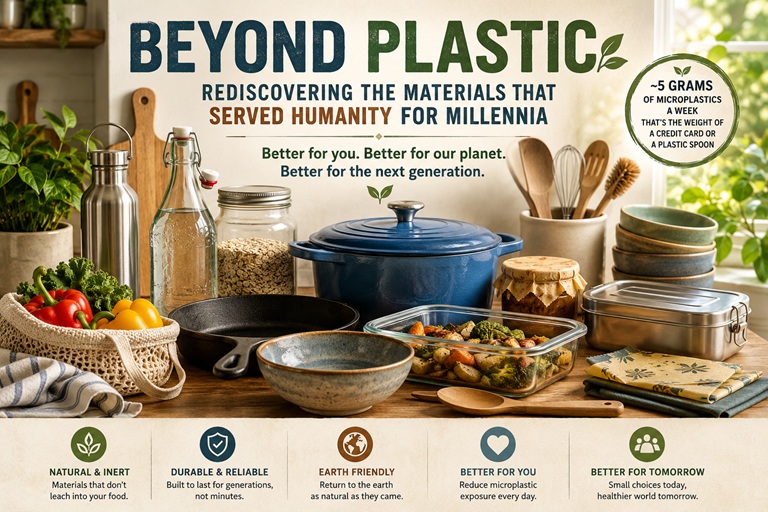
Researchers estimate that the average person ingests roughly five grams of microplastics every week through food, drinking water and the air we breathe — about the weight of a credit card.
Microplastics and nanoplastics have now been detected in human blood, lungs, liver, kidneys, placentas, breast milk, reproductive tissues and even the brain.
Recent studies suggest the human brain may accumulate several grams of these particles over a lifetime, although scientists are still working to understand the full implications. We also know that extremely small plastic particles can cross biological barriers that larger particles can not and many plastics can carry or leach chemicals such as bisphenols and phthalates that interfere with normal endocrine function.
There is still much we don’t know, but there is one thing we do know. You don’t wait until the house has burned to the ground before installing smoke detectors. Waiting for absolute certainty has never been humanity’s strongest survival strategy.
Choosing Better
This isn’t an argument for eliminating every piece of plastic from your life. That would be unrealistic.
Modern medicine depends on plastics. So do automobiles, aircraft, electronics, emergency equipment and countless technologies that improve and save lives.
This is simply an argument for using the right material for the right job.
If a material will spend hours touching the food you eat, the water you drink or the meal you’re preparing for your family, perhaps “the cheapest disposable petroleum product available” shouldn’t be our default choice.
The good news is the solutions aren’t experimental or futuristic. We have convinced ourselves that avoiding plastic requires sacrifice. It doesn’t. Nearly every task performed by disposable plastic already has a mature, affordable alternative. Glass containers. Stainless steel bottles. Ceramic dishes. Cast iron pans. Beeswax wraps. Cotton shopping bags. None of these are experimental. They are simply older than plastic and in many cases, better. We don’t need another revolutionary material. We need the wisdom to use the right material in the right place.
We already have thousands of years of historical proof that these traditional materials work and a mountain of modern medical data proving that we desperately need them back.
Sometimes progress isn’t about discovering something new. Sometimes it’s about remembering the wisdom we abandoned in pursuit of convenience.
Discover more from Tales of Many Things
Subscribe to get the latest posts sent to your email.