
A friend of mine told me something dubiously profound the other day. We were talking about the state of the world, which is always a dangerous conversational trailhead, and he leaned in with the intense, hushed tone usually reserved for classified government leaks.
“I don’t trust the economy today,” he whispered. “I’m slowly liquidating my index funds and buying gold.”
It was an interesting moment. Interesting in a “make my left eye twitch” sort of way.
“You’re buying gold?” I asked.
“As much as I can get.”
Not a little gold.
Not “some gold as a hedge.”
Gold. A lot of it.
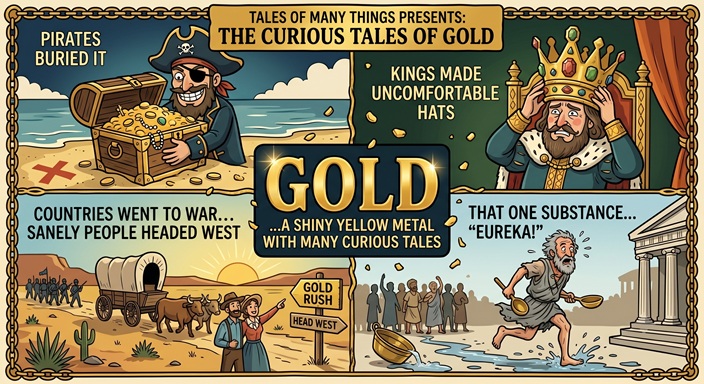
Gold, as in the shiny yellow metal. The stuff pirates buried in treasure chests and kings used to make hats that looked profoundly uncomfortable. The yellow rock that made countries go to war against one another and caused otherwise sane people to sell their belongings and head west, in hopes of striking it rich. That one substance that caused Archimedes to run naked down the street, yelling “Eureka!”
Now, I don’t have a formal PhD in business valuation or corporate accounting, but I’ve read Benjamin Graham, Peter Lynch and Warren Buffett. On the most fundamental, microscopic level, a business is a beautifully logical machine: it takes a set of inputs, makes something useful and sells it to people who actually need it. It could be a physical widget (manufacturing), an opinion (consulting) or a service (house cleaning or cloud infrastructure). Because of this, I know how money is made. I can measure how efficient a business is. I can look at a spreadsheet and differentiate between a cost and a profit.
But gold?
Valuating gold isn’t just harder than valuating a business. It’s entirely impossible.
The Brick That Does Nothing
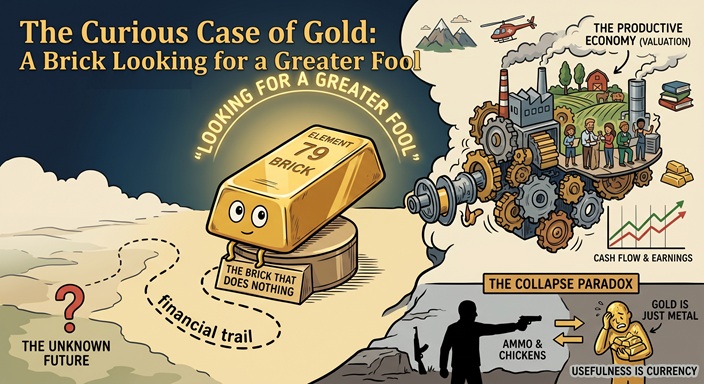
Let’s be brutally honest about what a bar of gold is: it is a heavy, shiny brick made of element 79 on the periodic table. And its primary behavior? It just sits there.
Now, before the angry emails arrive, let me acknowledge something.
Gold has value.
It has a handful of excellent industrial uses. It’s highly malleable. It’s highly conductive. It’s perfect if you are looking to manufacture a specialized electronic circuit that can handle a very low current with minimal signal loss while refusing to tarnish in high humidity. Beyond that, it’s a very pretty material that human beings have used for millennia to decorate their bodies and try to look important to their neighbors.
What gold does not do is make anything.
A share of stock represents ownership in a business. A business produces goods or services. Customers buy those goods or services. Revenue comes in. Expenses go out. Profit remains. That profit can be reinvested to grow the business or returned to shareholders.
That’s your dividend. I understand that.
I can examine whether the business is growing.
I can measure cash flow.
I can compare debt levels.
I can estimate future earnings.
Even if I’m wrong, I have something tangible to analyze.
Gold?
Gold is a brick.
A very shiny brick.
A brick that occasionally gets turned into jewelry or electrical contacts.
But mostly, just a brick.
It sits there.
It produces nothing.
It invents nothing.
It serves no customers.
It pays no dividends.
It doesn’t have an operating cash flow.
It doesn’t innovate.
It doesn’t hire an aggressive new CEO.
It doesn’t optimize its supply chain.
It has no earnings report.
The annual shareholder meeting for a gold bar consists entirely of wistfully staring at it.
If you put a brick of gold in a dark safe for thirty years and check in on it, you will not find a family of happy little gold coins running around the brick. No one has ever witnessed a brick of gold excrete pellets of revenue. Ever.
So how do you value it? How do you make money investing in a literal lump of metal?
That’s where things get interesting.
With a business, I can estimate future profits.
With a rental property, I can estimate future rent.
With a bond, I can estimate future interest payments.
With gold, there is no cash flow to analyze.
Its value is whatever somebody else is willing to pay for it.
That doesn’t automatically make gold worthless, but it does move the conversation from investing toward speculation.
The famous “greater fool theory” says you can make money buying something overpriced if you can later find an even bigger fool willing to pay more than you did.
Unlike a stock, gold does not create wealth. Its historical claim to fame is preserving wealth. Whether that preservation is worth decades of forgone productive returns is a separate question.
For the most part, gold is the ultimate game of financial hot potato. You aren’t investing. You are just praying that when the music stops, there is a more gullible soul standing next to you, holding an open wallet. To me, there is no purer, more distilled definition of speculation.
That sounds harsh, but there is an uncomfortable truth buried inside it.
If an asset produces no cash flow, then your return depends entirely on future buyers valuing it more highly than you do today.
You are not collecting profits.
You are not collecting rent.
You are not collecting interest.
You are waiting for someone else to offer you a better price.
That is the entire game.
Gold investors often object here.
They point out that gold has preserved purchasing power over very long periods of time.
Fair enough. But preserving purchasing power and generating wealth are two different things.
A productive farm generates food.
A factory generates widgets.
A software company generates revenue.
Gold generates patience.
And storage fees.
Sometimes theft concerns.
Occasionally a strong urge to show visitors your secret safe.
The distinction matters because wealth is ultimately created through production.
Society becomes richer when people build things, invent things, grow things, transport things, heal people, teach people and solve problems.
A gold bar does none of these. It merely exists.

The Recession Reality Check
The common response is that gold shines brightest during economic crises.
Let’s examine that.
Imagine a recession.
The stock market crashes.
Businesses fail.
Unemployment rises.
People are struggling to pay mortgages and buy groceries.
Gold owners proudly announce that their metal has retained value.
Excellent.
Now who exactly is buying it?
The struggling family trying to keep the lights on?
The laid-off worker?
The business owner fighting bankruptcy?
If everyone is suffering financially, the pool of people capable of paying premium prices for your gold will be smaller than expected. Gold works best when enough economic activity remains intact, when people still have money available to purchase gold.
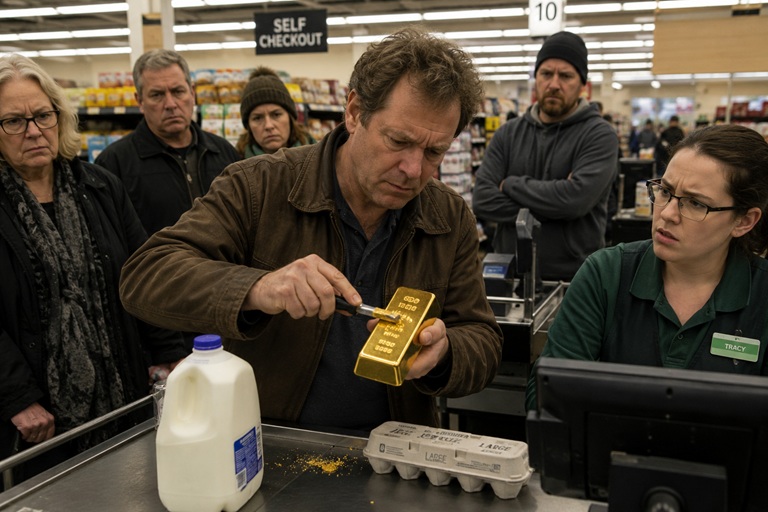
Are you going to chip off a corner of a gold bar at the grocery store checkout line to buy a gallon of milk? “Yes, hello, cashier, let me just shave off 0.04 ounces of this bullion for this carton of eggs.” What are everyday people even going to do with gold when they don’t have a secure roof over their heads? It turns out that luxury commodities require an abundant, cash-flush society to maintain their premium valuation.
Which means even the “gold saves me from economic disaster” scenario still depends heavily on functioning markets and functioning buyers.
The Ultimate Apocalyptic Paradox
And then we arrive at the survivalist version. This is where things become unintentionally hilarious.
Imagine the absolute worst-case scenario. The Full Collapse. This is the ultimate, late-night campfire fear of every doomsday prepper. The global markets are completely worthless, the government has entirely collapsed and the grid is dark. There is no internet, no banking system and absolutely no place to legally sell your gold.
Think about it.
Markets disappear.
The dollar becomes wallpaper.
Civil order evaporates.
Society is now operating on direct barter.
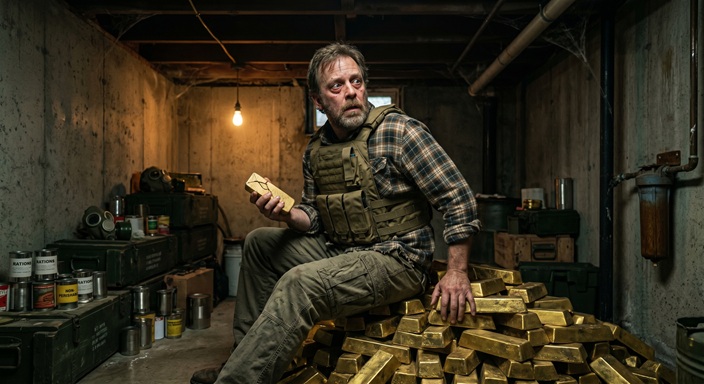
You have a basement filled with gold.
Your neighbor has chickens.
Another neighbor has potatoes.
Someone else has clean water.
Who wins?
Not the guy with gold.
The guy with chickens wins.
The guy with potatoes wins.
The guy with antibiotics wins.
The guy with clean water wins.
The mechanic wins.
The farmer wins.
The electrician wins.
The nurse wins.
The person who knows how to repair a generator wins.
Welcome back to the prehistoric barter economy. The local economy is now entirely defined by a simple transaction: trading a bushel of potatoes for a healthy chicken.
In a true collapse, usefulness becomes currency. Let’s play out this transaction. You walk up to a farmer with a heavy, glittering bar of 24-karat gold and you demand three chickens and a sack of grain. The farmer looks at you, looks at the gold and says: “I can’t eat that. My kids can’t eat that. It can’t keep my crops warm and it won’t stop a wolf. Keep your rock. I’m keeping my birds.”
You can not eat gold.
You can not drink gold.
You can not heat your home with gold.
You can not treat an infection with gold.
At that point, a gold bar is simply an unusually heavy object that reflects sunlight well.
In fact, let’s take it a step further into the deep, uncomfortable woods of logic. If we enter a true Mad Max apocalypse and I am the survivalist who invested heavily in functional tools, medical supplies, food, guns and ammunition and you are the survivalist who spent your life savings filling a basement with heavy gold bars, then guess what? I am now the guy with the guns, the ammunition and your basement full of gold. And something deeply unspeakable has probably happened to you.
History becomes very unpleasant when institutions disappear. If a societal collapse is severe enough to permanently destroy the value of paper money and corporate equities, no type of conceptual currency matters anymore. Gold only holds value because a stable government and a robust cooperative economy exist to back up the illusion that it represents wealth. Without the infrastructure of civilization, gold reverts instantly to what it always was: an inconveniently heavy, too-soft lump of metal.
Fortunately, I don’t think we’re headed there. Modern economies are remarkably resilient. The end-of-civilization scenarios make for entertaining movies, but poor investment strategies.
Which brings me back to my original concern.
What Gold is Actually Good For
Gold’s value depends on a paradox. Gold is often purchased because people fear the financial system, yet gold’s ability to function as an investment depends heavily on that same financial system continuing to operate.
You need buyers.
You need markets.
You need price discovery.
You need legal ownership.
You need enough prosperity that someone can afford to buy your shiny brick.
Without those things, gold stops being an investment and starts being an unusually expensive paperweight. Strip away the psychological panic, the apocalyptic marketing and the late-night gold-bug commercials and you are left with a simple truth. Gold is just a metal.
That doesn’t mean gold is worthless. It means gold is not productive. And over very long periods of time, productive assets tend to win.
Businesses create value.
People create value.
Innovation creates value.
Gold simply waits for someone else to decide it is valuable.
The irony is that nearly every gold investor ultimately believes in civilization. They have to. If civilization survives, they need markets, brokers, exchanges, buyers, property rights and functioning institutions to sell their gold. If civilization doesn’t survive, they need food, water, medicine and security. Gold occupies an awkward middle ground, too dependent on civilization to thrive in a true collapse, yet too unproductive to create wealth the way productive assets do during normal times.
Personally, I’d rather own a small piece of a company that wakes up every morning trying to make money than a metal brick waiting patiently for the next buyer. Because when the darkness inevitably falls on the market, I’d rather own a piece of a business that provides the world with electricity, food and medicine, rather than a basement full of shiny metal bricks, waiting around for a greater fool who might never show up.
At least that productive business is doing some work.
Discover more from Tales of Many Things
Subscribe to get the latest posts sent to your email.