
There are holidays that celebrate victories.
There are holidays that celebrate sacrifices.
And then there are holidays that exist because humanity made a terrible mistake.
Juneteenth belongs to that last category.
But for many, Juneteenth has already been neatly packaged into a three-day weekend with barbecues, federal closures and corporate emails expressing a generalized appreciation for “freedom”. But freedom isn’t a corporate perk point. And Juneteenth didn’t happen because humanity suddenly woke up, looked at itself in the mirror and decided to be kind.
Every year, someone asks why we need a holiday like this. The answer is uncomfortable because it forces us to confront a truth that stretches far beyond American history.
Juneteenth exists because we, as a species, possess a terrifying capacity to look directly at human suffering, calculate the profit margin and call it culture. It exists because for centuries an entire society convinced itself that some people were born to be owned. And if we want to understand the true weight of this day, we have to stop looking at history through the lens of a sanitized textbook and look at it for what it actually was: a systematic, state sponsored and religiously sanctioned theft of human life.
Human beings have spent thousands of years trying to convince themselves that some people matter less than others.
The Bible contains rules for slavery. Ancient Rome built an empire on it. Europe had serfdom, where generations of families were effectively tied to the land and to the will of their lords. Kingdoms conquered kingdoms and carried away captives. Tribes raided tribes. Empires traded people as commodities. The Catholic Church itself recently acknowledged its role in enabling slavery.
History offers no shortage of examples.
None of them make it right.
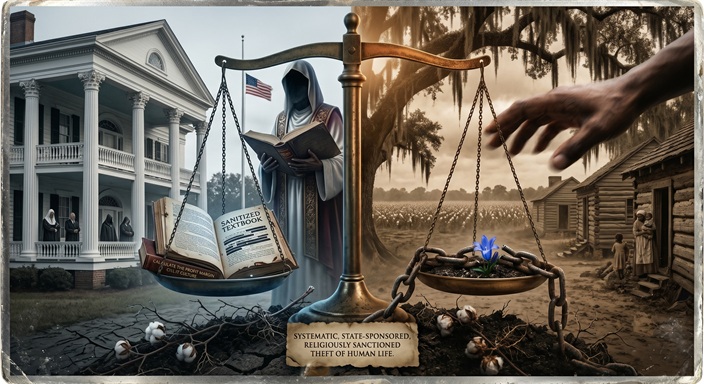
The Great Lie of Historical Equivalence
When we talk about American chattel slavery, a defense mechanism often kicks in. People rush to the history books to rationalize it. “Slavery has always existed,” they say. “The Romans did it. The Greeks did it. It has been the divine right of kings.”
Some will argue that slavery in America was different from other forms of bondage. Some historians would agree. Others would point out that serfdom was its own form of inherited misery.
Frankly, that debate misses the point. The moment one person decides another person is property, something fundamental has broken.
Let’s be brutally honest. From a moral perspective, serfdom is no more justifiable than any other form of forced servitude. Human subjugation is human subjugation. Throughout history, societies have repeatedly engineered elaborate hierarchies to convince themselves that some people were born to serve others.
It doesn’t matter whether the chains are iron shackles, legal contracts, inherited debts or social customs. It doesn’t matter whether the justification comes from economics, conquest, race, religion or tradition.
The argument is always the same.
“They exist to serve us.”
And that is the lie.
Juneteenth exists because a young America embraced that lie.
American slavery introduced a specific, uniquely toxic mutation to this ancient evil: race. In the ancient world, you became a slave because your army lost a war or because you fell into debt. It was a tragedy of circumstance. But in America, slavery became a permanent, generational curse written into your DNA. It wasn’t just about what you did. It was about who you were. It was a system that decreed that because of the color of your skin, you were subhuman. Your children were born into the ledger books as property before they even took their first breath. Enslavement became hereditary, permanent and legally tied to ancestry, creating a racial caste system that would outlive slavery itself.
Are we indeed so different as races that one group has a natural right to subjugate another? Science says no. DNA says no. Reason says no.
So why did we do it? Did we do it out of pure comic-book evil?
No. We did it because we could. And we did it because it paid well.
The most profitable lies are often the ones we teach ourselves until we mistake them for truth.
The Declaration of Independence proclaimed that all men are created equal while millions of African Americans were bought, sold, beaten and denied even the most basic right to determine the course of their own lives.
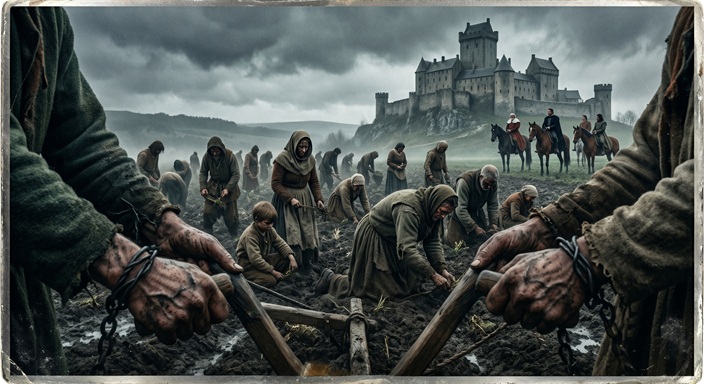
The Banality of Institutional Evil
The most frightening lesson of history is that evil rarely arrives wearing a black hat. It doesn’t introduce itself as a monster. Instead, it arrives wrapped in the law, validated by custom and preached from the pulpit.
For centuries, American slavery wasn’t a fringe underground crime. It was the bedrock of the global economy. It was normalized by ordinary people, respected institutions, democratic governments, massive businesses and religious organizations.
It is tempting to dismiss that contradiction as the work of villains. It is too easy.
The more unsettling lesson is that ordinary people accepted it.
Merchants accepted it because it was profitable.
Politicians accepted it because it was expedient.
Churches accepted it because they found ways to justify it.
Families accepted it because it was simply the way things had always been.
That may be the most frightening lesson of Juneteenth.
The greatest evils in history are rarely carried out by monsters.
They are carried out by ordinary people who become comfortable with injustice.
The Bible was quoted to justify the lash. Theology was twisted to argue that keeping African Americans in chains was actually a form of Christian benevolence. Just recently, the Catholic Church issued an apology for its historical role in enabling and validating the transatlantic slave trade. It took centuries to say what should have been obvious from day one: you can not own another human being.
But that is how deeply a culture can poison itself when an atrocity becomes profitable and convenient. When an entire economic system relies on free labor to build its empires, human conscience is the first thing to be auctioned off.
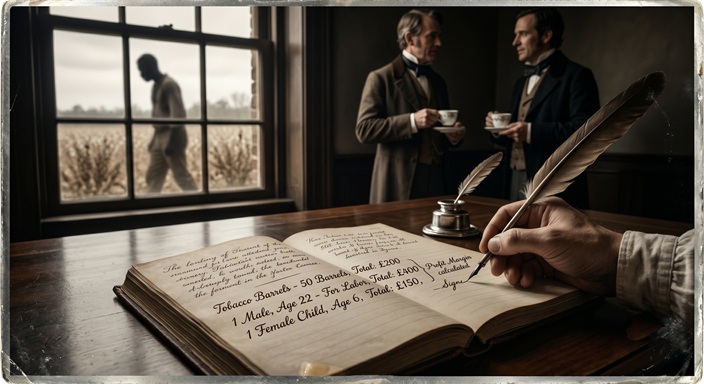
What Juneteenth Actually Means
Then came the Civil War.
Then came emancipation.
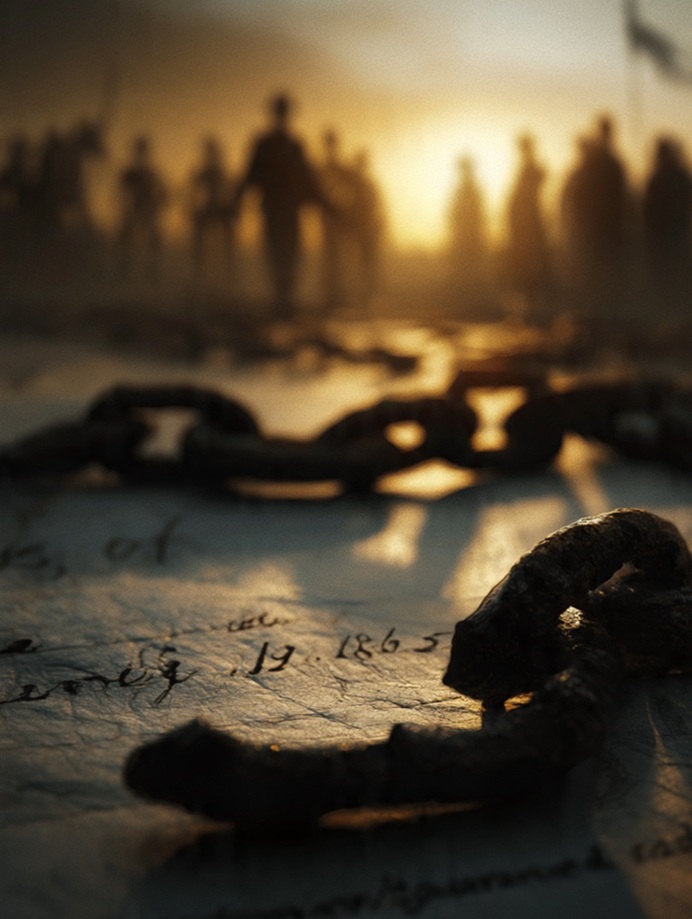
Then came June 19, 1865, when the news finally reached enslaved people in Texas that they were free.
Juneteenth commemorates the day Union soldiers arrived in Galveston, Texas to enforce the Emancipation Proclamation. It was a full two and a half years after the proclamation had legally freed enslaved people. Reflect on that lag. For thirty months human beings were kept in fields under the whip simply because enforcement had not arrived, because many enslavers concealed the truth and because those in power wanted one more harvest out of stolen labor.
Think about that for a moment.
The war was over.
Freedom had been declared.
And yet people remained enslaved because those in power simply refused to let go.
There is no excuse for what was done to African Americans in the early days of this country. None. No amount of historical context, no economic justification and no theological gymnastics can ever clean the blood off those ledger books.
Juneteenth is on our calendar because we must remember that human beings are capable of normalizing the unthinkable. It is a monument to the fact that laws can be fundamentally illegal in the eyes of human decency and that customs can be wicked.
Juneteenth is the day we remember that freedom delayed is freedom denied.
It is also the day we remember that ending slavery did not end the struggle for equality.
History did not suddenly become fair.
The work simply changed.
The uncomfortable truth is that we have not completely solved this problem.
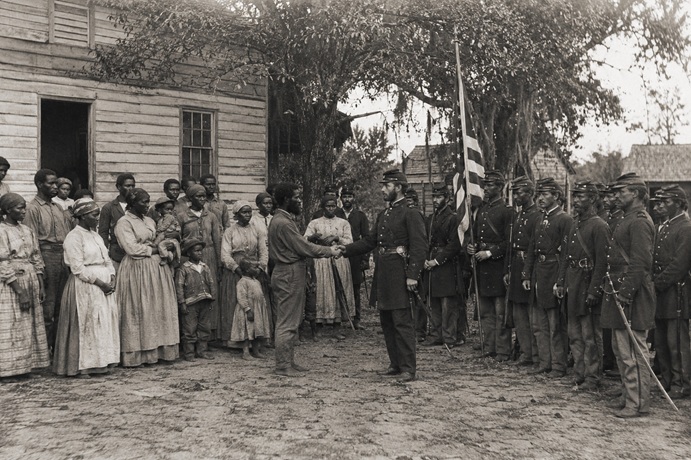
The Burden of the Future
If we think this is just a history lesson, we are missing the point entirely. Human trafficking is alive and well in the dark corners of the globe today. The impulse to exploit, to look at another human being and figure out how to extract wealth from their suffering, has not been engineered out of our species. Politics change. Technology changes. Human nature remains stubbornly the same.
How do we reconcile our past? By refusing to sugarcoat it. By looking at the scars left by chattel slavery and admitting they are still raw.
How do we fix our future? By recognizing that freedom is not a static state of being. It is an active, exhausting, daily defense against our worst impulses.
Human trafficking exists today.
Forced labor exists today.
Children are exploited today.
Debt bondage exists today.
Millions of people around the world are trapped in systems designed to strip away their choices and their dignity.
The faces change.
The methods evolve.
The lie survives.
“They exist to serve us.”
Juneteenth asks us to reject that lie.
Not for one race.
Not for one nation.
For everyone.
Because this holiday is bigger than the history of African Americans, even though that history is at its heart.
It is a warning to every country, every culture, every religion and every generation.
Never again convince yourself that another human being belongs to you.
Never again accept that freedom is a privilege reserved for some and denied to others.
Never again allow convenience, profit or tradition to outweigh human dignity.
We can not rewrite the past.
We should not try.
The scars are real.
The suffering was real.
The evil was real.
Our responsibility is something else entirely.
To remember.
To tell the truth.
To admit where humanity has failed.
And to make absolutely certain that when future generations look back at us, they can not say we saw injustice and looked the other way.
Ultimately, Juneteenth is a screaming, unyielding call to all people and all nations: no type of servitude, no type of slavery, is ever okay. People are born with the absolute, unalienable right of self-determination. It is our heavy, collective burden as a society to remember the horrific evils of our past, to dismantle the subtle ways we still devalue human life today and to fiercely champion the rights of all people going forward.
That is why Juneteenth matters.
Not because it reminds us that America was imperfect.
But because it reminds us that freedom is never guaranteed.
It is a promise that every generation has to choose to keep.
Today it is our burden to look past the holiday sales and the long weekend, to respect the dark history that brought us here. Because the moment we forget how easily ordinary people can normalize evil, we pave the way for it to happen again.
It must never happen again, but history offers no guarantees that it won’t.
Discover more from Tales of Many Things
Subscribe to get the latest posts sent to your email.