
In response to my SMR article, I received a one word message from a reader: “Fusion?”
Okay. That’s fair.
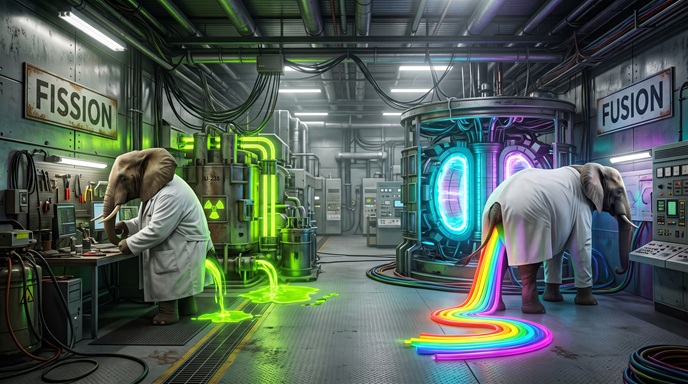
When we talk about nuclear energy, there are really two elephants wandering around the room. One is fission, where we split heavy atomic nuclei apart. The other is fusion, where we force light atomic nuclei together. Both processes release an enormous amount of energy. After that, their family resemblance gets a little strained.
One important distinction is that the fission elephant already powers homes, but poops dangerous radioactive fuel. The fusion elephant will one day poop rainbows, but provides no useful electricity today.
Fission is the technology we figured out how to build first. Fusion is the one we have been promising ourselves we are almost ready for since before most of us were born and that’s important because fusion is simultaneously one of the most promising technologies humanity has ever attempted and one of the most botched examples of the phrase “we’re almost there”.
We’ve been almost there for decades. If this was a dissertation, the doctoral candidate would have been beaten and barred from academia for life. Yet, we still claim we’re getting closer and that might be true. Something interesting has happened recently and we may actually be getting there for a change.
First, though, let’s create some context around these terms.
The Original Nuclear Power Plants Were Stars
Nuclear fission and nuclear fusion are not inventions. They are things the universe was doing long before humans showed up with laboratories and grant applications.
Fission can occur naturally in heavy radioactive elements. About 1.7 billion years ago, conditions in what is now Oklo, Gabon, were just right for natural nuclear reactors to operate underground. Uranium deposits there apparently achieved the necessary combination of uranium concentration, water and geology to sustain nuclear chain reactions for long periods.
Nature built a nuclear reactor long before humans figured out how to dress in animal skins. We just took a while to notice this amazing energy technology. It was 1938 when German chemists Otto Hahn and Fritz Strassmann experimentally demonstrated that bombarding uranium could produce barium. Lise Meitner and her nephew Otto Frisch then correctly explained what had happened and coined the term “nuclear fission”.
Four years later, Enrico Fermi and his team at the University of Chicago demonstrated the first controlled self-sustaining nuclear chain reaction with Chicago Pile-1. It was not a commercial power plant. It was a pile of graphite and uranium underneath a football stadium. The nuclear age had officially arrived.
Three years after that, fission had also produced a weapon, because any time humanity finds something new and exciting, someone in the back of the room has to stand up and ask, “can we weaponize this?” We can debate the morality, necessity and consequences of those events in a different article.
Fusion followed a very different path. The universe had already been doing fusion for billions of years before anyone on this planet knew what was happening.
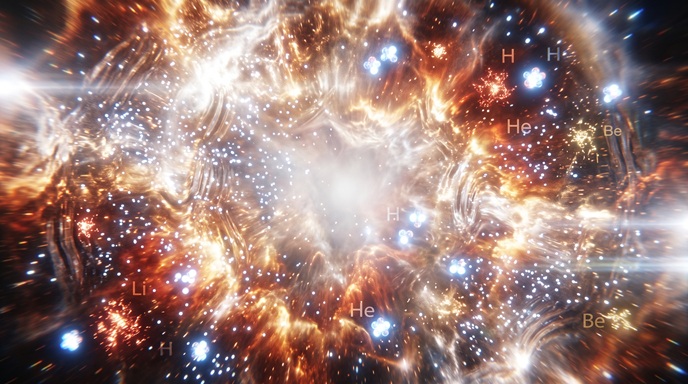
During the first few minutes after the Big Bang, nuclear reactions produced most of the universe’s hydrogen and helium, along with small amounts of lithium and beryllium. Later, stars took over the job, fusing lighter nuclei into heavier ones and releasing the energy that makes stars shine.
Arthur Eddington argued in the early twentieth century that the enormous energy output of stars had to come from subatomic processes. His 1926 work The Internal Constitution of the Stars became one of the landmarks in developing our understanding of stellar interiors.
The universe figured out fusion on its own. Humans merely decided that we should try it in a laboratory.
Fission is Easy. Fusion is Not.
Relatively speaking, fission is much easier to harness. A reactor has to arrange fissile material and control a neutron driven chain reaction, while also removing the enormous amount of heat that reaction produces.
Fusion has a much more demanding personality. The nuclei of atoms are positively charged. Positive charges repel each other. To make two light nuclei fuse, you have to get them close enough together for the strong nuclear force to overcome that electromagnetic repulsion. That means enormous temperatures and pressures.
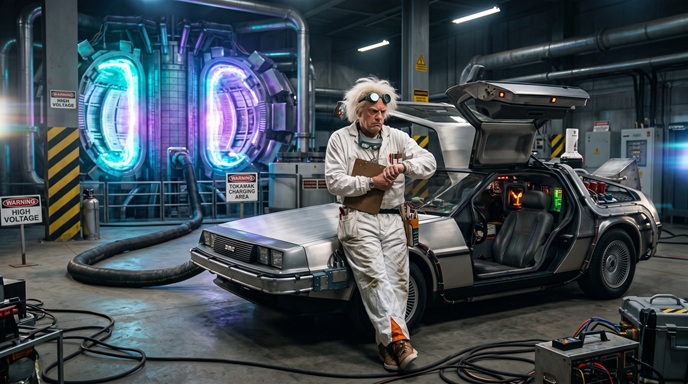
The most common approach being developed for future fusion power plants uses two hydrogen isotopes, deuterium and tritium. When they fuse, they produce a helium nucleus, a neutron and 17.6 megaelectronvolts of energy. That’s really small, nowhere near the 1.21 gigawatts that needed to power Doc Brown’s DeLorean.
The fusion reaction is extraordinarily energetic, but it is also extraordinarily inconvenient. The plasma has to be heated to temperatures of roughly 100 million degrees Celsius or more. That’s much hotter than the 15 million degrees Celsius in the Sun’s core.
Fortunately, we have a solution to the obvious problem. Don’t let it touch anything. Literally.
Magnetic confinement machines such as tokamaks use powerful magnetic fields to suspend the electrically charged plasma inside a vacuum chamber. The plasma is essentially a very angry, very hot doughnut that scientists are trying desperately to keep from touching the sides of the oven.
This is not a metaphor the engineers use in their papers. I am adding it for the benefit of the readers.
Then Came Cold Fusion
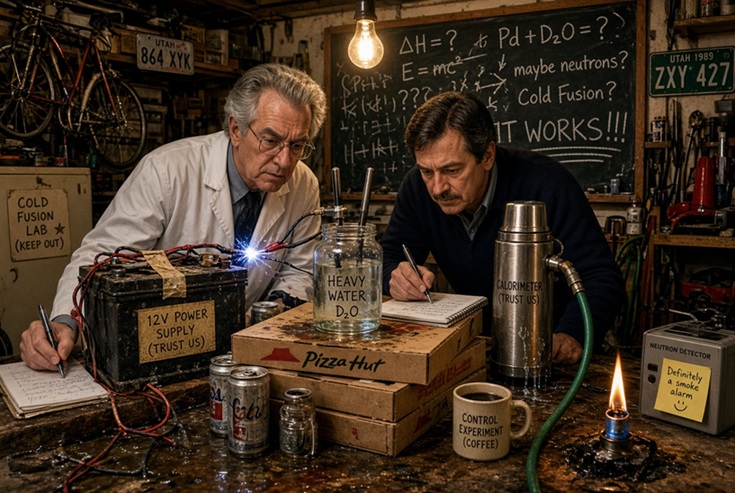
In March 1989, chemists Martin Fleischmann and Stanley Pons, at the University of Utah, announced something that sounded like it belonged in a science fiction movie. They claimed they had produced nuclear fusion at room temperature.
Their apparatus was remarkably unimpressive. Heavy water. Electrodes. Palladium. Electricity. No 100-million-degree plasma. No giant tokamak. No superconducting magnets. No building-sized laser array. If they were right, humanity had effectively discovered the nuclear equivalent of a toaster.
The implications were enormous. A cheap, compact, nearly limitless source of energy would change civilization. The University of Utah quickly moved to protect the potential intellectual property.
There was just one small problem. Other scientists couldn’t reliably reproduce the result. In fact, they couldn’t even do it unreliably. That is where science becomes inconvenient.
A scientific claim does not become true just because the people who made it are sincere. It does not become true because the result would be enormously useful. It does not become true because the university has already called the patent lawyers. Other scientists have to be able to do it, too.
When laboratories around the world tried, the claimed fusion signatures did not materialize. Some experiments reported apparent excess heat. Others did not. Problems emerged with calorimetry, background radiation and neutron detection. A 1989 Nature experiment using multiple calorimeter designs and high efficiency neutron and gamma-ray detectors found no evidence supporting the claimed fusion effect and identified several sources of possible experimental error.
A later effort by a team of researchers to revisit the question using modern experimental standards also failed to produce evidence of cold fusion. Mainstream fusion research moved on.
Fleischmann and Pons had not demonstrated a practical source of nuclear energy. They had, however, demonstrated something almost as useful. The scientific community is really good at finding out when you are wrong, sometimes painfully quickly.
The episode became a cautionary tale about what happens when the press conference arrives before the scientific consensus. “Science by press conference” is a dangerous business model and both science and journalism remembered this gaffe.
Then Something Actually Happened
For decades, fusion research proceeded in the scientific equivalent of a very long hallway. Researchers improved magnets, lasers, plasma physics, materials. They built machines that cost staggering amounts of money and occasionally demonstrated something spectacular for a few seconds before the plasma decided it had other plans.
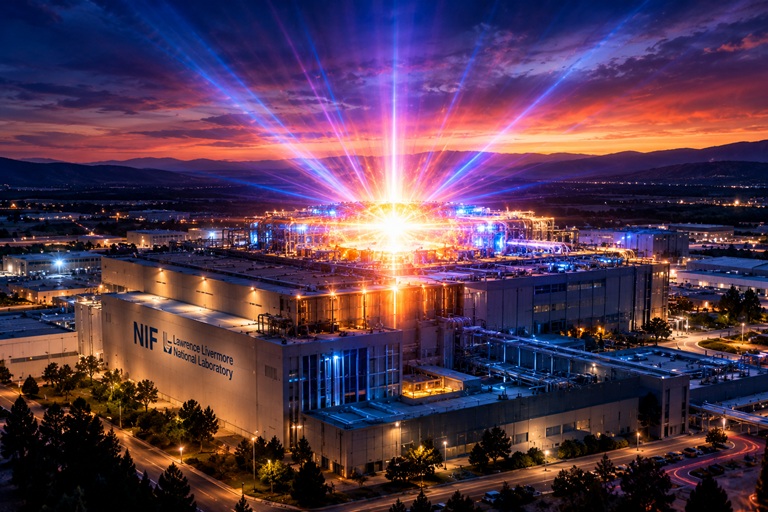
Then, on December 5, 2022, something genuinely historic happened at Lawrence Livermore National Laboratory in California. The National Ignition Facility fired 192 lasers at a tiny capsule containing deuterium and tritium. The lasers delivered 2.05 megajoules of energy to the target. The resulting fusion reaction produced about 3.15 megajoules.
That is a gain of roughly 54 percent. For the first time a controlled fusion experiment produced more fusion energy than the laser energy delivered to the target.
This wasn’t a one-off event. NIF has repeated ignition multiple times since then, with an April 2025 experiment producing 8.6 megajoules of fusion energy from 2.08 megajoules delivered to the target. By 2026, NIF had achieved ignition 11 times.
This is where we also need to be very careful with the phrase “net energy”. The entire facility did not produce more electricity than it consumed. Not even remotely. The 2.05 and 2.08 megajoules were the laser energy that actually reached the target. Producing that laser energy required substantially more electricity and the facility itself is enormous.
This was not a fusion power plant. It was a scientific milestone and, giving credit where it is due, it was a very big milestone. The actual fusion event was also over before you could blink. The laser pulse lasted only billionths of a second.
Lawrence Livermore’s experiment was not a little fusion reactor humming away in a laboratory. It was closer to a microscopic nuclear explosion that scientists had learned to trigger with extraordinary precision.
This is important and encouraging.
The Plasma Record is Getting Longer
The other major fusion approach uses magnetic confinement.
Here the goal is not to compress a tiny fuel pellet for an instant. The goal is to keep an incredibly hot plasma contained for increasingly long periods. This is where the recent headlines get particularly interesting for nuclear physics nerds.
In January 2025, China’s EAST tokamak maintained a high-confinement plasma for 1,066 seconds, almost 18 minutes. A few weeks later, France’s WEST tokamak maintained a hydrogen plasma for 1,337 seconds, approximately 22 minutes. That is an extraordinary engineering achievement.
It is worth putting a giant asterisk next to the headline. WEST’s 1,337-second record was a hydrogen plasma experiment. It was not 1,337 seconds of sustained commercial fusion power.
Likewise, Germany’s Wendelstein 7-X stellarator set an important 2025 record for the fusion relevant triple product during a 43 second plasma discharge. It was a major plasma physics achievement, but it was not a demonstration of a working fusion power plant.
This is a recurring problem with fusion headlines. The technology advances. The headlines get excited. The distinction between “we demonstrated an important piece of fusion physics” and “we built a power plant” gets quietly left in the parking lot.
So What is Still Missing?
There’s quite a lot left to be done. This is where the rainbow pooping elephant runs into the electrical grid.
The basic physics works. We know fusion happens. We can make fusion happen on Earth. We can even make a fusion reaction produce more energy than the energy delivered directly to the target. Now we have to turn that trick into an industrial machine and that is considerably harder.
A future fusion power plant has to reliably produce enormous amounts of heat, remove that heat without destroying the machine, convert it into electricity and keep the whole thing operating economically.
The heat problem is particularly interesting. The plasma may be around 100 million degrees Celsius, but the reactor wall can not be. The solution is a carefully engineered blanket surrounding the plasma. Fusion neutrons escape the magnetic field, slam into the surrounding material and deposit their energy as heat. A coolant then carries that heat away. Eventually, that heat would be used to make steam or otherwise drive a turbine and generator, much like a conventional nuclear and fossil fuel powered plants.
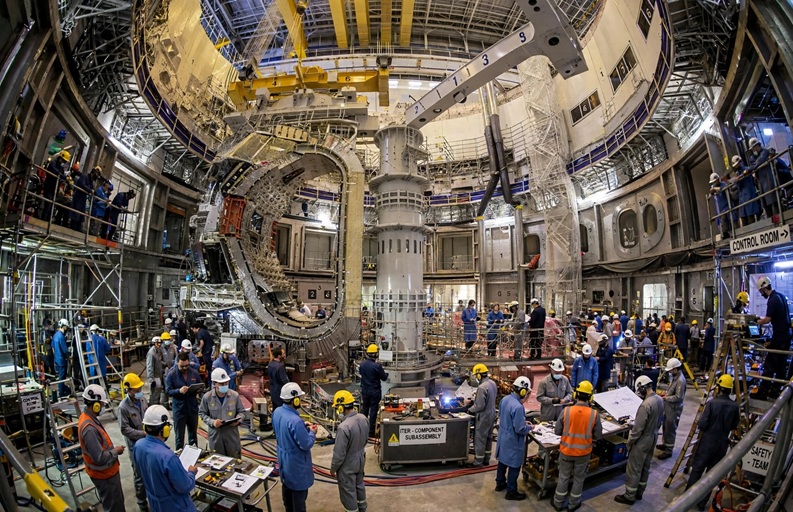
The physics is straightforward. The engineering is not. The materials surrounding the plasma have to survive an extraordinarily hostile environment of heat, high energy neutrons and electromagnetic forces. They will gradually become damaged and radioactive through neutron activation.
Fusion is not radiation free. That is another important correction to the popular sales pitch. Fusion does not produce the enormous quantities of long-lived transuranic waste associated with conventional fission reactors and the primary helium product is harmless, but the reactor itself becomes radioactive.
The difference is that fusion’s radioactive waste is expected to be dominated by activated structural materials rather than spent fuel containing plutonium and other transuranic elements. ITER describes the resulting waste as very low, low or medium activity and notes that much of the radioactivity could decay substantially over a period of decades to roughly a century, depending on the materials used.
That is a very different waste problem, but it is not waste free.
Then There is Tritium
Remember those two hydrogen isotopes we were talking about? Deuterium is abundant. There is a lot of it in seawater. Tritium is another story.
Tritium is radioactive and naturally occurs only in trace quantities. Its half-life is about 12.3 years and the world does not have enough tritium sitting around to fuel a fleet of commercial fusion reactors.
A future fusion plant will have to make its own. This is where lithium enters the story. The high energy neutrons produced by the fusion reaction can interact with lithium in a surrounding breeding blanket, producing new tritium. That tritium can then be extracted and fed back into the reactor. In other words, the reactor has to manufacture its own fuel while it is operating. We have not yet demonstrated that entire process at commercial scale.
ITER is intended to help test the technology, including prototype tritium breeding blankets. A future commercial plant will have to demonstrate that it can produce enough tritium to sustain its own operation, while also recovering and recycling it efficiently.
That is not a footnote. That is one of the central engineering problems.
Then There is the Slight Problem of Electricity
This may be the most important hurdle of all.
A fusion experiment that produces more fusion energy than the energy used to heat the plasma is a tremendous scientific achievement. A fusion power plant has to produce more electricity than the entire facility consumes. Those are very different milestones.
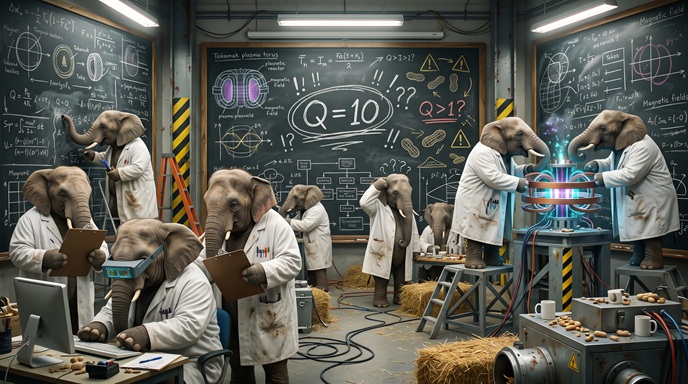
ITER, for example, is designed to produce about 500 megawatts of fusion power from 50 megawatts of input heating power in the plasma, a target often described as Q = 10, but ITER will not generate electricity for the grid. It is an experiment.
The electricity required to run its magnets, heating systems, cooling systems, cryogenics and other equipment is a separate engineering problem. ITER itself notes that commercial fusion plants will ultimately have to account for all of those parasitic loads when calculating their actual electrical output.
That is the difference between scientific breakeven and engineering breakeven and engineering breakeven is the number that your electric utility actually cares about. Nobody at the power company is going to accept “Q equals 10” as payment for your electricity bill.
So, are We There Yet?
No, but this time I am considerably more optimistic than I would have been thirty-seven years ago when the cold fusion news broke. We have gone from asking whether controlled fusion is physically possible to arguing about how to engineer it. That is the definition of progress.
The 2022 NIF experiment demonstrated ignition at the target. Tokamaks and stellarators are demonstrating increasingly impressive plasma confinement. Researchers are learning how to operate plasmas for longer periods. Materials scientists are working on components capable of surviving the neutron environment. Engineers are developing tritium breeding blankets. Private companies are now throwing serious money at fusion concepts that would have sounded ridiculous a generation ago.
None of that means commercial fusion is imminent. It means the problem has changed. We are no longer trying to prove that fusion exists. We are trying to make fusion useful. That’s a much better problem to have.
The Two Elephants
So I am back to the two elephants. Fission already works. It produces enormous quantities of reliable electricity, but it also produces radioactive spent fuel and requires us to manage that material for a very long time.
Fusion offers an extraordinarily attractive alternative. Its fuel is abundant, its primary reaction products are helium and neutrons and it does not produce the same kind of long lived radioactive waste associated with fission, but fusion has a rather inconvenient personality trait. It doesn’t currently produce useful electricity. It is the world’s most sophisticated science project with a very expensive heating bill.
The 1989 cold fusion experiment promised that we could skip all the difficult parts. It turned out that we couldn’t. The 2022 ignition experiment showed that one of the hardest parts really could be done. The long duration plasma experiments are showing that another hard part is getting better.
Now comes the tedious part. Materials. Fuel breeding. Heat removal. Maintenance. Reliability. Economics. Eventually, we will have to figure out how to put electricity on a grid without requiring a national laboratory and a few thousand scientists standing around the machine praying to the gods of plasma stability. That is where fusion will either become a power technology or remain the greatest science experiment that never quite grew up.
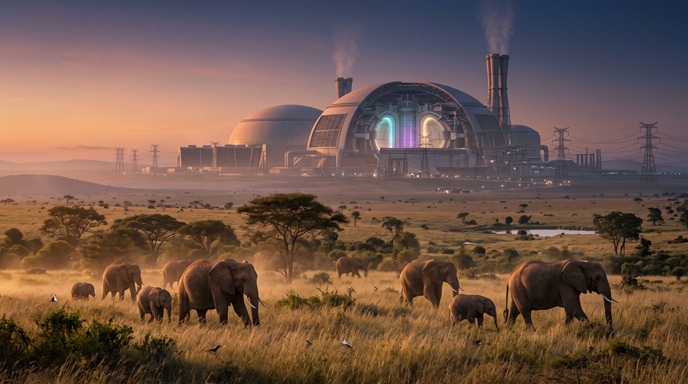
I wouldn’t bet against it. I also won’t build my retirement plan around it. Not yet. But someday, somewhere, that rainbow pooping elephant may actually show up at the power plant and when it does, I suspect we are going to discover that the really interesting part wasn’t making fusion. It was making fusion boring, because the ultimate victory will not be a record setting plasma. It will be a switch on the wall.
You flip it.
The lights come on.
Nobody has to care how the elephant did it.
Discover more from Tales of Many Things
Subscribe to get the latest posts sent to your email.