
Survey a group of city dwellers about a backcountry rescue and you’ll probably hear some familiar answers.
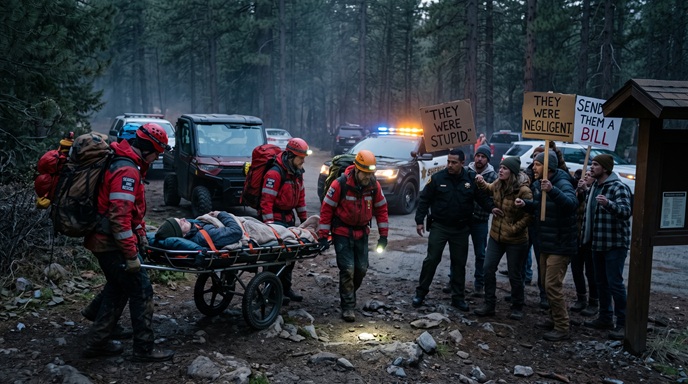
“They were stupid.”
“They were negligent.”
“Send them a bill.”
It comes up again and again. Someone gets lost. Someone twists an ankle. Someone heads into the mountains without enough clothing, water, food, experience or perhaps just not enough good judgment.
When the rescue makes the news, somebody inevitably asks, “Who is going to pay for all this?”
It’s a reasonable question. Search and rescue can be expensive. There may be dozens of responders, vehicles, specialized equipment, aircraft, law enforcement, dispatchers, medical personnel and hours (or sometimes days) of work involved, but there is another question that matters a lot more.
What happens if someone is afraid to call for help because they think they can’t afford the rescue?
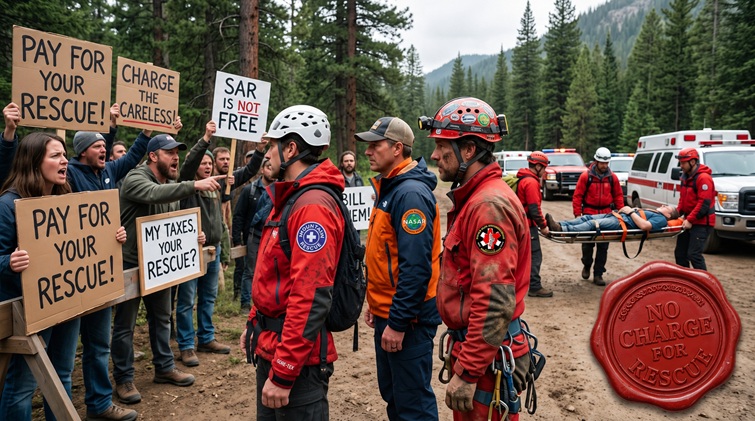
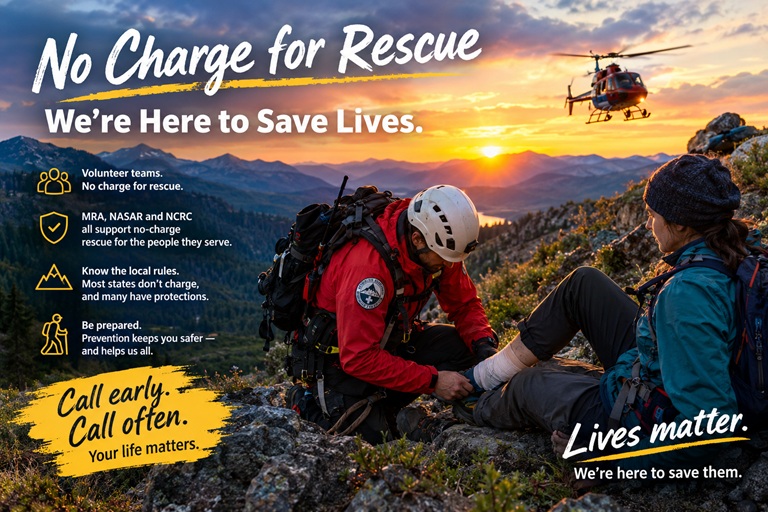
That question is one of the reasons search and rescue generally does not charge the person being rescued.
The Bill That Never Gets Sent
The perception that a backcountry rescue automatically comes with a four- or five-figure bill is surprisingly common and that perception can be dangerous.
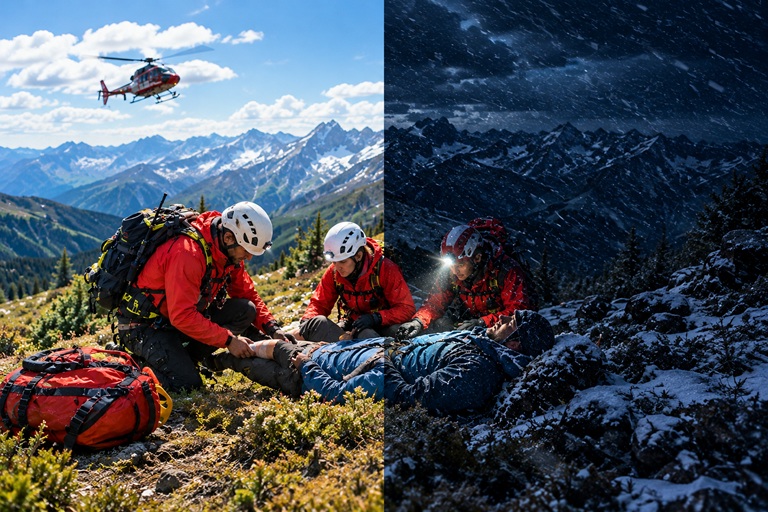
A hiker rolls an ankle at 3 PM. The weather is good. They are uncomfortable, but maybe they can limp another mile or two. They decide to wait. The sun starts going down. The temperature drops. The terrain gets more difficult. That sprained ankle isn’t getting better. It’s actually getting worse from overuse.
What was a relatively straightforward daylight evacuation is becoming a nighttime operation. Now the subject is colder, more exhausted, dehydrated, potentially more injured and the rescuers are dealing with darkness, changing weather and a much harder environment.
The Mountain Rescue Association has been making essentially this argument for decades. Fear of being charged can delay a call for help and that delay can increase the danger to both the person in distress and the rescuers.
From personal experience, I can tell you that a 3 PM rescue is a lot easier than a 3 AM rescue. That isn’t just about convenience. It’s about safety, ease of access, temperatures.
Call early. If something has gone seriously wrong, don’t spend six hours trying to determine whether you can afford to be rescued. Call for help. You might save yourself a lot of pain. You might prevent a minor injury from becoming a major one. You might make the rescue substantially safer for the people coming to find you.
We Aren’t Coming to Judge You
There is another misconception about search and rescue that is begging to be retired.
We’re not coming to give you a lecture. We’re not going to rescue you, load you into the ambulance and then call your boss. We’re not going to call your friends and tell them what you did. We’re certainly not going to call your significant other and announce that the reason you’re spending the night on a mountain is because you thought hiking in flip-flops was a good idea.
You may see rescue stories on the news all summer long, but there’s an important detail people often miss. Those stories usually exist because somebody wanted the story told. Search and rescue’s default setting isn’t to run to the press and announce what happened to you.
Our job is much simpler. Find you. Stabilize you. Get you somewhere safe. Go home. You may have a one-in-a-million story. Actually, you probably do. No two rescues are alike. I’ve had two missions, four days apart, in the same place, looking for the same person, effectively staffed by the same responders and they were completely different missions. That’s one of the things that makes search so interesting. It is also one of the reasons we don’t pretend we can look at a rescue afterward and neatly divide the subject into categories like inexperienced, reckless or negligent.
Sometimes it was inexperience. Sometimes it was recklessness. Sometimes it was bad luck. Usually, it was some combination of all three. Add weather, terrain, equipment, companions, fatigue, navigation, a medical condition nobody knew about, the phase of the moon, possibly space aliens, if Smaug happened to be out looking for more treasure that day. That probably wouldn’t help either.
The point is that humans are complicated. So are emergencies. We’re not coming to conduct your trial. We’re coming to get you home.
So, is There a Charge?
Here’s where the answer gets a little less satisfying. I want to simply say, “No”. In many places, that is exactly the right answer. In my state, for example, backcountry search and rescue teams do not charge for their services. Our search and rescue organizations explicitly describe rescue as a public good and point to the danger of delaying a call because of fear of a bill.
The Mountain Rescue Association, likewise, maintains a longstanding position against charging subjects for the cost of their rescue. Its member teams have always performed rescues without charging the people they assist. The same is true for the National Association for Search and Rescue and for the National Cave Rescue Commission. All of these non-profits are looking to get distressed individuals to safety.
The problem is that the United States doesn’t have one national search and rescue billing policy. State law matters. Some states have laws that allow government agencies to seek reimbursement under specific circumstances, particularly when extraordinary resources are used or when someone’s intentional or reckless conduct meets particular legal requirements.
California, for example, permits certain counties to seek reimbursement when extraordinary rescue methods are required and the incident resulted from an intentional violation of law that led to a criminal conviction.
Utah takes a different approach, with a statewide Search and Rescue Assistance program that can reimburse counties for eligible rescue expenses. Its program also provides protection for participants except in circumstances involving reckless or intentional conduct.
New Hampshire takes perhaps the most publicized and widely misunderstood approach to rescue billing. Under state law, the Fish and Game Department is authorized to recover search and rescue costs if a person acts negligently or disregards public safety warnings. The state aggressively pursues reimbursement in high profile cases of clear negligence, which frequently makes national headlines and fuels the myth that every rescue comes with a bill. What gets left out of those news clips, however, is the state’s voluntary prevention mechanism, the Hike Safe card. For a nominal annual fee, hikers and outdoor enthusiasts can purchase a card that exempts them from reimbursing rescue costs if they accidentally run into trouble, barring intentional or criminal acts. Even in a state known for enforcing financial responsibility, the primary goal remains supporting the rescue system through preparation rather than penalizing people for making an honest mistake.
In other words, there are exceptions, but the idea that every time you need rescue you are going to receive a massive bill from the county is simply not how most volunteer backcountry SAR systems work. Even where cost recovery laws exist, that does not mean every rescued hiker is routinely billed. The details depend on the jurisdiction, the circumstances and the agency involved.
If you’re heading into the backcountry, learn the rules where you’re going. Even in states that have recovery laws, there may be an inexpensive permit that you can obtain which will cover rescue costs. Most importantly, don’t sit injured on a mountainside wondering whether you should call 911 because somebody on social media told you rescue costs $20,000.
Think of It Like the Fire Department
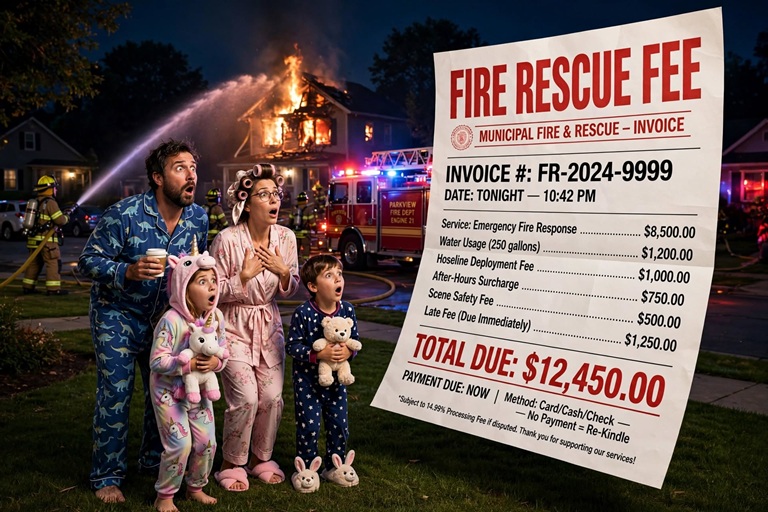
Here’s a simpler way to think about a rescue. If your house catches fire and you call the fire department, the firefighters don’t arrive with a credit card reader. “Before we put out the flames, will it be Visa or Mastercard?”
If you witness a crime and call the police, the officer doesn’t hand you an invoice for responding. These services are free to you and the entire community.
Search and rescue operates on much the same principle. We’re an emergency service. We don’t ask whether you deserve to be rescued. We ask what needs to happen to get you safe. That doesn’t mean the rest of the emergency response system is free and this distinction is important.
If we get you off the mountain with a broken leg, the leg is still broken when we reach the trailhead. Medical treatment is a separate matter. An ambulance may charge. A helicopter medical transport may charge. A hospital may charge. Your health insurance may or may not cover all of those costs.
Those are medical expenses. The rescue itself is a different thing.
For many areas search and rescue organizations specifically note that other resources brought into a rescue, such as ground or air ambulances, can have costs even when the search and rescue team’s services do not, so don’t confuse “no charge for rescue” with “nothing associated with this emergency can ever cost money”. That’s not what it means.
The Best Rescue is the One We Never Have to Run
There is an irony here. Search and rescue doesn’t actually want more rescues. We’re not thrill seeking adrenaline junkies with a hero complex. We want fewer rescues.
You may see us at a trailhead asking whether you checked the weather. We may ask whether you have enough water, whether you have extra layers, whether you brought a headlamp, whether someone knows where you’re going, whether you have the Ten Essentials.
That isn’t because we’re trying to keep you off the mountain. Quite the opposite. We want you to enjoy the outdoors as much as we do. We just want you to come home safe. To us rescue is important, but prevention is better. Every rescue prevented is one less night someone has to spend on a mountain, one less family waiting for a phone call, one less team of volunteers getting out of bed at 2 AM, one less responder exposed to cold, rockfall, lightning, avalanche, exhaustion or a dozen other hazards. And yes, one less night when the rest of us look like we spent it in a bar fight when we show up for our day jobs the following morning.
We like those quiet nights. So do our families.
We Pay It Back
Most SAR responders aren’t doing this because we think people deserve to be punished for making mistakes. We’re volunteers. We give our time. We train. We buy our own equipment. We get called away from dinner, holidays, family, sleep and work. We do it because somewhere in our own lives there’s a story.
Maybe somebody rescued us. Maybe somebody helped our family. Maybe somebody taught us what preparedness really means. Maybe we simply reached a point where we realized that if we have the ability to help another human being, we should.
So we pay it back and we pay it forward. That’s what “no charge for rescue” means to many of us. It doesn’t mean poor decisions don’t have consequences. They do. It doesn’t mean we don’t want outdoor enthusiasts to be prepared. We absolutely do. It doesn’t mean taxpayers, volunteers and communities aren’t carrying real costs. They are.
It means something more fundamental. Your life is worth saving whether or not you made every decision correctly.
When you’re cold, injured, lost, scared or simply in over your head, we don’t want you doing the math. We don’t want you wondering whether you’re going to get a bill. We don’t want you trying to crawl another five miles across broken terrain because you’re afraid that asking for help will bankrupt you.
We want you to call, because every minute matters. Every hour matters. Daylight matters. Weather matters. Sometimes the difference between a difficult rescue and a tragedy is nothing more complicated than someone deciding “I need help”.
Call. We’ll figure out the rest and if we can teach you something afterward, we’ll do that too, because lives matter. That’s why we’re here.
We’re here to save them.
Discover more from Tales of Many Things
Subscribe to get the latest posts sent to your email.