
Every year, twice a year, we participate in one of the strangest government sponsored rituals of modern civilization. We change the clocks.
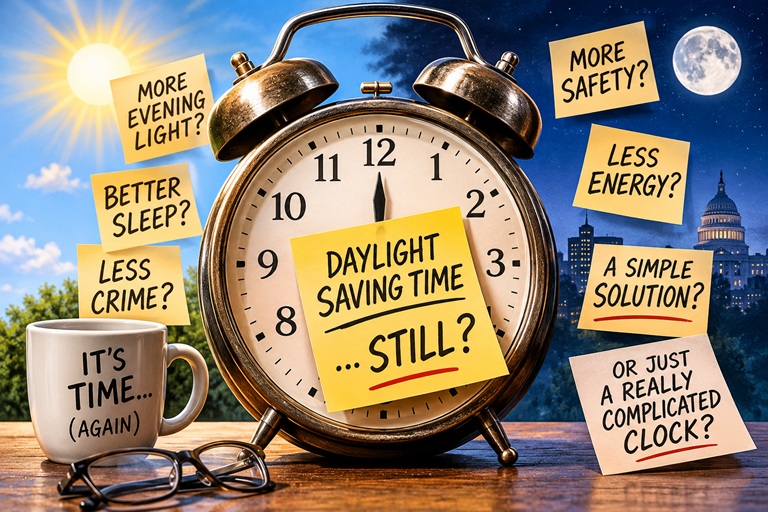
Today, we fell back to Standard Time, dutifully moving the hands of our clocks backward one hour. Somewhere, millions of people are celebrating an extra hour of sleep. Others are wondering why it gets dark before they’ve finished their afternoon tea. Virtually everyone is asking the same question, why are we still doing this?
It’s 2026. We have artificial intelligence, semi-autonomous vehicles, reusable rockets, gene editing and computers that can process more information in a second than entire generations of humans could process in their lifetimes, but apparently, we still haven’t figured out what time it should be.
Let’s take a look at how we got here.

A Brief History of Moving the Clock Hands
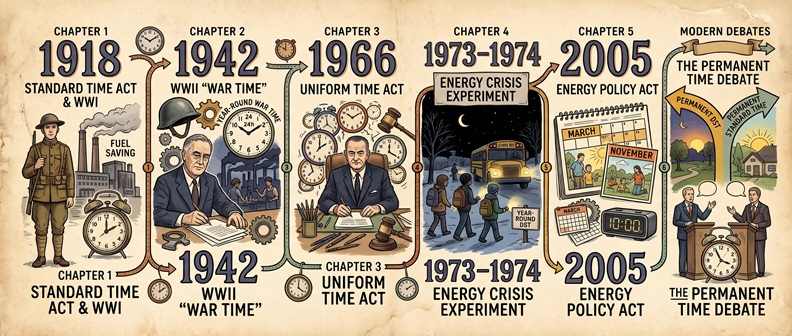
The United States first established Daylight Saving Time (DST) through the Standard Time Act of 1918. The legislation officially established U.S. time zones and introduced DST as a wartime measure intended to conserve fuel and electricity during World War I.
The public wasn’t particularly enthusiastic. Agricultural interests and other groups objected and Congress repealed DST in 1919 over President Woodrow Wilson’s veto. Time zones, however, remained.
Following the attack on Pearl Harbor, President Franklin D. Roosevelt reintroduced year-round DST in 1942. It was called “War Time” and remained in effect continuously until September 1945.
After the war individual communities and states adopted their own arrangements, creating a confusing patchwork of local time observances. Transportation companies and federal regulators eventually decided enough was enough.
In 1966 President Lyndon B. Johnson signed the Uniform Time Act, establishing a consistent national framework for observing DST. States could opt out entirely, which Hawaii and most of Arizona eventually did.
Then came the energy crisis of the 1970s. In December 1973 President Richard Nixon signed legislation establishing a two year experiment with year-round DST. The idea was to conserve energy by giving people more daylight in the evening.
It sounded wonderful, until winter arrived. Children were waiting for school buses and walking to school in darkness. Safety concerns mounted, public support evaporated and Congress intervened. Standard Time was temporarily restored during the winter of 1974-1975. Apparently, the sun hadn’t received the memo.
In 2005 Congress passed the Energy Policy Act, extending DST. Beginning in 2007 clocks would spring forward on the second Sunday in March and fall back on the first Sunday in November.
So here we are, all on the same schedule and still confused.
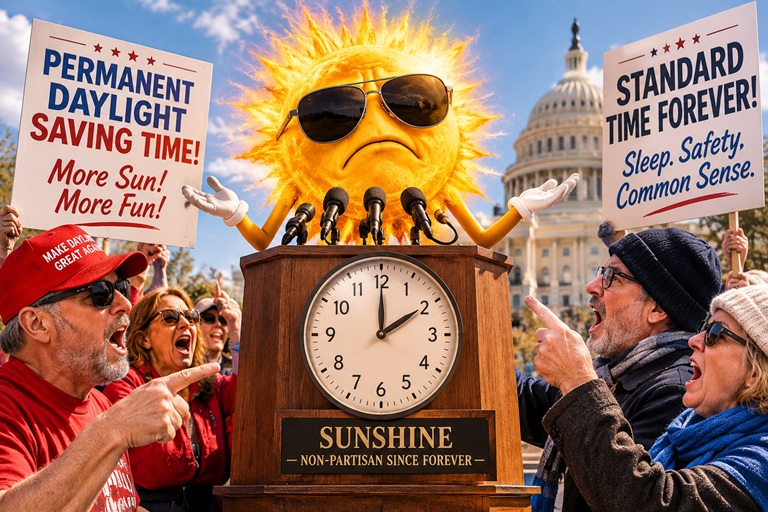
In March 2022 the Senate unanimously passed the Sunshine Protection Act which would have made DST permanent. The legislation went nowhere in the House. More recently, the 2025 version of the bill passed the House in July 2026, only to encounter resistance in the Senate. I understand not being able to agree on economic policy or foreign policy, but this is two bodies of the legislative branch playing volleyball with an old style alarm clock.
So, after more than a century of debate, we’re still trying to figure out how to set the clock on the microwave.
The Great Debate: Which Clock Is the Right Clock?
There are essentially two camps. One wants permanent Daylight Saving Time. The other wants permanent Standard Time. Both have arguments, both have supporters and both have managed to turn an incredibly simple question into a political, economic, medical and philosophical debate.
The Case for Permanent Daylight Saving Time
The argument is relatively straightforward. People generally prefer daylight in the evening. Later sunsets mean more opportunities to shop, dine out, play golf, exercise, take the kids to the park or enjoy outdoor activities after work.
Businesses like the additional evening activity. Retailers and restaurants potentially benefit from increased foot traffic. Some studies also suggest that daylight during evening commuting hours can reduce certain types of crime and traffic accidents.
Historically, another argument was energy conservation. If people have more daylight in the evening, they need less artificial lighting. It’s a convenient idea. More sunshine, more outdoor activity, more economic activity. What’s not to like?
Well, winter mornings, for starters.
The Case for Permanent Standard Time
Sleep scientists and organizations such as the American Academy of Sleep Medicine favor permanent Standard Time. Their argument is based on human biology.
Our circadian rhythms are influenced by exposure to natural light. Morning sunlight helps synchronize our internal biological clocks, promotes alertness and helps regulate our sleep-wake cycles. Excessive evening light can delay melatonin production and interfere with sleep.
Permanent DST would shift sunrise an additional hour later during the winter. In northern parts of the country, children could be heading to school in darkness well into the morning. That isn’t just an inconvenience. It raises legitimate concerns about pedestrian safety, traffic accidents and the health consequences of disrupting our natural sleep patterns.
There are also concerns for people who work outdoors, particularly those whose shifts begin early in the morning.
So, one side wants more daylight after work. The other wants more daylight before work. Congratulations. We’ve managed to turn sunlight into a partisan issue.
The Science Isn’t Particularly Ambiguous About One Thing
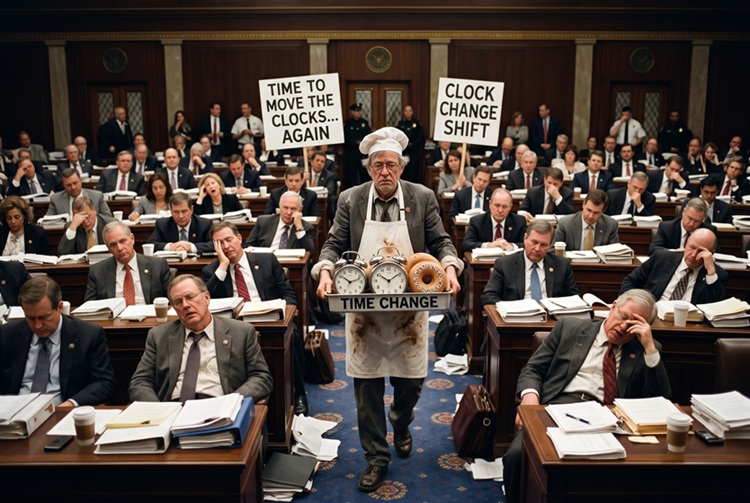
The twice yearly clock change itself has consequences. Research has associated the spring transition with increased heart attack risk, traffic accidents, sleep disruption and workplace injuries. The evidence isn’t equally strong for every claimed consequence and the broader research isn’t entirely consistent, but there is enough evidence to make the twice yearly disruption difficult to defend.
The American Academy of Sleep Medicine has explicitly recommended eliminating seasonal clock changes in favor of permanent Standard Time.
Even if you disagree about which permanent arrangement is best, deliberately disrupting people’s sleep schedules twice a year isn’t exactly a brilliant public health strategy.
Then there’s the original justification, energy conservation. The theory made sense in an era when lighting was a substantial part of household energy consumption. More daylight in the evening meant fewer hours using candles, gas lamps and eventually incandescent light bulbs.
Except we’ve changed.
Modern LED lighting uses a fraction of the electricity consumed by older lighting technologies. Heating and cooling, appliances, electronics and other household demands have become much more significant considerations.
In other words, the energy argument that helped justify DST in 1918 isn’t nearly as compelling in 2026. We’re still rearranging our lives around an energy saving theory developed when people were lighting their homes with technology that predates the television.
We’ve Changed, but Time Hasn’t
This is where I think the entire debate goes off the rails. We keep trying to find a solution that accommodates everybody. Why?
People don’t all work the same hours. They never have. If you work in an office, your hours might be 8 AM to 5 PM. If you’re a baker or a barista, you might start at 4 AM and finish around noon. If you’re a bartender, your workday might run from 6 PM until 2 AM.
News anchors cover morning and evening broadcasts. Hospital employees work 7-to-7 shifts. Firefighters pull 24 hour shifts every third day. Actors and theater employees often work when everyone else is going home. A lot of these people don’t particularly care when the sun comes up or goes down.
Years ago I supported a project in France. I worked the graveyard shift because that was their business day. When my coworkers were arriving at 8 AM, I was packing up to go home. When the sun was shining outside, I was sleeping with a blanket pulled over my head to keep the light out. The sun didn’t care. Neither did my employer. We simply adjusted our schedules to accommodate the work.
Today, my current employer operates on three continents. We literally “follow the sun”. I have teammates in five different time zones. Not just coworkers. Teammates. People working on the same projects, sharing responsibilities and collaborating throughout the day. The twice yearly transition between Daylight Saving Time and Standard Time is a pain in the ass. (Forgive my English.)
Why? Because not everyone in the world changes their clocks on the same schedule. Some locations don’t observe DST at all, others change on different dates and every time somebody moves a clock, our carefully coordinated schedules need to be reconsidered.
We’ve built a global economy that operates around the clock, but we’re still arguing about whether the sun should set at 5 PM or 6 PM according to a number printed on a clock. We’ve moved beyond the agrarian society that helped shape our original assumptions about time. The old convention of being up with the chickens and going to bed with the chickens doesn’t describe modern life anymore.
Besides, modern chickens have very different schedules, too.

What If We Stopped Thinking About Time That Way?
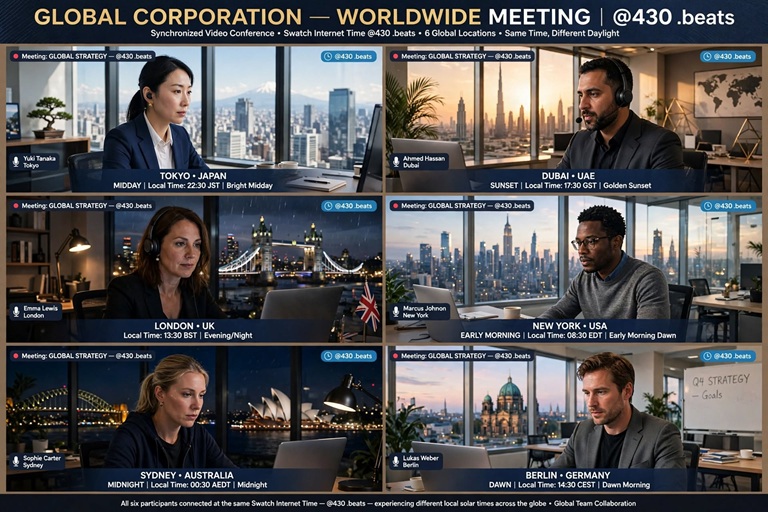
In 1998, the Swiss watchmaker Swatch introduced an interesting experiment called Swatch Internet Time. The idea was to eliminate time zones and conventional hours and minutes in favor of a universal system. Instead of dividing a day into 24 hours, Swatch Internet Time divides it into 1,000 units called “.beats”. One .beat equals exactly 86.4 seconds, a long minute, in effect.
The day begins at midnight in Biel, Switzerland, the home of Swatch. That’s designated @000. Noon is @500 and the day ends at @999, before starting over again. The interesting part? There are no time zones. If it’s @700 in New York, it’s @700 in Tokyo, Paris, London and in Biel, Switzerland. The local clock might say 8 AM in one location and 3 PM in another, but both locations would agree that it’s @700. The reference is universal. The local schedule is not.
Think about that for a moment. I could schedule a meeting with someone in Germany at @430. Someone in Japan could join at precisely the same moment. Nobody needs to calculate whether Berlin is four or five hours ahead of New York, whether Europe has changed its clocks or whether somebody forgot that Arizona doesn’t observe Daylight Saving Time.
My workday could start at @583 and end at @958. I’d even be willing to go @580 to @960! I wouldn’t need AM or PM. I wouldn’t need to worry about the local time in another country. It’s a universal reference.
Of course, this doesn’t mean the sun rises at the same local time everywhere. It doesn’t mean everyone should work the same hours or eat dinner at the same time. I could have coworkers hop on at @900 and work until @280 in one “time zone” and go @250 to @630 in another! This method simply separates the measurement of time from the local conventions we use to organize our lives.
That makes a tremendous difference. Swatch Internet Time never became a mainstream standard, but the underlying concept is worth considering. We already use UTC as a common reference for aviation, computing, science and international coordination. We don’t need to reinvent timekeeping. We need to recognize that different applications have different requirements. UTC and non-locational reference systems already prove we can separate global coordination from local schedules.
Time is a measurement. Our schedules are a social convention. Daylight is a physical phenomenon. We’ve confused the three.
The Problem Isn’t the Clock, It’s Us
What I find particularly amusing is this entire debate. We have spent more than a century arguing about how to rearrange an hour. We’ve conducted experiments. We’ve passed legislation. We’ve repealed legislation. We’ve studied energy consumption, traffic accidents, crime rates, economic activity and human circadian rhythms.
We’ve even managed to make it a political issue and yet, the fundamental problem hasn’t changed. People have different schedules. Different jobs. Different lifestyles. Different relationships with daylight. There is no magical clock arrangement that makes everybody happy.
Permanent Daylight Saving Time has advantages and disadvantages. Permanent Standard Time has advantages and disadvantages. The current arrangement manages to combine some of the disadvantages of both while adding the inconvenience of changing clocks twice a year. That’s quite an accomplishment.
I don’t particularly care whether we settle on permanent Standard Time or permanent Daylight Saving Time. I have preferences and I understand the scientific arguments favoring Standard Time. What I do care about is ending an unnecessary ritual that disrupts millions of lives twice a year.
We should be able to agree on a consistent system of timekeeping without pretending that changing the clock changes the amount of daylight available.
The Earth will continue rotating. The seasons will continue changing. Sunrise and sunset will happen whether Congress approves or not. Perhaps it’s time we stopped trying to legislate the sun. After all, it’s been doing its job quite successfully for about 4.5 billion years and it hasn’t changed its clock once.
Discover more from Tales of Many Things
Subscribe to get the latest posts sent to your email.