
My wife and I were sitting in a restaurant when the kid at the next table asked a perfectly reasonable question. “Why are the oceans salty?”
It’s a good question. It’s the kind of question that has occupied geologists, oceanographers, chemists and other people who get genuinely excited about rocks and water for considerably longer than anyone has occupied a restaurant booth. To be honest, I wanted to hear the answer, too.
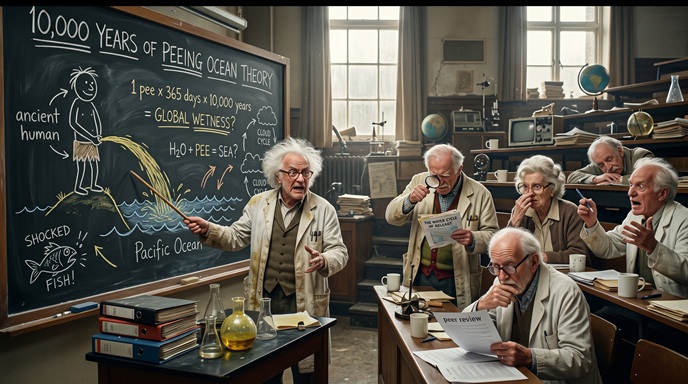
The child’s father didn’t hesitate. “Because people have been peeing for ten thousand years and it’s all been running downhill.”
That’s the answer that makes you squirt whatever you were drinking out of your nose.
I definitely have questions. Not about the ocean. We have actual scientists for that. I have questions about the man who just delivered that answer with the confidence of someone explaining the quadratic equation to a room full of Nobel laureates.
Was it a desperate attempt to get his kid to be quiet and focus on his fries? Was it an honest admission of ignorance disguised as a plumbing metaphor? Was he testing a new theory of oceanography and hoping the peer review process would be distracted by the appetizers? Or, and this is the possibility that concerns me most, did he actually believe it?
Because somewhere between “I don’t know” and “the Earth is a giant port-a-potty”, we seem to have misplaced our collective appreciation for the difference between an answer and a sentence that happens to contain nouns and verbs.
Naturally, I had to investigate. For science. And because I couldn’t get out of my head the image of eight billion people standing on the continental divide, peeing downhill.

First, Let’s Talk About the Plumbing
The basic theory seems straightforward enough.
Humanity urinates. Gravity does its thing. Water flows downhill. Eventually, all the pee arrives in the ocean, where it accumulates until the planet’s largest bodies of water achieve their distinctive salty flavor.
It’s an elegant theory, provided you ignore geology, chemistry, hydrology, the water cycle and the inconvenient fact that the human race has not been around nearly long enough to explain the age of the oceans.
Let’s be generous in our assumptions. Let’s assume our father of the year is correct about the general mechanism and investigate whether the numbers support his hypothesis.
First, we need to know how salty urine actually is.
The Science of Wee
Human urine contains water, dissolved minerals, waste products and various other substances your kidneys have decided your body would prefer not to keep. Its composition varies with diet, hydration, health and a number of other factors, normally ranging from 2 parts per thousand to 9 parts per thousand. For the sake of argument, let’s assign our hypothetical urine a dissolved salt concentration of 5 grams per liter. That’s a deliberately simplified assumption, not a universal measurement of human urine.
Seawater, by comparison, contains roughly 35 grams of dissolved salts per liter. Our hypothetical urine is therefore much less concentrated in dissolved salts than the ocean.
Already, Houston, we have a problem.
If you fill an empty ocean basin with urine, you don’t get an ocean with normal ocean salinity. You get an enormous, faintly yellow, mildly concerning body of liquid with a dissolved salt concentration considerably below that of seawater.
And here’s another hiccup in the theory. You can keep peeing into the ocean until the cows come home. You can invite the cows to participate, too. You can recruit every mammal on the planet and establish a global initiative called Project Golden Shower.
The concentration won’t increase just because you add more liquid of the same concentration. Five grams of salt per liter times a billion liters is a lot of salt, but it’s still five grams per liter. Chemistry is annoyingly indifferent to enthusiasm.
So, technically, the father wasn’t just wrong about the timescale. His entire mechanism fails the basic arithmetic test.
Let’s not stop there. We still have oceans to fill.

How Much Pee Would It Take to Make an Ocean?
The world’s oceans contain approximately 1.335 billion cubic kilometers of water. That’s 1,335,000,000 cubic kilometers. I wrote the number out because scientific notation can make absurd quantities feel abstract. Adding all those zeros makes them feel absurd in a more personal way.
Let’s imagine emptying the ocean basins and refilling them with our hypothetical urine. To produce the same total mass of dissolved salt found in the oceans, we’d need approximately seven ocean volumes of urine at our assumed concentration of 5 grams per liter.
That’s about 9.35 billion cubic kilometers of urine. Seven oceans’ worth. Humanity has apparently been underperforming.
Of course, we can’t simply pour seven oceans of urine into the existing ocean and expect the salinity to reach 35 parts per thousand. We’d be diluting the very thing we’re trying to concentrate.
We’d have to collect all that urine, extract the dissolved salts and get rid of most of the water. Imagine the industrial infrastructure. The world’s largest desalination plants would look like your neighbor’s kids’ soapbox lemonade stand. We’d need a processing facility so enormous that the phrase “employee restroom” would take on a whole new meaning.
And then we’d need to evaporate approximately six-sevenths of our collected liquid to leave enough concentrated material to fill the ocean basins at the desired volume and salinity. We have now officially reached the point where a child’s question has become a planetary scale waste management proposal.
Let’s see how long the collection phase would take.
A Modest Proposal for the Next 2.3 Billion Years
Suppose eight billion people each produce approximately 1.4 liters of urine per day. That’s about 11.2 billion liters every day. It’s a staggering amount of pee, by any reasonable standard. Wastewater processing plant managers are cringing at the very thought.
At that rate, collecting the equivalent of seven oceans of urine would take roughly 2.3 billion years. Two. Point. Three. Billion. Years.
That’s long enough for continents to rearrange themselves, mountain ranges to rise and erode and entirely new forms of life to evolve, become dominant, invent plumbing and begin asking why the oceans are salty all over again.
Meanwhile, we’re supposed to believe ten thousand years of human urination did the job? Ten thousand years is barely a rounding error on this particular timeline. It’s the scientific equivalent of arriving at work three seconds early and claiming you built the building before the next person arrives.
Given the father’s hypothetical proposal, we would need an unlimited supply of patience and a very large collection bucket and humanity would need to keep at it for hundreds of thousands of times longer than recorded civilization has existed.
That’s before we get to the part where urine isn’t actually a suitable substitute for the mineral composition of seawater.
At this point, I think we can safely retire the theory, unless the father was referring to an undocumented civilization of immortal giants with kidneys the size of military heavy lift cargo planes, in which case, I’ll ask to see the peer reviewed literature.

So, Why are the Oceans Salty?
Here’s where things get genuinely interesting, for a scientist, anyway.
Oceans didn’t become salty because the planet has been used as a communal urinal. They became salty through a combination of geological processes operating over immense periods of time.
Unlike our proposed alternative, these processes have the advantage of being real.
- Rain is a Very Slow Rock Thief
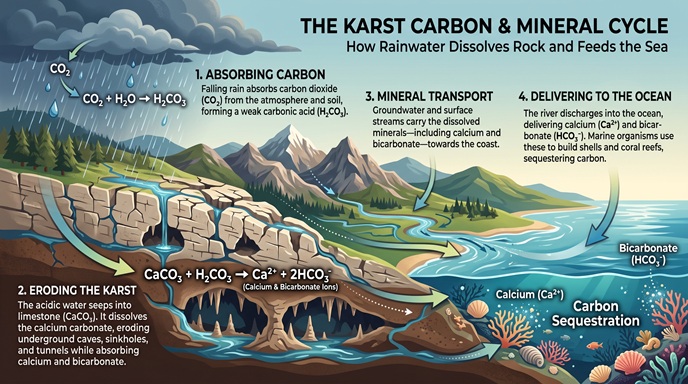
Rainwater isn’t chemically pure. As it forms and falls through the atmosphere, it absorbs carbon dioxide, forming a weak acid called carbonic acid. When that rain hits rocks, it gradually reacts with their minerals, breaking them down and releasing dissolved ions.
Some of those ions include sodium and chloride, the familiar components of table salt. Others include calcium, magnesium, potassium and bicarbonate.
Streams and rivers carry these dissolved materials toward the sea. Each river contributes a little. Then another river contributes a little. Then another. Repeat this process for millions and billions of years and the ocean receives a truly impressive mineral delivery service.
It’s not particularly fast. Nobody is going to make a fortune by investing in a company that promises to dissolve the Rocky Mountains by Tuesday.
Given enough time, the process adds up. The Earth is very good at doing small things for an offensively long time.
- The Sun Runs a Very Effective Water Recycling Program
Here’s the other half of the equation.
Water evaporates from the ocean, rises into the atmosphere, forms clouds and eventually returns to the surface as precipitation. What’s important is that when water evaporates, most of the dissolved salts stay behind. Evaporation doesn’t create salt. It concentrates the dissolved material already in the water.
The ocean is essentially running a natural separation process on a planetary scale. Water goes up. Most dissolved salts don’t. Rain then weathers more rock, rivers carry more dissolved minerals to the sea and the cycle continues.
It’s a little like boiling a pot of salty water until the water disappears and the salt remains, except the pot is the size of the Earth, the heat source is a star and the process has been running for geological ages.
However, the ocean isn’t simply getting saltier forever. There are processes that remove dissolved material, too.
Which brings us to the ocean’s underground plumbing.
- The Ocean has a Geothermal Plumbing Problem
Beneath the waves, seawater circulates through cracks in the ocean floor and interacts with hot rock. At hydrothermal vents, heated water dissolves some minerals and triggers chemical reactions that can either add substances to seawater or remove them. Undersea volcanic activity also contributes materials to the marine environment.
The ocean floor is not just the bottom of a giant bathtub. It’s an active chemical interface between the water above and the planet below. Unlike the hypothetical urine theory, this explanation doesn’t require billions of years of humanity holding its collective bladder. It does, however, require a basic understanding of geology.
Apparently, we can’t have everything.
- Why Doesn’t the Ocean Get Saltier Forever?
This is the question that makes the whole subject more interesting than it initially sounds.
If rivers continuously carry dissolved material into the sea, why hasn’t the ocean become so salty that it’s automatically brining all the fish in it? The answer is simple. The ocean is part of a dynamic churning system.
Minerals are removed through chemical reactions, interactions with seafloor rocks, incorporation into sediments and biological processes. Some materials become part of shells and skeletons. Others are buried or transformed through geological processes.
The balance varies across different substances and timescales. Ocean salinity has changed throughout Earth’s history and individual regions of the ocean can be considerably saltier or fresher than the global average.
The modern ocean has a broad, relatively stable average salinity because the processes adding dissolved material and the processes removing it operate together. Nature, as it turns out, has been managing the situation for quite a while. No committee meetings. No budget overruns. No press conference announcing the launch of the Global Urine Mitigation Initiative.
Just geology.
Wait. Why is Pee Salty, Anyway?
Before we leave our original theory behind, there’s one more question worth asking. If the oceans aren’t salty because of urine, why does urine contain salt in the first place?
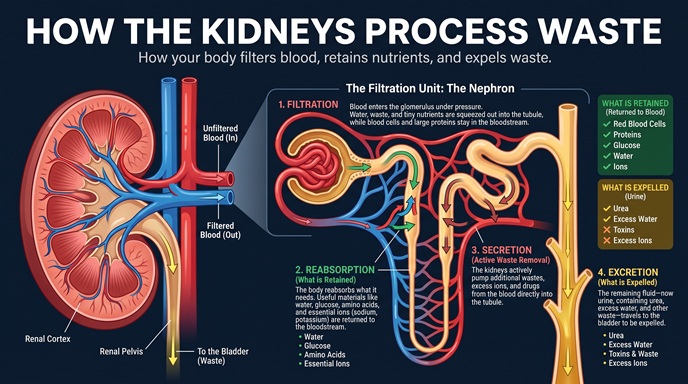
The answer is that your kidneys are not tiny ocean making machines. They’re sophisticated filtration and regulation systems. Your body needs electrolytes, including sodium, chloride and potassium to regulate fluid balance, transmit nerve signals and make muscles contract. Your kidneys filter blood and then carefully reabsorb the water and substances your body needs. They also regulate how much sodium and other electrolytes leave in urine.
Most of the filtered sodium is reclaimed. The amount that ends up in urine depends on your body’s needs, your diet, hydration and other factors. Eat a lot of sodium and your kidneys may excrete more of it. Become dehydrated and your kidneys conserve water, producing more concentrated urine.
The result is a fluid that contains dissolved salts and plenty of other compounds, including urea. It’s a carefully managed waste product, not a concentrated sample of the Atlantic Ocean.
Your kidneys are maintaining the chemistry of your internal environment. They are not conducting a long term geological experiment with the goal of seasoning the planet.
They have enough to do.
The Real Question isn’t About Salt
Let’s return to the restaurant.
A kid asks a question. A parent supplies an answer. The answer is absurd, but it arrives without hesitation. Maybe it was a joke. Maybe it was an attempt to end the conversation. Maybe the father simply didn’t know and didn’t want to admit it.
Any of those explanations are possible.
To be fair, nobody knows everything. Not even scientists. Especially not scientists, who spend much of their professional lives discovering how much they don’t know. Trust me. I live that life.
There’s nothing wrong with saying, “I don’t know.” There’s nothing wrong with guessing, provided you identify it as a guess. There’s even something valuable about making a ridiculous hypothesis and then testing it. That’s how you get from an interesting question to an interesting answer. Or discover you were wrong. I have a story for this, too.
The problem isn’t ignorance. Ignorance is the starting point of learning. The problem is treating confidence as a substitute for knowledge.
A child who asks why the ocean is salty has given an adult an opportunity. You can encourage curiosity. You can explain what you know. You can look it up together. You can discover that the answer is more complicated and fascinating than either of you expected. Or you can tell the kid that ten thousand years of human urination has turned the planet into a giant saltwater aquarium.
One of those approaches might produce a future geologist. The other might produce a future politician. I’ll leave it to you to decide which is more concerning.
In the meantime, the oceans remain salty, the rivers keep carrying dissolved minerals downhill and the human race continues to produce urine at a truly astonishing rate.
If we ever discover that the father was right, I want credit for asking the obvious follow-up question: How big was the first guy?
Discover more from Tales of Many Things
Subscribe to get the latest posts sent to your email.