
There are foods we celebrate because they represent the pinnacle of human culinary achievement. There is chocolate. There is pizza. There is a perfectly cooked steak.
Then there is bologna, the meat that looks like a giant pink hockey puck. The lunch meat that has inspired generations of school children to question its origins, composition and basic right to exist. The food whose very name sounds like something a politician says when they don’t want to answer a question.
Baloney.
Actually, that’s not a bad place to start.
October 24 is National Bologna Day and I can’t let it sneak out the door without being called out, so let’s take a closer look at this humble deli counter staple, its surprisingly sophisticated ancestry, its international relatives and the uncomfortable question of what, exactly, we’re putting between two slices of bread.
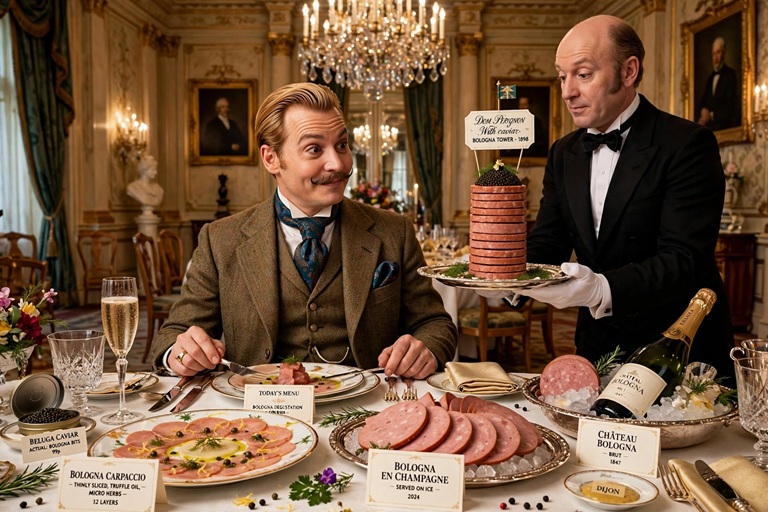
First, Let’s Get Our Baloney Straight
Bologna is pronounced baloney, not bo-LOAN-ya, despite what the spelling might suggest. The name comes from Bologna, Italy, a city with a long culinary tradition and a considerably better reputation for food than the stuff occupying that lonely corner of your refrigerator.
American bologna is a cooked sausage made from finely ground meat, commonly beef, pork or a combination. Poultry versions are available, too. The meat is ground, blended with fat, seasonings and other ingredients, then processed into a smooth mixture and cooked, sometimes with smoking as part of the process.
The result is a uniform, sliceable sausage with a mild, savory flavor. By uniform, I mean remarkably uniform.
You could slice a piece of bologna, hold it up to the light and struggle to identify anything that once had a recognizable relationship with an animal. It is meat that has completed its journey from livestock to lunch with all the identifying characteristics of a witness entering a protection program.
That smooth texture isn’t an accident. It’s the result of food processing techniques designed to produce a consistent, stable, convenient product, which is a perfectly reasonable engineering achievement. It’s also how you end up with meat that looks like it was designed by someone who had only heard rumors about sandwiches.
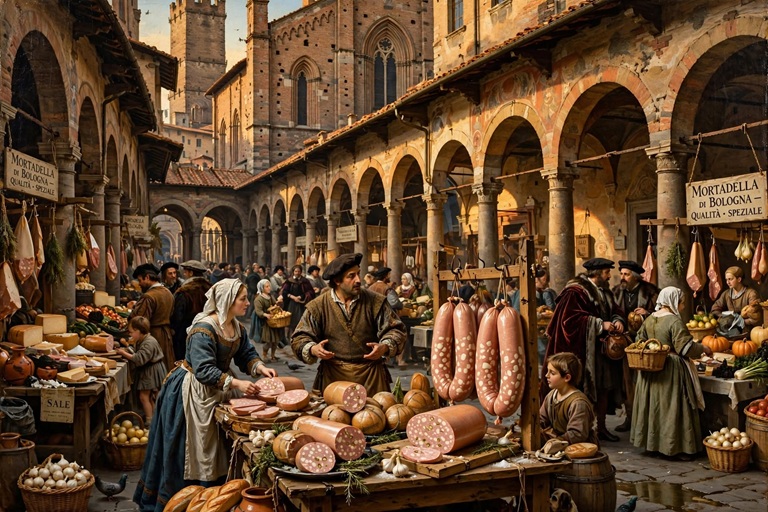
An Italian Family with Better Credentials
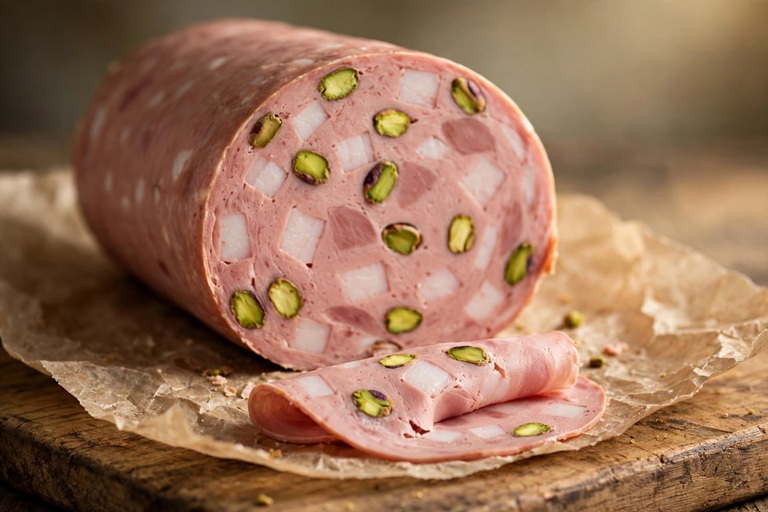
Here’s where bologna deserves a little respect. Its culinary inspiration is mortadella, a traditional Italian sausage originating in Bologna. Before anyone starts making jokes, traditional mortadella is a legitimate culinary specialty with a history stretching back centuries.
Mortadella is traditionally made primarily from finely ground pork with distinctive cubes of pork fat distributed throughout. Depending on the recipe, it may include black pepper, spices, myrtle berries or pistachios.
That’s right, the Italian version has pistachios.
American bologna looks like it was designed to survive a school lunchbox. Mortadella looks like it might arrive on a wooden board at a restaurant where the waiter explains the provenance of the olive oil.
Both are cooked sausages and both have their place, but they’re not identical and treating them as interchangeable is a little like comparing a frozen pizza with a Neapolitan pie and concluding that Italy has some explaining to do.
American bologna is a simpler, smoother relative of the Italian tradition. Mortadella’s visible fat cubes and more distinctive seasoning give it a character of its own.
So the next time someone mocks bologna, remember that its Italian cousin has been enjoying a much more distinguished social life.
Perhaps bologna doesn’t need a rebrand. Perhaps it needs better public relations.
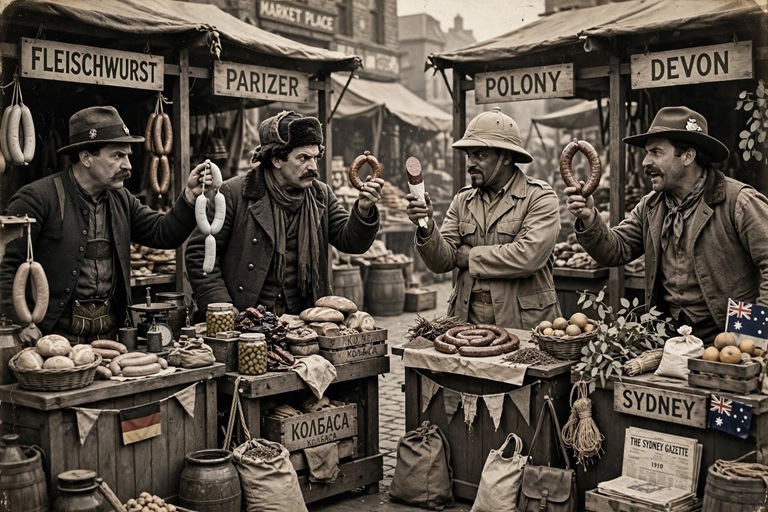
Bologna has a Passport
One of the more interesting things about bologna is that the basic idea of a finely ground, cooked sausage appears in different forms around the world. The names change, the seasonings change, the cultural standing changes. Apparently, the sausage itself is not responsible for its reputation.
Germany: Fleischwurst and Lyoner
Germany takes sausage seriously. The country has a vast sausage tradition and varieties such as Fleischwurst and Lyoner occupy some of the same culinary territory as bologna.
These smooth, cooked sausages are eaten cold, sliced into sandwiches or used in salads. A traditional Wurstsalat, or sausage salad, can combine sliced sausage with cheese, onions, pickles and a tangy vinegar dressing.
That’s a considerable promotion from being the thing your parents put on white bread when the grocery budget was having a difficult week.
Eastern Europe: Parizer
In parts of Eastern Europe and the Balkans, sausage varieties known as Parizer or similar regional names are popular sandwich and breakfast foods.
The name is associated with Paris, although the sausage itself belongs to a broader European tradition of cooked, finely ground meats. It can be served in sandwiches, eaten cold or fried in a pan.
Fried bologna, you say?
Suddenly, we’re no longer talking about a desperate lunch. We’re discussing international culinary diplomacy.
Southern Africa: Polony
In South Africa and other parts of southern Africa, polony is an affordable, widely available processed meat used in sandwiches, school lunches and street food. Like American bologna, it offers convenience and a mild flavor at a relatively accessible price.
Its popularity illustrates something important. Inexpensive foods can play a meaningful role in people’s daily lives. Not everyone has the time, money or kitchen facilities to prepare elaborate meals. Sometimes lunch needs to be affordable, filling and ready before the morning school bell rings.
Australia: Devon and Fritz
Australia has its own regional vocabulary for similar luncheon meats. In many parts of the country, the product is known as Devon, while South Australians may call a related variety Fritz.
This creates an interesting problem for American travelers. You can fly halfway around the world, order what you think is a familiar lunch and discover that the meat has a different name but the same suspiciously perfect geometry.
Australia has given this sausage several regional identities. Somewhere, a bologna slice is probably applying for citizenship. At least the sandwich knows where it stands.
So, What Exactly is in Bologna?
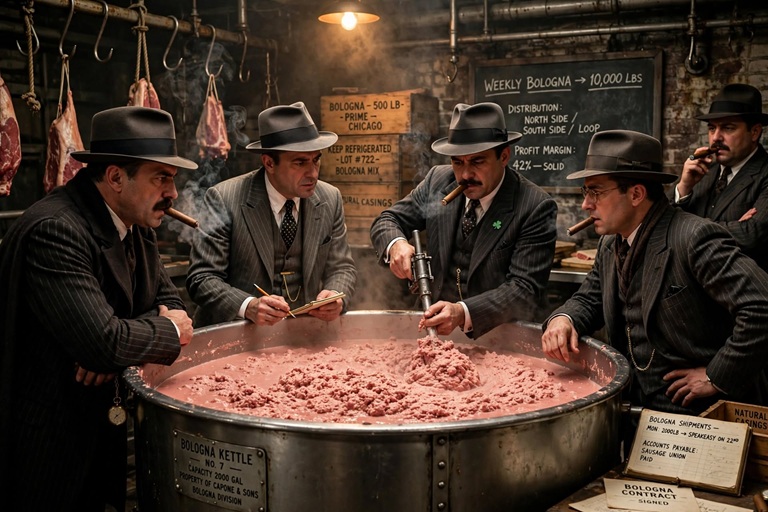
Let’s address the question that has fueled playground rumors for generations. The answer is less scandalous than the jokes suggest. Bologna is not a mystery meat made of swept up factory floor scraps, random slaughterhouse waste or Jimmy Hoffa. Bologna is made from actual meat, processed into a remarkably uniform product. The ingredients may be less glamorous than a prime rib roast, but they aren’t a culinary conspiracy.
Bologna can be made from beef, pork or poultry, depending on the product. Commercial recipes may use different cuts and meat trimmings, along with fat, salt, spices, water and other permitted ingredients.
The mixture is finely ground and emulsified, meaning fat and water are dispersed throughout the meat mixture to create a consistent texture. The mixture is stuffed into a casing and cooked. Some varieties are also smoked.
Curing ingredients such as sodium nitrite may also be used. Nitrite helps preserve cured meats, contributes to their characteristic color and inhibits the growth of dangerous bacteria, including the organism responsible for botulism.
These ingredients are regulated and their presence isn’t evidence of some secret industrial conspiracy. They’re part of a food production process developed to make the product consistent and safe.
The important distinction is that highly processed doesn’t mean fake. Bologna is real food made from real meat. Its smooth texture doesn’t mean someone ground up a mysterious assortment of anatomical leftovers and hoped nobody would ask questions. Although, admittedly, the texture doesn’t do the public relations department any favors.
The Nutritional Elephant in the Lunchbox
Now, for the less entertaining part. Bologna is a processed meat and many varieties are high in sodium and contain substantial amounts of saturated fat. The exact nutritional profile depends on the brand, ingredients and serving size, so checking the label is more useful than assuming every slice is nutritionally identical.
Bologna also provides protein. It isn’t devoid of nutritional value and processing doesn’t automatically strip meat of every useful nutrient, but there’s a reason nutrition experts recommend limiting processed meat.
The International Agency for Research on Cancer, part of the World Health Organization, classifies processed meat as carcinogenic to humans based on sufficient evidence that its consumption causes colorectal cancer. In the studies reviewed, eating 50 grams of processed meat daily was associated with an approximately 18% increase in relative colorectal cancer risk.
That is a relative increase, not an 18 percentage point increase in your absolute chance of developing cancer. The finding concerns habitual consumption, not the consequences of eating one sandwich. The practical lesson is straightforward. Making processed meat a regular dietary staple is worth reconsidering.
Bologna doesn’t need to be banished from the refrigerator under a court order, but perhaps it shouldn’t be the centerpiece of lunch five days a week, either. If you enjoy it, consider eating it less frequently, choosing options with less sodium or saturated fat and mixing things up with other fillings.
Roasted turkey, leftover chicken, eggs, tuna, hummus and bean based spreads can all make satisfying sandwiches. They offer different nutritional advantages and preparing some of them yourself can help you control the ingredients.
You don’t have to abandon convenience. You just have to acknowledge that a sandwich can contain something other than a pink circle.

In Defense of the Fried Bologna Sandwich
For all the jokes, bologna has earned its place in American food culture. It has fed generations of schoolchildren, provided inexpensive lunches for workers and occupied countless refrigerators. It is familiar, affordable and versatile. For many people, a fried bologna sandwich isn’t merely lunch. It’s a small, edible piece of childhood.
There’s something to be said for that. Food isn’t just a collection of nutrients. It’s also memory, culture, comfort and the things we share with other people. A perfect diet on paper doesn’t account for everything that makes eating meaningful.
That doesn’t mean nostalgia should overrule nutritional science. It means we can recognize both. We can acknowledge the health concerns without treating people who enjoy bologna as culinary criminals. We can appreciate the ingenuity of food processing without pretending every processed food belongs in a health food advertisement. We can laugh at a meat that has spent decades being mistaken for the punchline of a joke.
Happy National Bologna Day
So, on October 24, let’s raise a sandwich to bologna, the humble sausage that crossed an ocean, acquired an American identity, developed a reputation for questionable origins and somehow survived generations of schoolyard ridicule.
Its Italian cousin has pistachios. Its German relatives have salads named after them. Its Australian cousins have multiple identities. Bologna itself has endured more insults than a politician at a town hall.
It may not be the pinnacle of culinary achievement, it may not be the first thing a nutritionist recommends, it probably won’t be winning any beauty contests unless the judges are particularly fond of uniform circles, but it has fed people, brought comfort and earned a place in food history.
You don’t have to evict bologna from your refrigerator. Just consider giving it a little less real estate. Try roasted turkey, chicken, eggs, hummus or beans. Your sandwich will survive the transition. Your childhood memories will remain intact. And bologna can continue its distinguished career as the meat that sounds like something your uncle made up. After all, October 24 is National Bologna Day.
We came here to celebrate, educate and question several decades of questionable lunch decisions, not to confiscate anybody’s sandwich.
And if anyone asks whether bologna is good for you? Well, that’s a load of baloney.
Discover more from Tales of Many Things
Subscribe to get the latest posts sent to your email.