
I hear a lot of people talk about AI. It is constant at work. My friends are fascinated by it. I hear people talking about it in line at the grocery store and at social events. It is on the news nightly. AI is no longer a curiosity or a passing fad. It has become a force of nature, an inseparable part of our lives.
Financial analyst David Gardner likes to talk about the “snap test”. If you snap your fingers and a company, an industry or even just a product disappears, will anyone notice?
With AI, the answer is yes, absolutely! The whole world will notice. It will be disruptive. Industries will struggle, productivity will take a hit and entire workflows will grind to a halt. Deepfakes will disappear, too, but that’s okay. We can live with that last one.
Something else interesting will happen. People who are not quite experts in their fields, but use AI to pass themselves off as experts, will be exposed. The reports will stop appearing. The presentations will stop materializing. The code will stop writing itself. The confident answers will go silent. As Warren Buffett famously observed, you only discover who has been swimming naked when the tide goes out.
AI may eventually provide one of the more interesting demonstrations of that principle.
Over the past decade, AI has exploded from a specialized technology into a commercial juggernaut. It touches nearly everything we do and, ever so slowly, it is becoming part of everything we touch. Like an invasive species, it is spreading into environments that were not necessarily prepared for it.
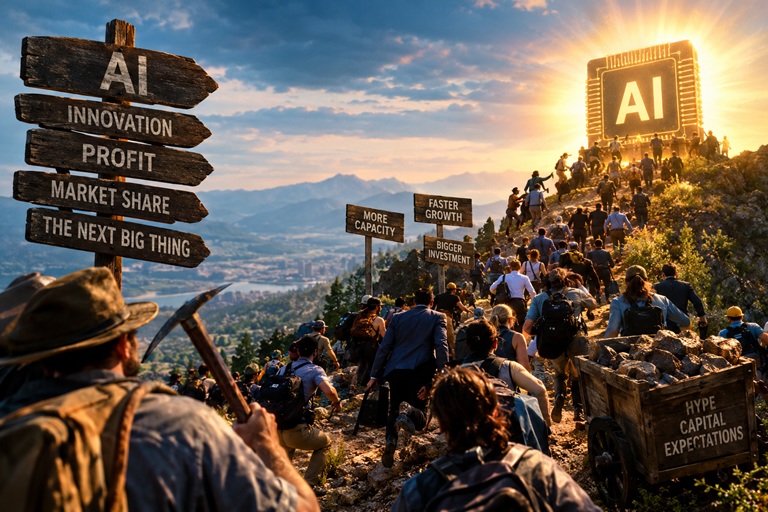
Like any other gold rush, everyone is lining up to stake their own claim.

The Race to Keep Up
Think about it. If you manufacture widgets and all your competitors are ramping up production, you have to run faster just to stay in the same place.
If you do not build factories and expand assembly lines, your market share shrinks. Your competitors gain an advantage, your costs become less competitive and eventually you risk becoming obsolete.
So you build factories, too. You expand capacity, hire workers, borrow money and increase production. You do all of this while privately acknowledging that nobody needs five widgets when one will do. The problem is that you can not afford to sit still. Your competitors are expanding and if you do not keep up, they will eat your lunch.
Multiply this decision across an entire industry and you get a race in which everyone is running faster simply to avoid falling behind.
Eventually, the factories are built. The production lines are humming. The warehouses are full. There is just one problem. Customers have not multiplied at the same rate as the industry’s capacity.
The industry has overproduced. There are too many widgets chasing too few buyers. Prices fall. Profit margins disappear. Companies that borrowed heavily to expand discover that their shiny new factories are liabilities rather than competitive advantages. No one ever got fired for successfully keeping up, but once everyone has raced to the top, the industry may find itself racing to the bottom.
This is one of the recurring patterns of an economic boom. Demand attracts investment. Investment creates capacity. Competition drives prices down. Eventually, the market has to reconcile the expectations that justified all that investment with the money customers are actually willing to spend.
Even when the technology is useful, the investment can still be excessive.

COVID-19: A Lesson in Extraordinary Demand
The COVID-19 pandemic gave us a powerful lesson in what happens when extraordinary circumstances create extraordinary demand.
E-commerce exploded, video conferencing exploded, telehealth expanded, pharmaceutical companies raced to develop vaccines, home delivery services boomed, people bought exercise equipment because gyms were closed and their living rooms had become their offices, restaurants and fitness centers.
Companies that could satisfy these sudden needs became market darlings. Investors priced in years of growth, sometimes as though the extraordinary conditions of the pandemic would continue indefinitely. Then the world changed again.
People returned to offices, gyms and restaurants. Some pandemic era habits stuck, others faded. Many businesses survived, but the expectations baked into their stock prices did not.
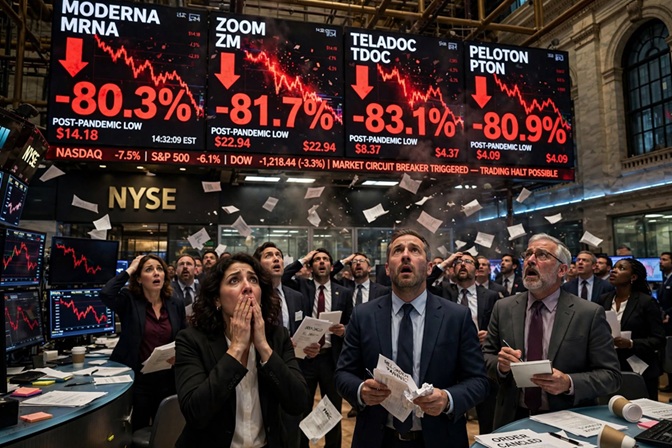
Look at Teladoc, Moderna, Zoom and Peloton. These were pandemic-era darlings, companies that investors once believed could do little wrong. Their stock prices soared as people rushed to embrace the services they offered, then came the hangover.
Measured from their respective peaks, these companies have suffered enormous stock-price declines, often north of 90%. The underlying lesson is unmistakable: investors can get carried away when a business experiences an extraordinary surge in demand. After a $1000 investment at market’s peak, most were lucky to walk away with less than a hundred dollars of their hard earned cash remaining.
Zoom did not become useless when people returned to their offices. Moderna did not suddenly forget how to develop vaccines. Peloton did not stop making exercise equipment. Teladoc did not cease providing telehealth services. What changed was the expectation of how much these companies would grow and how much investors should be willing to pay for that growth.
The pandemic did not eliminate demand for these products. It changed the assumptions investors had made about how much demand there would be.
That distinction matters because it defines a lens through which many investors forget to look.
The Dot-Com Boom: We Have Seen This Movie Before
If you want an earlier example of this phenomenon, look at the dot-com boom of the 1990s.
The internet was real. Its potential was enormous. It changed commerce, communication, entertainment and nearly every other aspect of modern life. Investors understood that something important was happening. Unfortunately, many concluded that virtually any company associated with the internet was destined to make a fortune.
Money poured into online retailers, search engines, internet service providers, telecommunications companies and the infrastructure required to connect everyone to everything.
Companies laid fiberoptic cable, built networks and expanded capacity in anticipation of demand. Entrepreneurs launched online businesses with ambitious projections and business models that often relied on the assumption that profitability would take care of itself later, sometimes much later.
The internet infrastructure was useful. The market’s appetite for internet related investments was not always rational. When the bubble burst in March 2000, companies failed, investors lost fortunes and enormous amounts of capital evaporated. Some infrastructure was left underused. Other infrastructure became the foundation for the next generation of internet businesses.
Remember Yahoo? AOL? AltaVista? Infoseek? Webvan? Pets.com? Compaq? 3dfx? Some of these names survive in corporate history. Others are remembered mainly by people who were around when they mattered. Their businesses differed considerably, but they shared a place in the story of a technology boom that produced both genuine innovation and spectacular failures.
The median age in the United States is 39.4. Think about what that means. Someone who is 39 today was around 13 when the dot-com bubble burst. For a substantial portion of today’s workforce, the crash is something they might have studied in a business class, not something they experienced as working professionals.
The giants of the 1990s are, for the most part, footnotes in the history of technology. Their successors inherited the internet they helped create, often without inheriting their business models, their market positions or their investors’ (lost) fortunes.
Take AOL. At its peak, it was a gateway to the internet for millions of Americans. In 1997 more than half of all internet users in the United States were on AOL. It sent floppy disks and, later, CDs through the mail to entice people to sign up. At one point, those promotional discs seemed almost as ubiquitous as junk mail.
AOL became synonymous with getting online. Its familiar greeting, “You’ve Got Mail,” was practically a cultural institution. It even became a movie.
Today AOL’s dial-up internet service is gone. It officially shut down on September 30, 2025. AOL Mail and other select services remain available, but the company no longer occupies anything resembling its former position as a dominant gateway to the internet. AOL did not disappear entirely. It simply stopped being the gateway through which much of the internet passed.
That change is the more interesting lesson. A company can survive while losing the role that once made it indispensable. The technology it helped popularize can flourish even as its original champion fades into the background.
Google, Amazon, PayPal, Salesforce and Nvidia emerged as important players in the broader technological transformation, although each followed a different path and not all were direct replacements for the dot-com companies that came before them.
The companies that built the future were not always the companies investors expected to own it.

The AI Gold Rush
Why is this history important? Because AI today feels as though it could be following a similar route.
In a past article I explored the parallels between AI infrastructure and the great railroad booms. Building infrastructure for a transformative technology can create enormous long term value, but that does not guarantee that every company financing the construction will survive long enough to collect the profits.
Today the AI race extends from chip designers and data center operators to cloud providers, model developers and companies building applications on top of those models. The spending is extraordinary. Advanced AI requires specialized chips, enormous computing capacity, electricity, cooling systems, engineering talent and continuing research. The infrastructure must be built before all the anticipated demand can be served and the equipment can become outdated long before the financing is paid off.
The business opportunity is equally extraordinary. Companies are racing to build better models, offer faster responses, lower costs and attract customers before their competitors do, yet the economics are not the same for everyone.
A company that owns a profitable cloud business can finance AI investment from its existing operations. A startup developing a frontier model may have to raise enormous sums of money before its revenue can support its ambitions. A data center operator may have billions of dollars tied up in facilities that depend on continued demand from a relatively small number of customers. These businesses all benefit from AI growth, but they do not have the same risk profile and this is where the gold rush analogy becomes an echo of the past. Mark Twain noted that history rarely repeats itself, but it does rhyme.
During a gold rush, the person selling shovels can make money whether or not the people buying them strike gold. The same can be true of the companies supplying chips, networking equipment, electricity and computing infrastructure, but even the shovel seller can get into trouble if too many competitors enter the business, customers stop expanding or the price of the product falls below the cost of making it.
No business model is immune to arithmetic.
The King has a Problem
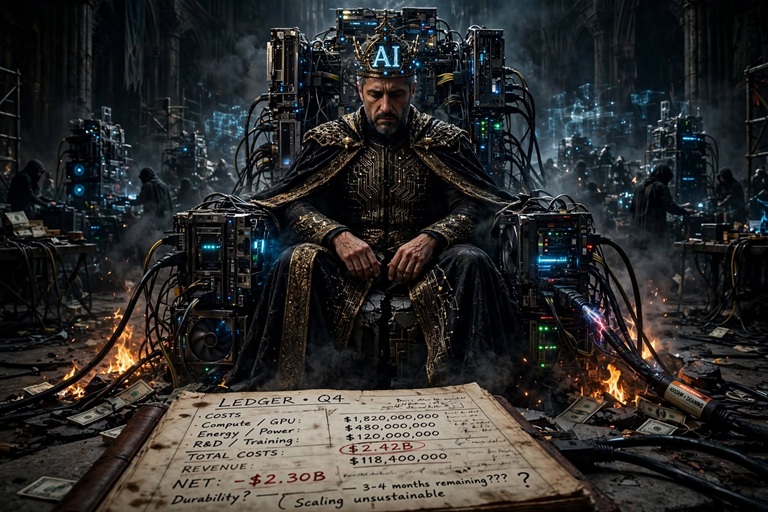
AI is king, but the king harbors a deep secret. Anyone with sufficient funding and technical expertise can attempt to build an AI system. The competition has become fierce. New models appear, existing models improve and companies that once seemed to have an insurmountable lead discover that their competitors are catching up.
Meanwhile, the costs of competing at the frontier are enormous. Consider some of the reported 2025 financial figures. OpenAI generated approximately $13.1 billion in revenue while recording an operating loss of roughly $20.9 billion. Anthropic generated approximately $4.6 billion in revenue and reported operating losses exceeding $8 billion. xAI generated approximately $3.2 billion in revenue while losing roughly $6.4 billion.
These figures come from reported financial disclosures and reporting about private company finances, which require care because operating losses, net losses and cash expenditures are not interchangeable. Anthropic’s reported net loss, for example, was much larger because of substantial accounting charges associated with financial instruments, but its operating losses were also significant.
The precise accounting distinctions matter. They do not make the underlying question go away. These companies are spending extraordinary sums to develop, train, operate and improve AI systems. Their revenues are growing, in some cases spectacularly, but so are their costs.
Alphabet is in a different position. It has established businesses that generate substantial revenue and can help finance its AI ambitions. That gives it a significant advantage over companies that depend more heavily on outside investment, but even for a company with deep pockets, AI is a massive investment whose ultimate returns must justify the expenditure. The fact that a company can afford a moonshot does not guarantee that the moonshot will pay off.
The question then drifts from whether AI companies can attract customers. We know they clearly can. It is whether they can generate enough durable revenue to justify the cost of building, operating and continually improving their systems. This part of the formula becomes a much more complicated variable in the equation.
Everyone Wants a Piece of the Pie
There is another problem. AI is not one market with one business model. Some companies sell subscriptions. Others sell access to models through application programming interfaces. Some bundle AI into products customers already pay for. Others make money from advertising, cloud computing, consulting or enterprise contracts.
Many also offer free access. That one point matters more than others because the free version of an AI product can satisfy a surprising number of everyday needs. People ask questions, summarize documents, generate images, experiment with recipes and produce amusing pictures of themselves, in an identical pose, in places they have never visited.
There is nothing wrong with any of that. I use AI, too, both professionally and personally. The technology is useful, fascinating and, at times, astonishing, but a person who occasionally generates a funny image is not necessarily a customer willing to pay a substantial monthly subscription. A business that experiments with AI is not necessarily a business that will commit millions of dollars to use it. A user who loves a free service may discover that love has a surprisingly low price when the service introduces a paid tier.
The challenge for AI companies is converting usage into sustainable economics. Free access can be a brilliant way to attract users, build habits and establish a market. It can also be an expensive way to discover that users love the product, but do not love it enough to pay for what it costs to operate.
Competition makes the problem more complicated. If several companies offer increasingly capable models, customers have less reason to remain loyal to any one provider. If one company raises prices, another may undercut it. If a competitor releases a model that performs nearly as well at a fraction of the cost, customers may switch. The technology improves, but the price of using it may fall.
That is wonderful for consumers. It can be brutal for investors who paid premium valuations on the assumption that today’s leaders would retain their advantages and capture extraordinary profits for years to come.
The market is not necessarily saturated with demand for AI. It may, however, be saturated with companies trying to capture that demand, all investing heavily in products that increasingly compete on price and performance.

The Market Beneath the Headlines
If you look at the S&P 500, you might conclude that everything is just fine. A capitalization weighted index can remain near a record high even when the typical stock is struggling. A handful of enormous companies can carry the index while much of the broader market falls behind.
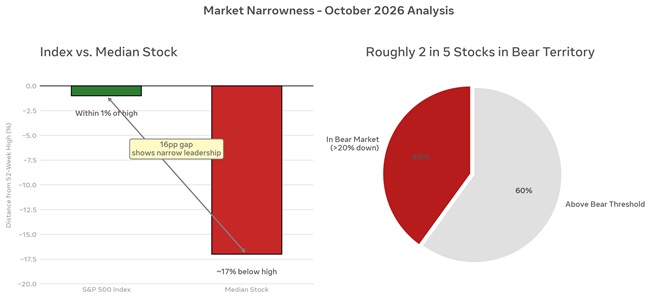
In a market analysis published in October 2026, the S&P 500 was within approximately 1% of its high while the median stock sat about 17% below its own 52 week high. Roughly two in five stocks had fallen more than 20% from their high, a decline commonly used as the threshold for bear market territory.
These measurements are time sensitive snapshots, not permanent conditions, but they illustrate the important point that the index does not tell the whole story. The market can appear healthy while a significant portion of its individual stocks struggles. The biggest winners can conceal weakness elsewhere.
When so much enthusiasm is concentrated in companies associated with a single transformative technology, it is worth asking what happens if expectations change. Tariffs, transportation costs, inflation and other economic pressures can weigh on businesses. AI investment can support the companies selling chips, computing capacity and infrastructure, even while other industries face rising costs and uncertain demand.
Investment enthusiasm is not the same thing as economic prosperity and rising stock prices are not proof that every business model is sound. Eventually, investors have to decide which companies can turn today’s spending into tomorrow’s profits.
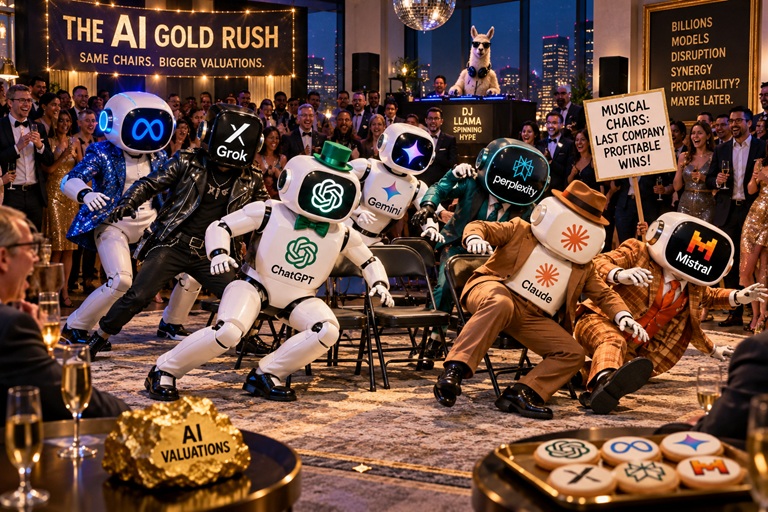
What Happens When the Music Stops?
Nothing goes up forever. All booms eventually have to confront reality, although not every boom ends in a spectacular crash.
A business can survive years of losses if it has sufficient capital, credible prospects and investors willing to finance its growth. A company can also be strategically important without being profitable in its current form. None of this is inherently irrational. The danger appears when expectations become disconnected from what the business can reasonably deliver.
Investors may begin to demand evidence of returns rather than promises of future dominance. Lenders may become more cautious. Customers may discover that they can accomplish much of what they need with cheaper alternatives. Companies may decide that they have built enough capacity for the moment.
When that happens, projects get delayed, expansion plans are revised, hiring slows, financing becomes more expensive. Companies that depend on a continuous flow of new capital become vulnerable.
The weakest businesses may fail. Others may be acquired. Some will cut costs, change their products or discover that their original business model never made much sense in the first place. The market will not necessarily collapse in one spectacular event. It may simply become harder to raise money, harder to grow revenue and harder to justify the prices investors once paid. Some of the most celebrated companies of the boom may turn out to be much less important than they appeared.
The AI industry is not immune to this cycle. In fact, the enormous cost of competing at the frontier makes the question of sustainable economics especially important. The companies building AI may be laying the foundations of a technological revolution, but if too many companies build too much capacity, spend too aggressively and compete away their margins, the result could be a painful shakeout.
Some companies will fail. Others will consolidate, change direction or discover that their most valuable asset is not the model they built, but the customers, infrastructure or expertise they accumulated along the way. New leaders will emerge from the rubble.
The Future Belongs to the Survivors
I do not want to be a doomsayer. I do not want to predict the fall of AI or forecast a market crash. The technology is too important, the applications too varied and the future too uncertain for that kind of a claim, but we have been here before.
Railroads transformed transportation. The internet transformed communication and commerce. The companies that built those industries did not all survive and the investors who backed them did not all prosper.
AI will follow its own path, but some of the same forces that crushed gold rushes are already visible. Competition encourages overinvestment. Overinvestment creates excess capacity. Excess capacity puts pressure on prices. Falling prices force companies to find efficiencies, differentiate their products or leave the market.
Venture capital is not an endless supply of free money. Investors eventually want a return. Even the most patient investor has limits and even the most compelling vision has to survive contact with a balance sheet. Some AI companies will fail. Others will find profitable niches. Some will be acquired by larger companies with the resources to keep their technology alive. A few may become dominant businesses for decades. Some companies that barely register today may become indispensable, while the giants that dominate today’s headlines will become footnotes in tomorrow’s history books.
AI itself is not going away. We have already integrated it into too many products, workflows and expectations for the entire technology to simply vanish. Even if investment falls sharply, the knowledge, infrastructure and capabilities already created will remain.
The more likely transformation is that AI becomes cheaper, more accessible and less remarkable. What seems extraordinary today may eventually become an ordinary feature of software, much as internet connectivity became a basic expectation rather than a premium service.
That would be a success for the technology, even if it disappoints some of the people who invested in it. The gold rush will not end because there is no gold. It will end when the easy money disappears, the economics change and the survivors discover what their businesses are actually worth.
The real question is who will still be standing when the dust settles.

Discover more from Tales of Many Things
Subscribe to get the latest posts sent to your email.