
Sometimes the greatest scientific discoveries begin when absolutely nothing goes according to plan.
We tend to imagine science as a pristine, highly choreographed endeavor. We picture sterile laboratories, meticulously organized equipment, complicated equations covering whiteboards and brilliant scientists in crisp white coats executing carefully calculated experiments.
Apparently, Hollywood has never visited an actual laboratory. None of my instructors ever wore a white lab coat and if popular depictions of science have taught us anything, it’s that real scientific progress probably involves considerably more caffeine, questionable housekeeping and more profanity than the movies would have us believe.
Science is messy. Experiments fail. Equipment breaks. Chemicals behave badly. People forget things. Sometimes, the most interesting thing in a laboratory isn’t what a scientist intended to create, but what happened when everything went sideways. In fact, some of the most consequential discoveries in modern history began with mistakes, unexpected observations, failed experiments and people who were simply paying attention when something unusual happened.
There’s even a word for this phenomenon, serendipity, the art of discovering something valuable while looking for something else. Of course, there’s a catch. Serendipity favors the curious, not the careless.
In honor of World Science Day for Peace and Development (November 10), let’s celebrate a few of the glorious accidents that helped build the modern world, because sometimes scientific progress doesn’t follow a blueprint. Sometimes, it follows a trail of crumbs.

The Slacker’s Petri Dish: Penicillin
Alexander Fleming, 1928
Let’s start with a discovery that probably wouldn’t survive a modern laboratory inspection.
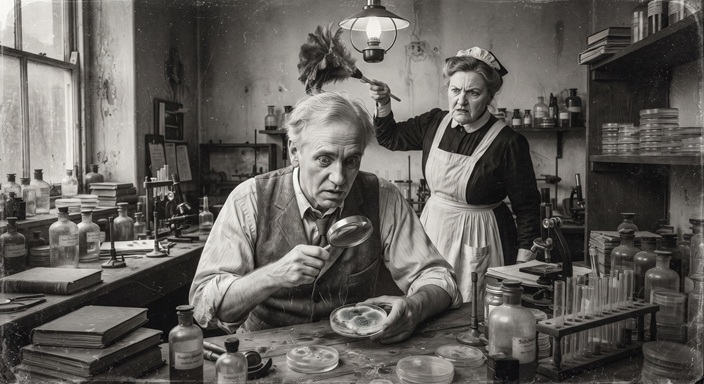
In 1928, Scottish bacteriologist Alexander Fleming was studying Staphylococcus bacteria when he left his laboratory for vacation. Before departing, he left a Petri dish containing a culture on his laboratory bench rather than placing it in the incubator. It was an ordinary oversight, but one that would have extraordinary consequences. When he returned, he discovered that the dish had become contaminated with mold. That’s generally considered a pretty good reason to discard an experiment and start over, but something caught Fleming’s attention.
Around the mold was a clear area where the bacteria weren’t growing. Something produced by the mold was actively killing or inhibiting the bacteria. Fleming investigated and identified the substance as penicillin, produced by a mold then classified as Penicillium notatum. He had stumbled onto one of the most important medical discoveries in human history.
Well, sort of.
Fleming recognized the antibacterial properties of penicillin, but extracting, purifying and developing it into a practical medicine proved extraordinarily difficult. That work took another team of scientists, including Howard Florey and Ernst Chain, who, along with their colleagues, eventually developed it into a usable medicine.
Before antibiotics, an otherwise minor infection could become a death sentence. Surgical wounds, pneumonia and bacterial infections that are routinely treatable today could easily kill a century ago. Penicillin changed that equation. A contaminated Petri dish helped launch the antibiotic era, saving countless lives.
The lesson: Sometimes the difference between a scientific breakthrough and a housekeeping violation is understanding what you’re looking at.
The Pocket Snack: The Microwave Oven
Percy Spencer, 1945
Imagine working on cutting edge military technology and accidentally inventing a way to reheat yesterday’s leftovers.
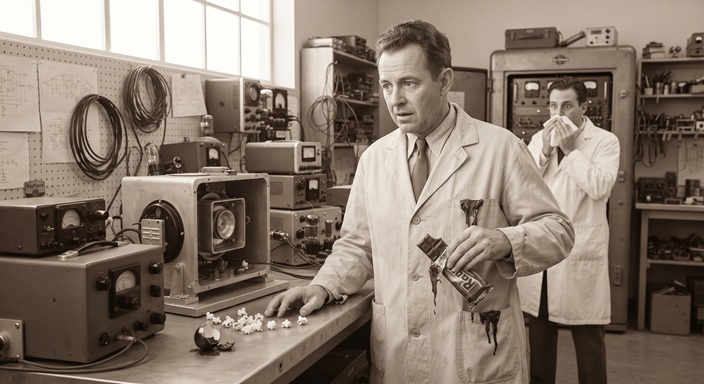
In 1945, Percy Spencer, an engineer at Raytheon, was working with magnetrons, powerful vacuum tubes used in radar systems during World War II. While standing near an operating magnetron, Spencer noticed something unusual. The candy bar in his pocket had melted. Most people would probably have blamed the heat, cursed their laundry and found another snack.
Spencer got curious. He began experimenting with food and the electromagnetic radiation produced by the magnetron. Popcorn kernels popped. An egg reportedly exploded in the face of a colleague who got a little too close to the experiment. Science can be dangerous, especially breakfast.
Spencer realized that microwave radiation could rapidly heat food. He and his colleagues developed the technology into the first microwave oven and Raytheon filed a patent in 1945.
The original commercial microwave, called the Radarange, was enormous. Unveiled in 1947, it stood roughly six feet tall, weighed around 750 pounds and cost a small fortune. It wasn’t exactly a countertop convenience, but the technology continued to evolve, eventually becoming the familiar kitchen appliance that reminds us yesterday’s fresh pizza should have been finished yesterday, instead of being turned into a rubbery approximation of its former self in around 45 seconds, all because an engineer noticed that his candy bar was melting in his pocket.
The lesson: Curiosity is what happens when someone asks why their lunch is melting instead of simply buying another one.
The Glue That Couldn’t Stick: Post-it Notes
Spencer Silver and Art Fry, 1968–1980
Sometimes failure isn’t about creating something that doesn’t work. It’s about creating something that works perfectly for a problem nobody has.
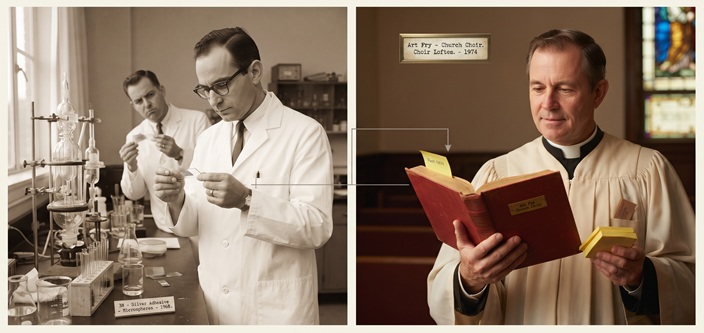
In 1968, 3M chemist Spencer Silver was attempting to develop a super strong adhesive. The aerospace industry was one potential market for a stronger adhesive and a really good adhesive could have been worth a fortune.
Instead, Silver created something rather unusual. His adhesive consisted of tiny acrylic microspheres that produced a relatively weak bond. It stuck to surfaces, but could be peeled away easily without leaving much residue. Even better, it could be reused.
In other words, he had invented glue that didn’t really want to glue anything permanently. Not exactly a ringing endorsement for an adhesive.
Silver spent years trying to find a practical application for his invention. His colleagues weren’t particularly impressed with the idea either. Then another 3M scientist, Art Fry, came along. Fry sang in his church choir and had a recurring problem. The little paper bookmarks he used to mark hymns kept falling out of his hymnal. He remembered Silver’s unusual adhesive and realized it could make a perfect reusable bookmark.
The idea eventually became Post-it Notes. The original product was introduced nationally in 1980 and the rest is office supply history. There’s even a little additional serendipity in the story. The familiar yellow color reportedly came about because a neighboring laboratory had scrap yellow paper available.
Today, Post-it Notes are everywhere. You see them in offices, classrooms, refrigerators, computer monitors and occasionally places where someone has forgotten what the note was supposed to remind them to do.
A failed attempt to create stronger glue became one of the most recognizable stationery products in the world.
The lesson: Just because something doesn’t do what you intended doesn’t mean it isn’t useful. Sometimes you simply haven’t found the right problem to go with your solution.
The Empty Gas Cylinder: Teflon
Roy Plunkett, 1938
Here’s a scientific discovery that began with something apparently missing.
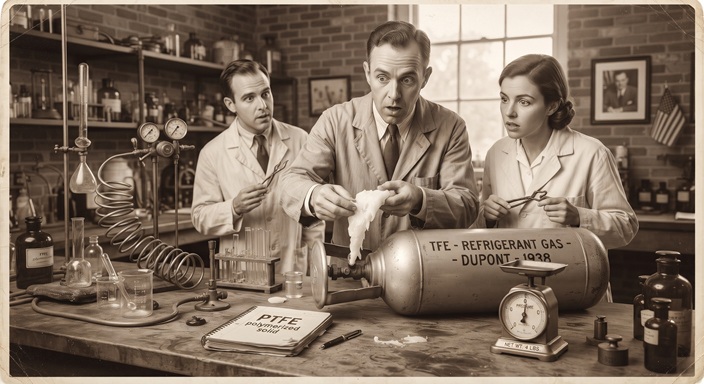
In 1938, chemist Roy Plunkett was working for DuPont, experimenting with refrigerant gases. He was investigating alternatives to existing refrigerants when he encountered an unexpected problem. A cylinder that was supposed to contain a particular gas stopped releasing anything.
The obvious assumption might have been that the cylinder was empty, but Plunkett and his assistant noticed something strange. Although the pressure had dropped to zero, the cylinder hadn’t lost any weight. Whatever had happened, the gas hadn’t escaped.
When they opened the cylinder, they discovered a strange white, waxy substance inside. The gas had spontaneously polymerized into a solid material called polytetrafluoroethylene or PTFE.
The substance had some remarkable properties. It was exceptionally resistant to heat and chemicals, had an extremely low coefficient of friction and was remarkably difficult for other materials to stick to. It eventually became known commercially as Teflon.
Today, PTFE is used in everything from nonstick cookware to industrial equipment, electrical insulation and specialized applications where chemical resistance is essential. Think about that the next time you’re making breakfast and your eggs slide effortlessly across a nonstick pan.
A gas that had apparently vanished had become one of the most useful synthetic materials ever developed.
The lesson: Before assuming something is empty, it’s worth finding out where the contents went.
The World’s Worst Handwashing Habit: Saccharin
Constantin Fahlberg, 1879
If there’s one scientific discovery that might make you reconsider your laboratory hygiene practices, this is it.
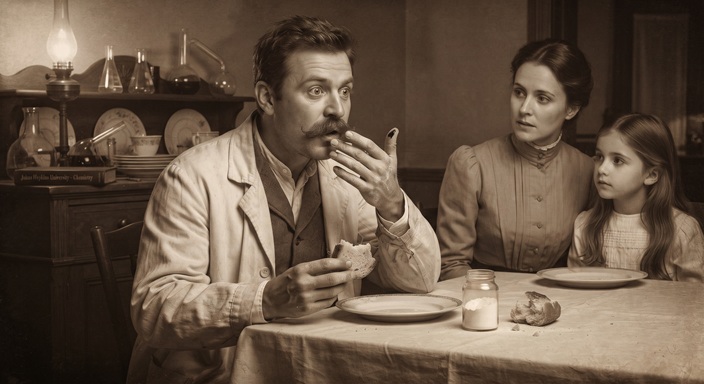
In 1879, chemist Constantin Fahlberg was working at Johns Hopkins University, investigating compounds derived from coal tar. After a long day in the laboratory, he went home for dinner. At some point, he noticed that his bread tasted unusually sweet.
He investigated and traced the sweetness to a chemical residue on his hands. Apparently, he hadn’t washed them particularly well before leaving work. The compound responsible was saccharin, an artificial sweetener hundreds of times sweeter than ordinary sugar.
Fahlberg eventually developed a process for producing saccharin commercially. It became one of the first widely used artificial sweeteners, offering a sugar substitute with essentially no calories. Its popularity would grow considerably, particularly during periods when sugar was expensive or rationed, all because a chemist apparently decided that washing his hands could wait until tomorrow.
Of course, there’s an important consideration here. This isn’t an endorsement of poor laboratory hygiene. Fahlberg was fortunate to encounter a harmless sweet tasting compound rather than something considerably more dangerous. Still, it’s difficult not to appreciate the sweet irony.
Modern food science owes a small debt to one man’s failure to wash his hands before dinner.
The lesson: Curiosity is valuable. Laboratory hygiene is still highly recommended.
The Invisible Photograph: X-rays
Wilhelm Conrad Röntgen, 1895
Not every accidental discovery produces a convenient household product. Some fundamentally change our understanding of the universe.
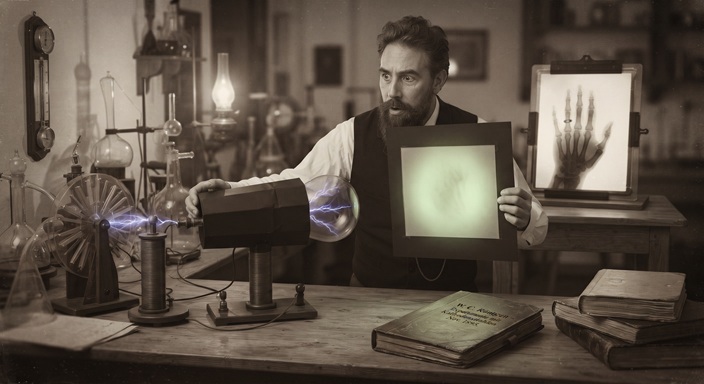
In 1895, German physicist Wilhelm Conrad Röntgen was experimenting with cathode ray tubes, equipment used to investigate electrical discharges in vacuum tubes. During his experiments, he noticed something strange. A fluorescent screen some distance away began glowing, even though the discharge tube was covered with black cardboard. Something was escaping the tube and traveling through the cardboard.
Röntgen investigated the mysterious radiation and discovered that it could pass through many materials that ordinary light could not. It could even pass through human tissue while being absorbed more readily by denser materials such as bone.
He called the mysterious radiation X-rays, using X as the mathematical symbol for something unknown. One of his earliest famous images was a photograph of his wife’s hand, showing the bones and the ring on her finger.
Imagine seeing a photograph of your own skeleton for the first time. It must have been a rather unsettling experience.
Within a remarkably short time, X-rays began transforming medicine. Doctors could examine broken bones and locate foreign objects inside the human body without performing surgery. Today, X-ray imaging is so commonplace that we barely think twice about it, yet it began with a scientist noticing that a screen was glowing when it shouldn’t have been.
The lesson: Sometimes the most important discoveries begin when someone notices something that shouldn’t be happening.
The Real Secret Behind Happy Accidents
There’s a common misconception that scientific discoveries are the result of perfectly executed experiments, brilliant minds and carefully calculated plans.
Sometimes they are, but science also advances through unexpected observations, failed experiments, unusual results and the occasional spectacular blunder.
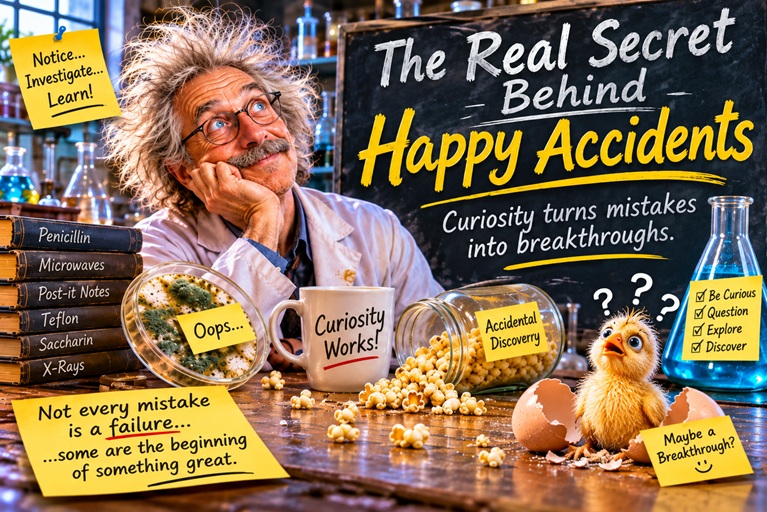
Of course, there’s a catch. Laboratories experience contamination every day. Experiments fail constantly. Equipment breaks. Chemicals behave unpredictably. Scientists make mistakes. Most of those incidents don’t produce penicillin, microwave ovens or revolutionary new materials. The difference isn’t necessarily the accident. It’s what happens afterward.
Fleming could have discarded the contaminated Petri dish. Spencer could have cursed his ruined candy bar. Silver could have abandoned his failed adhesive. Plunkett could have thrown away the mysterious white substance. Instead, they got curious. They questioned what they were seeing, investigated the unexpected results and followed the evidence wherever it led. That’s the real secret behind happy accidents. It’s not laziness, not incompetence, not even luck.
Just imagine how many otherwise incredible scientists had discarded a potentially life changing experiment that did not go according to plan.
Science works best when scientists exhibit curiosity and try to understand what they see. Science isn’t about knowing all the answers before you start asking questions. It’s about being willing to follow the evidence, even when it takes you somewhere you never intended to go.
We live in a culture that is increasingly obsessed with perfection. We double-check our emails, obsess over productivity and beat ourselves up when a recipe, a project or an experiment doesn’t work out exactly as planned.
Precision matters. Especially when you’re developing antibiotics, designing nuclear reactors or conducting experiments involving exploding eggs, but there’s a difference between avoiding mistakes and being afraid of unexpected results. Sometimes, the most valuable thing you can do is stop, take a closer look and ask why something went wrong.
So the next time you burn dinner, discover something strange in the refrigerator or forget to clean up your workspace, don’t immediately assume the day is ruined. You might have a failure on your hands or you might have the next big thing.
Just remember to wash your hands before lunch and maybe keep the eggs away from the magnetron.
Discover more from Tales of Many Things
Subscribe to get the latest posts sent to your email.