
This is the third and final installment of our 2026 Friday the 13th trilogy. If you missed the first two, we explored the eerie mathematics back in February and the rare double-feature phenomenon in March.
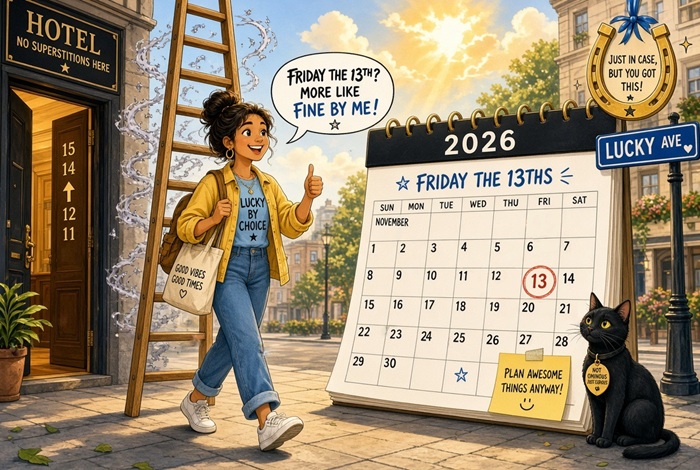
For most of the calendar year, society operates under a quiet undercurrent of unspoken anxieties. Black cats dart across sidewalks, ladders are respectfully bypassed and hotel floors mysteriously skip from 12 to 14. Apparently, even architecture has trust issues.
But when a year like 2026 delivers a rare trifecta of Friday the 13ths, landing in February, March and November, something fascinating happens.
The spell begins to crack.
While the superstitious lock their doors and clutch their lucky charms, a different breed of person looks at the calendar and smiles. For them, 2026 isn’t a gauntlet of bad luck. It’s a golden opportunity.
Today, we’re not talking about the curse of the date. We’re talking about the people who refuse to play along, the curious history of those who challenged superstition head on and why sometimes the best way to defeat an irrational fear is to give it a good laugh.
Meet the Original Rebels: The Thirteen Club
If you think modern contrarians are edgy for flying on Friday the 13th, you have to meet Captain William Fowler and the Thirteen Club.
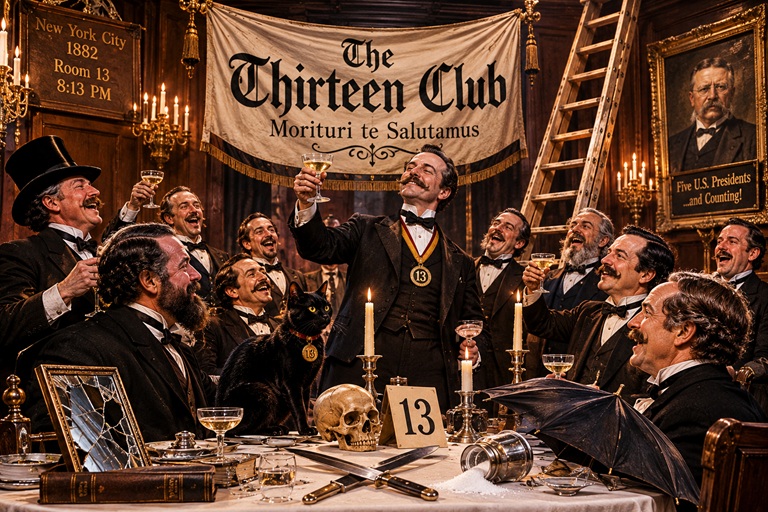
Founded in New York City in 1882, this society dedicated itself to systematically violating every superstition its members could find. Fowler’s first notorious dinner took place on Friday, January 13, 1882, at the Knickerbocker Cottage. Thirteen members gathered in Room 13 at precisely 8:13 p.m. Their mission was to demonstrate, through sheer empirical mockery, that triskaidekaphobia (the fear of the number 13) and its associated rituals were nonsense.
Their banquets were legendary exercises in deliberate provocation:
- The guest list: Exactly 13 people at a table. Because apparently, someone had to make sure the seating chart was sufficiently threatening.
- The decor: Crossed knives, spilled salt, broken mirrors, open umbrellas and other symbols of impending doom. Subtlety was not on the menu.
- The grand entrance: Members and guests walked under a ladder just to reach the dining hall. No shortcuts. No exemptions. No OSHA compliance.
The club even adopted the Latin motto Morituri te Salutamus, “we who are about to die salute you”. They apparently thought a little theatrical foreshadowing improved the appetite.
As the club’s popularity grew, its honorary membership included five U.S. presidents, Chester Arthur, Grover Cleveland, Benjamin Harrison, William McKinley and Theodore Roosevelt.
The club members didn’t just survive their defiant dinners. They continued living their lives, much to the apparent disappointment of the superstition industry. Their message was refreshingly simple. Fear doesn’t become rational simply because enough people believe it.
The Statistical Gift: Why “Unlucky” Is a Contrarian’s Best Friend
Fast-forward to the modern era and the spirit of the Thirteen Club lives on in dinner parties, economics and human behavior.
Our brains are remarkably good at noticing threats. Psychologists call one aspect of this ‘negativity bias’. We tend to give negative experiences more attention and emotional weight than equally positive ones. It’s generally understood as an evolutionary survival advantage. Remembering the one time a predator nearly ate you is generally more useful than remembering the pleasant afternoon you spent watching butterflies.
Unfortunately, that same wiring can make us spectacularly irrational. When people collectively expect bad things to happen on a particular day, they may change their behavior. They postpone travel, avoid making decisions or simply spend the day waiting for something terrible to find them. The calendar becomes a convenient excuse for anxiety that would otherwise need to find another hobby.
Then there’s the stock market.
Historical market data has produced a rather amusing result. In one long-running analysis, Friday the 13th delivered better average stock returns than ordinary Fridays and trading days overall. An analysis published by Axios in June 2025, using data from LPL Financial, found that since 1928, the average return on Friday the 13th was approximately 0.09%, compared with 0.05% on ordinary Fridays and 0.03% across all trading days.
That’s right, the supposedly cursed day outperformed the average.
Of course, correlation isn’t causation and nobody should mortgage the house because a calendar looks promising. Other academic studies have found mixed results, with no reliable, universally exploitable Friday the 13th trading strategy.
Still, the irony is delicious. The market apparently didn’t get the memo.
The real lesson has little to do with market luck. Human expectations and actual outcomes simply have a complicated relationship. We can manufacture fear, but that doesn’t mean reality is obligated to cooperate.
When the crowd is frozen by an irrational narrative, the contrarian at least gets to enjoy the show. Possibly a quieter flight, a shorter restaurant wait and a little less competition for a parking space.

A Global Reminder: When Friday the 13th Gets a Little Kinder
If you still need proof that the universe doesn’t consult the Gregorian calendar before deciding whether to be pleasant, consider this. November 13 is also World Kindness Day.
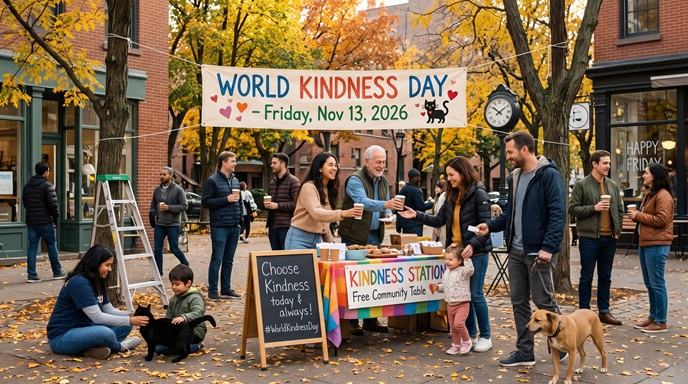
Established in 1998 by the World Kindness Movement, the annual observance encourages people around the world to celebrate compassion, generosity and the occasional act of being decent to another human being. In 2026, World Kindness Day falls on, you guessed it, Friday the 13th.
There’s an even better coincidence. The original World Kindness Day was launched on November 13, 1998, which was itself a Friday.
Think about that for a moment. A date supposedly cursed by centuries of superstition was chosen for an observance dedicated to making the world a little less unpleasant. Somewhere, a black cat is probably reconsidering its fur color.
Of course, kindness doesn’t require a special day and neither does good fortune. People fall in love, children are born, scientific discoveries are made, businesses open and neighbors help neighbors every day of the year. Some of those things happen on Fridays. Some happen on the 13th. Occasionally, the calendar manages to put the two together.
The universe has considerably more important things to worry about than whether you walked under a ladder. It has galaxies colliding, stars exploding and asteroids wandering around without adult supervision. Your travel plans are probably not its highest priority.
Friday the 13th is neither lucky nor unlucky. It is just another day on the calendar, except when it reminds us to be nice to one another. That’s a superstition I can get behind.
Closing the Trilogy
As we close out our 2026 trifecta on this November Friday, the lesson of the year is simple. We live in a world overflowing with arbitrary rules, inherited anxieties and phantom fears. Some deserve our attention. Others deserve a raised eyebrow and a healthy dose of skepticism.
Over a century ago, the Thirteen Club understood something that remains relevant today. Fear loses much of its power when we stop treating it as an unquestionable authority, so spill a little salt, walk under that ladder, book that flight, make that investment decision based on actual research rather than the date printed on your calendar.
Embrace the universe and while you’re at it, do something nice for somebody else. It’s World Kindness Day, after all. It might not change your luck, but it could certainly improve someone else’s day.
Three Friday the 13ths in one year, three opportunities to challenge a superstition and one final reminder that the best way to conquer an irrational fear is to laugh right in its face. Besides, if the universe really wanted to get you, do you honestly think it would bother leaving clues on the calendar? Murphy’s Law famously reminds us that if the universe was out to get you, it would do so on its own schedule.
Discover more from Tales of Many Things
Subscribe to get the latest posts sent to your email.