
A Corporate Soap Opera
For those of you who keep an eye on politics, technology or the stock market, the past couple of weeks have been rather unusual. For those who have been blissfully occupied with more productive things, let me offer a brief recap.
On November 8, 2026, NVIDIA CEO Jensen Huang’s personal life became very public when reports surfaced of extramarital relationships. What initially appeared to be one affair quickly expanded into reports of multiple relationships, including one with Alice Huang (no relation), a former executive at Megaspeed, a Singapore based data center company.
The situation became considerably more complicated when questions emerged about Alice Huang’s alleged connections to Chinese intelligence. The allegations raised national security concerns given NVIDIA’s position at the center of the global artificial intelligence industry and the strategic importance of its technology. Alice Huang denied being a spy and China rejected the allegations as well.
Other reported relationships involved NVIDIA employees, including a senior executive and a subordinate. Suddenly, what might otherwise have been a private marital matter became a much larger question involving workplace conduct, conflicts of interest, executive accountability and potentially national security.
On November 12, Jensen Huang stepped down as CEO of the company he had led for 33 years. CFO Colette Kress assumed the role of interim CEO.
Then the plot thickened.
Government statements offered varying degrees of clarity about what officials knew, when they knew it and whether information about the suspected intelligence connection had reached the appropriate people. The Justice Department subsequently indicated that it had not reached a conclusion about whether Alice Huang was working for Chinese intelligence.
Meanwhile, NVIDIA’s board initially stood by its decision to accept Huang’s resignation. On November 17 the board announced that reinstating him was not its intention. Several prominent business and political figures, including President Donald Trump and Elon Musk, publicly supported Huang’s return. Investor and employee support also became part of the conversation.
On November 23, the board reversed course. Jensen Huang was reinstated as NVIDIA’s CEO, president and board member, effective immediately. The board said it had received input from senior U.S. government officials and was satisfied that his return posed no national security risk. It also announced additional national security oversight and plans to appoint a Chief Compliance Officer.
NVIDIA stock promptly surged 31.5% on the news.
If I were writing a soap opera, I would probably be told that this was an unrealistic number of plot twists to squeeze into one season, much less into two weeks. Apparently, reality has a better writing staff.
Somewhere between the alleged affairs, questions about foreign intelligence, government involvement, boardroom reversals and a stock market celebrating the return of the company’s CEO, something more interesting started to emerge. It wasn’t about NVIDIA’s stock price.
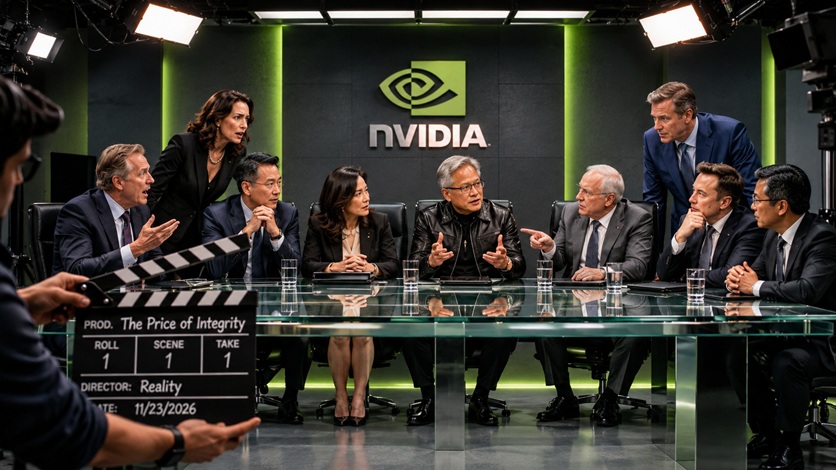
A Tale of Two CEOs
This isn’t the first time a major corporation has had to decide what to do when the personal conduct of its chief executive conflicts with the standards expected of the organization.
On November 1, 2019, McDonald’s CEO Steve Easterbrook was terminated after the company discovered that he had engaged in a consensual, nonphysical relationship with an employee. The relationship involved explicit messages and video calls and violated company policy.
At the time, Easterbrook had been credited with helping McDonald’s improve its business performance. He was hardly an executive whose departure would have been considered inconsequential. McDonald’s, nevertheless, decided that his conduct demonstrated poor judgment and was incompatible with the standards the company expected of its CEO.
There is an important additional detail to this story. A subsequent investigation in 2020 uncovered other relationships with employees, including physical relationships, that Easterbrook had failed to disclose during the original investigation. The SEC later found that Easterbrook had misled the company and investors about the circumstances surrounding his departure.
These two situations aren’t identical and it would be unfair to pretend that they are. The circumstances, available evidence, company policies and subsequent developments differ, but they do present an interesting contrast.
McDonald’s terminated a successful CEO after determining that he had violated company policy through an inappropriate relationship with an employee. NVIDIA accepted the resignation of its CEO following reports of multiple relationships, including one involving a subordinate and another that raised national security concerns, only to reinstate him less than two weeks later.
The question isn’t necessarily whether either board made the correct decision. We don’t have access to all the information available to those directors and we shouldn’t pretend that we do. The question is what happens when the perceived value of an executive begins to influence how we apply our ethical standards.

The Price of Success
There is a concept in economics and risk management called moral hazard. In simple terms, it describes a situation where someone is more willing to take risks or engage in questionable behavior because they don’t expect to bear the full consequences of their actions. It’s an interesting concept when applied to corporate leadership.
Imagine an organization with a clearly defined code of conduct. Employees are expected to follow it. Managers are expected to enforce it. Executives are expected to demonstrate it. The message is straightforward. The rules apply to everyone. Until they don’t.
What happens when the person violating those standards is also the person responsible for billions of dollars in revenue, thousands of jobs and the strategic direction of the company? Does the calculation change?
Perhaps the board believes that the executive is uniquely qualified to lead the company. Perhaps replacing that person would create substantial financial risk. Perhaps investors, employees and customers genuinely believe that no one else can do the job as effectively. Those are legitimate business considerations. Corporate boards have a responsibility to protect the interests of shareholders and the long term health of the organization.
The distinction we need to recognize is between considering someone’s value to an organization and allowing that value to excuse conduct that would otherwise be unacceptable. An organization doesn’t really have ethical standards if those standards disappear when enforcing them becomes expensive. Think about the message that sends to everyone else.
An employee is expected to follow company policy, a manager is expected to demonstrate sound judgment, a director is expected to uphold governance standards, but what if you’re important enough? What if your financial contribution is sufficiently large? What if replacing you would make investors uncomfortable? Do the rules become negotiable? And if they do, what exactly are those rules worth?
The problem isn’t necessarily that an organization gives someone a second chance. People make mistakes and accountability doesn’t always have to mean permanent exile. There is room for acknowledgment, restitution, changed behavior and redemption. The problem arises when the standards used to evaluate one person are fundamentally different from those applied to everyone else simply because that person is more valuable to the bottom line.
When employees begin to believe that accountability is proportional to their replaceability, an organization has a cultural problem that no quarterly earnings report can adequately measure. Worse, it teaches the next generation of leaders that exceptional results can compensate for questionable methods.
That is a dangerous lesson.

The Currency of Integrity
Many years ago, my former manager told me something that has stayed with me ever since. We were discussing a personality conflict involving a third party and she made a statement that I have carried with me through countless professional and personal decisions.
“At the end of the day, the only currency you have left to trade is integrity.”
She went on to describe a person’s reputation as a bank account. You make deposits and withdrawals throughout your life. Every decision, every interaction and every difficult choice represents an opportunity to add to or subtract from that account. Over time, if your deposits don’t outweigh your withdrawals, your credit rating eventually collapses. That’s integrity.
It’s a deceptively simple analogy, but the more I’ve thought about it, the more profound it has become. Integrity isn’t something you can declare about yourself. It’s something other people come to recognize through your actions and unlike a bank account, there is no guarantee that you can make a sufficiently large deposit to recover what you’ve withdrawn. Integrity is accumulated over time, often quietly, through decisions that nobody else may ever know about and it is most valuable when doing the right thing is inconvenient.
Both in business and in my volunteer activities, one of the principles I tried to maintain was that we should always be prepared to defend our decisions. It doesn’t matter whether someone was auditing our records, interviewing our staff, reviewing our procedures or pulling files from our servers. We wanted the facts to demonstrate that we had made the right decisions, even when those decisions were difficult, unpopular or more expensive.
Sometimes doing the right thing means taking the harder road, sometimes it means having uncomfortable conversations, sometimes it means sacrificing an easier solution because it wasn’t the right one, but at the end of the day, there was a certain freedom in knowing that we aren’t trying to hide anything.
We didn’t need to worry about which records someone might find or which decisions might be questioned. We could explain what we did, why we did it and how we arrived at the decision. That was the culture my manager wanted to build and that was the culture I embraced.
It wasn’t because I believed that we were perfect. We weren’t. We made mistakes and we had disagreements, but we understood that mistakes and integrity aren’t mutually exclusive. What matters is how you respond when something goes wrong.
Do you acknowledge it? Do you take responsibility? Do you correct it? Or do you look for ways to make the problem disappear?
Integrity is accumulated through the decisions we make when nobody is watching, but it is also tested when everybody is watching and the consequences of doing the right thing become painfully obvious.

What are We Teaching Ourselves?
This brings me back to NVIDIA. I don’t have a window into its boardroom. I don’t know all the details of the internal investigation, the conversations with government officials or the considerations that ultimately led to Huang’s reinstatement.
More importantly, I don’t need to know those details to ask a broader question. What does this decision communicate?
The board has determined that Jensen Huang is the right person to lead NVIDIA. It has expressed confidence in his candor and ability to lead and it has taken additional steps to strengthen oversight of national security and compliance matters.
Those are the board’s stated conclusions, but there is another consideration that deserves attention, the message that corporate decisions send beyond the boardroom.
When a company makes an exception for an executive because of that person’s perceived value, what does that tell everyone else about the organization’s priorities? When a company reverses a decision after public pressure from investors, employees and influential political and business figures, what does that communicate about the independence of its governance? When the market rewards the return of an executive with a massive increase in share price, what exactly are we celebrating?
Perhaps we’re celebrating the return of a brilliant business leader. Perhaps we’re celebrating the removal of uncertainty surrounding one of the world’s most important technology companies. Those are perfectly reasonable interpretations, but I worry about the possibility that we’re also celebrating the idea that some people are simply too valuable to be held to the same standards as everyone else. That’s a much less comfortable proposition.
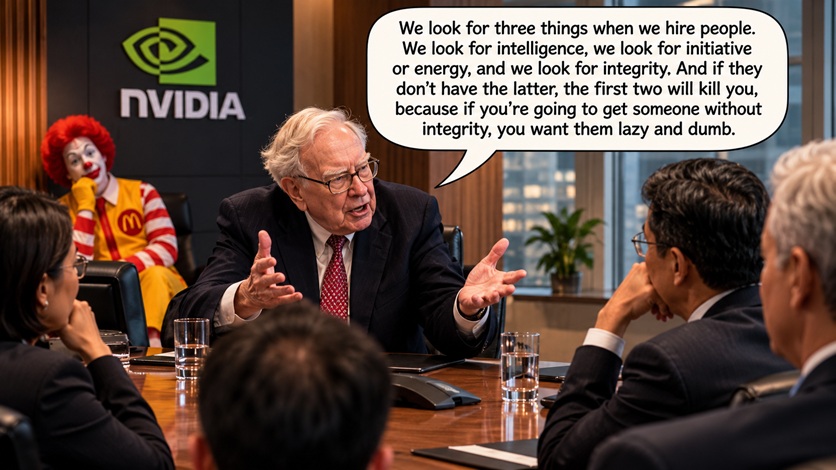
Charles Marshall is often credited with saying, “Integrity is doing the right thing, even when no one is watching.” Warren Buffett offered a similarly blunt observation about the importance of integrity when hiring people. He explained that intelligence and initiative are valuable, but without integrity, those qualities can become liabilities. In his words, if you hire someone without integrity, you’d be better off if they were lazy and dumb. It’s a colorful way of making a serious point.
Intelligence can make someone effective. Initiative can make someone productive. Neither guarantees that they will use those abilities responsibly. In fact, without integrity, intelligence and ambition can make the consequences of poor decisions considerably worse and that applies to more than corporate executives. It applies to politicians, public officials, organizational leaders and anyone entrusted with responsibility over other people.
We routinely ask our leaders to demonstrate accountability, transparency and ethical judgment, yet we sometimes seem willing to overlook those expectations when the person in question delivers something we want. We want the successful CEO, the effective politician, the winning coach, the productive employee and the person who gets things done.
We are less enthusiastic about asking how they got there. Perhaps that is where we have taken a wrong turn.
The Bottom Line
I don’t own NVIDIA stock. I sold my shares some time ago when I became uncomfortable with the company’s valuation. My interest in this situation isn’t financial. It’s a question of what kind of standards we want to establish for ourselves and the organizations we depend on.
I don’t believe that one mistake should define an entire career. I don’t believe that personal relationships should automatically determine someone’s professional worth. I certainly don’t believe that every ethical disagreement should end with someone’s immediate dismissal.
People deserve the opportunity to acknowledge mistakes, take responsibility and demonstrate that they have learned from them, but there is a difference between offering someone a second chance and deciding that the rules no longer apply because the person is too valuable to lose. That is a critical distinction.
A company’s stock price can recover. Its leadership can change. Its products can improve and its financial performance can rebound. Integrity is harder to measure, harder to restore and considerably harder to replace.
My former manager’s words still resonate with me. The only currency you have to trade is integrity. I think about that statement whenever I face a difficult decision, particularly one where doing the right thing comes at a cost, because eventually the financial statements get filed, the headlines fade and the stock market moves on to the next big thing. What remains is the reputation we have built and the trust we have earned.
If we’ve spent that currency carelessly, it doesn’t matter how much money we made along the way. The question isn’t whether success is valuable. Of course it is. The question is whether we’ve decided that success is valuable enough to excuse almost anything.
I hope the answer to that is no.

Discover more from Tales of Many Things
Subscribe to get the latest posts sent to your email.