
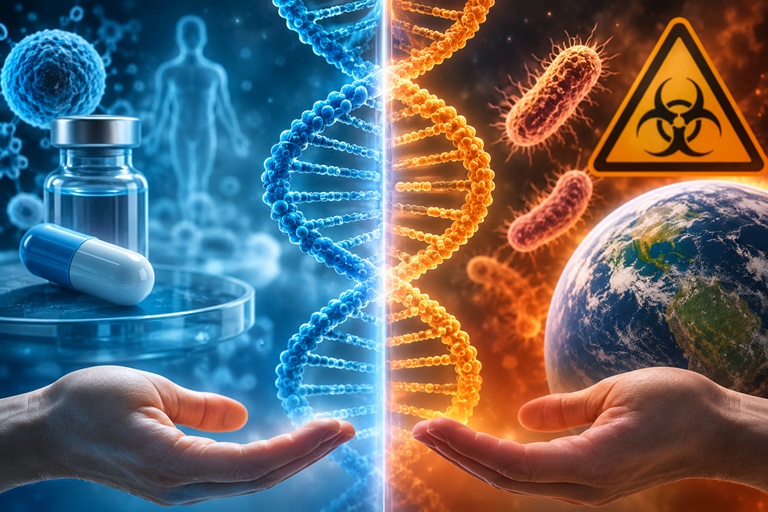
More than sixty years ago, a seemingly gentle sedative taught modern medicine a brutal lesson about geometry at the molecular scale. Introduced in the late 1950s and withdrawn from markets around the world by 1961, thalidomide demonstrated that the shape of a molecule can matter just as much as its chemical composition. The same collection of atoms, connected in the same sequence but arranged differently in three-dimensional space, can interact with the human body in dramatically different ways.
Today, synthetic biologists are contemplating a far more ambitious experiment with that same molecular geometry. Rather than reversing the handedness of a single drug molecule, researchers are exploring whether humanity could eventually construct mirror life, entire biological systems built from the opposite molecular handedness of everything we know in nature.
The potential benefits are intriguing. Mirror image molecules could provide longer lasting medications, new approaches to fighting disease and materials with properties that conventional chemistry struggles to achieve, but a self-replicating mirror organism presents an entirely different proposition. It could operate outside many of the biological safeguards that have shaped life on Earth for billions of years.
As explored in Immortality: The Hidden Subtext, science increasingly gives us the ability to manipulate the fundamental machinery of life, but the ability to build something doesn’t necessarily mean we understand all the consequences of unleashing it and sometimes, the smallest differences have the biggest consequences.
The Thalidomide Tragedy: One Formula, Two Fates
Developed by the German pharmaceutical company Chemie Grünenthal, thalidomide was marketed as a sedative and sleep aid. It was also promoted as a treatment for nausea and morning sickness, making it particularly attractive to pregnant women.
The drug was widely considered safe. It was marketed as a non-addictive alternative to existing sedatives and early testing failed to reveal the devastating effects it could have on fetal development. Behind that reassuring clinical profile was a problem of molecular handedness.
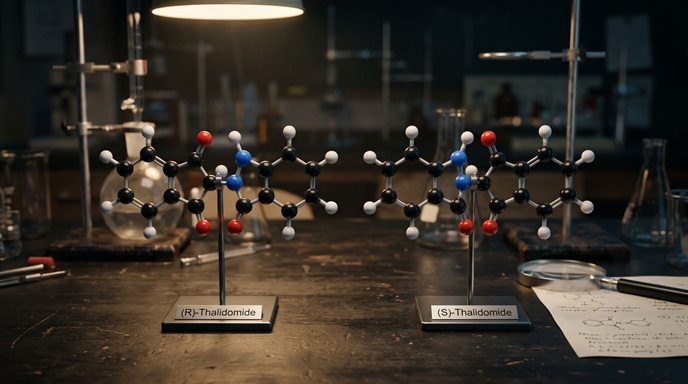
Thalidomide is a chiral molecule, meaning it can exist in two forms that are mirror images of one another, but can not be superimposed. These forms are called enantiomers and are designated the (R)- and (S)-isomers.
The two enantiomers have the same chemical formula and the same connections between their atoms. Their difference is spatial. The arrangement of their atoms around a central carbon is reversed.
Early research suggested that the (R)-enantiomer was primarily responsible for the desired sedative effects, while the (S)-enantiomer was responsible for the drug’s devastating teratogenic effects, meaning its ability to disrupt fetal development.
However, the story is more complicated than simply separating the good molecule from the bad one. Thalidomide undergoes a process called racemization in the body. The two enantiomers can spontaneously interconvert, meaning that even administering a purified version of one form does not prevent the body from producing the other. In other words, separating the two molecular hands would not have provided a reliable solution.
The consequences were catastrophic. More than 10,000 children worldwide were born with severe congenital abnormalities, including phocomelia, a condition characterized by severely shortened or missing limbs. Many others died before or shortly after birth.
The tragedy transformed pharmaceutical oversight, accelerated changes in drug testing requirements and helped establish the modern expectation that medications must be evaluated for reproductive and developmental toxicity.
Thalidomide eventually found legitimate medical applications under strict controls, including treatment of certain complications of leprosy and multiple myeloma. Its history remains a reminder that a compound’s therapeutic potential and its capacity to cause harm can coexist.
Thalidomide wasn’t an example of mirror life, nor does its mechanism predict what mirror organisms would do. The lesson wasn’t simply that chemistry can be dangerous. It demonstrated something more fundamental. Biological systems are sensitive to molecular geometry in ways that aren’t always apparent until something goes wrong and understanding what a molecule does requires understanding how it interacts with everything around it.
Chirality: Why Life on Earth Is One-Sided
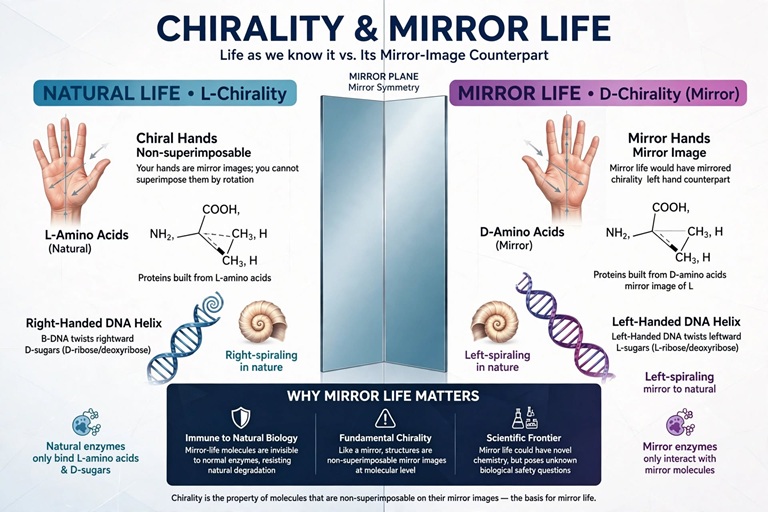
Imagine holding your left hand in front of a mirror. The reflection looks like a right hand. Both have the same basic components, but no amount of rotating the left hand will make it perfectly fit a right handed glove. That property is called chirality, derived from the Greek word cheir, meaning hand.
Molecules can exhibit the same property. They may contain precisely the same atoms connected in precisely the same sequence, yet their three-dimensional arrangements create two non-superimposable mirror images.
This isn’t merely a chemical curiosity. It is fundamental to how life works. Earth’s known biology is overwhelmingly homochiral, meaning living organisms use a consistent molecular handedness for many of their essential building blocks.
| Biological building block | Predominant form in Earth life | Mirror counterpart |
| Amino acids (proteins) | L-amino acids | D-amino acids |
| Sugars (DNA and RNA) | D-sugars | L-sugars |
The labels L and D describe molecular configurations relative to a chemical reference system. They aren’t simply interchangeable with left handed and right handed descriptions of every physical property, but they provide a useful shorthand for understanding the distinction.
Why did life choose one side instead of mixing both? We don’t know exactly how biological homochirality emerged. It may have involved small initial asymmetries that were amplified through chemical reactions and early evolutionary processes. What we do know is that once life established a particular handedness, evolution built upon it.
Proteins folded into structures compatible with L-amino acids. Enzymes developed active sites that recognized particular molecular shapes. DNA and RNA machinery evolved around sugars with a particular configuration. The entire biological system became interconnected around these choices.
Think of it as an extraordinarily complex collection of locks and keys. Each protein, enzyme, receptor and biological mechanism evolved to recognize particular molecular shapes. Change the shape and the key may no longer fit.
This consistency is one of the foundations of modern biology. It is also what makes mirror biology so interesting.
Crossing Over to Mirror Life
Mirror biology attempts to reverse that molecular architecture.
Instead of proteins constructed from L-amino acids, researchers can synthesize proteins using D-amino acids. Instead of conventional DNA and RNA containing D-sugars, scientists can construct mirror nucleic acids using L-sugars.
The resulting molecules are not merely different versions of their natural counterparts. They are their structural mirror images and because the biological machinery on Earth evolved to recognize one particular molecular handedness, these mirror molecules interact very differently with conventional biological systems. This is where the technology can become dangerously interesting.
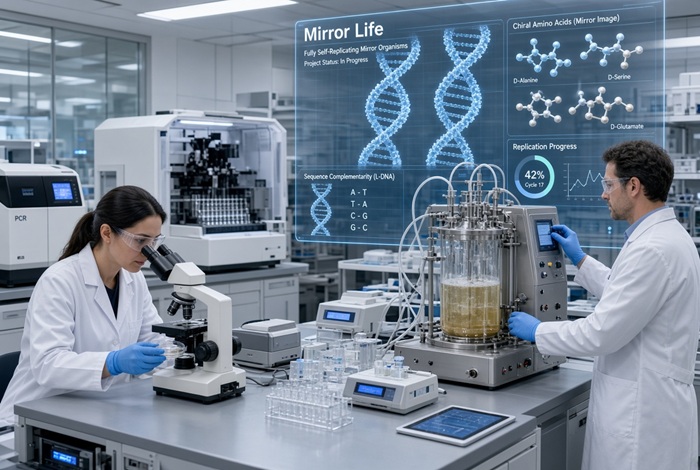
It is important to distinguish between making individual mirror molecules and creating an entire living organism from them. Scientists have already produced a variety of mirror image biological molecules and demonstrated that some can perform useful biological functions.
A fully self-replicating mirror organism, however, would require an entirely different level of engineering. It would need mirror versions of the machinery responsible for storing genetic information, copying DNA, producing proteins, processing nutrients, maintaining cellular structures and reproducing.
In essence, researchers would need to recreate the fundamental machinery of life with its molecular handedness reversed. That is an enormous undertaking. It is also why mirror life remains hypothetical.
The Promise: When Biology Can’t Break the Molecule
Why would anyone want to create mirror molecules in the first place?
One of the biggest challenges in medicine is that the human body is exceptionally good at breaking things down.
Enzymes digest proteins. Other enzymes degrade nucleic acids. Metabolic processes identify and process foreign compounds. These mechanisms are essential to keeping us alive, but they can also make developing effective medications difficult. A drug may work beautifully in a laboratory, but disappear too quickly inside the body to provide lasting therapeutic benefits.
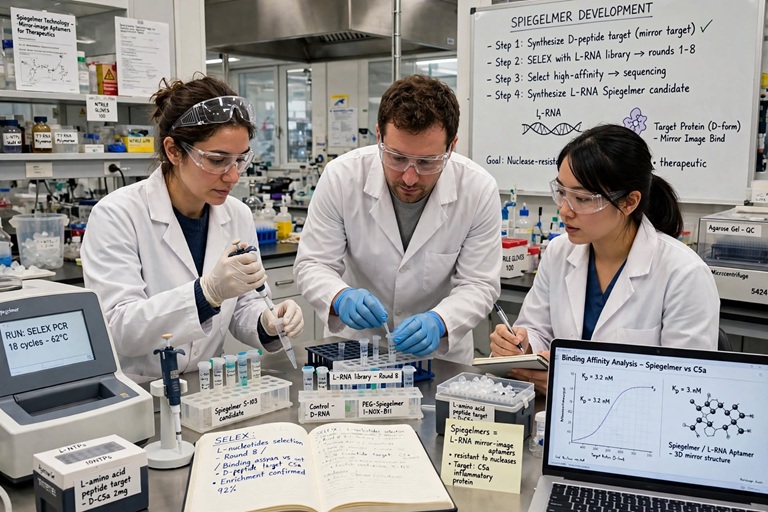
Mirror molecules offer a potential workaround. Because ordinary biological enzymes are designed to recognize natural molecular configurations, they often struggle to interact with mirror image versions. A mirror peptide, for example, may resist degradation by the proteases that would normally break down its conventional counterpart. That stability could translate into several important applications:
Longer lasting medications: Mirror peptides and proteins could remain active in the body longer, potentially reducing how frequently patients need medication.
New therapeutic targets: Mirror molecules could be designed to bind specific biological targets while resisting the enzymes that would otherwise destroy them. This could open new avenues for treating diseases that are difficult to address with conventional drugs.
Antimicrobial research: Mirror image antimicrobial peptides are being investigated as potential tools against bacterial infections. Their unusual structure could make them less susceptible to some of the mechanisms bacteria use to defend themselves against naturally occurring antimicrobial peptides. Whether this translates into meaningful advantages against antibiotic resistance remains an active research question.
Diagnostic tools: Mirror image DNA and RNA can be used in molecular detection systems. One particularly interesting application involves Spiegelmers, synthetic mirror image nucleic acid molecules designed to bind specific biological targets. Their resistance to ordinary biological degradation makes them attractive candidates for diagnostic and therapeutic applications where conventional nucleic acids may be too fragile.
Advanced materials: Mirror biological molecules may also have applications in nanotechnology, photonics and materials science. Their unusual structural properties could help researchers develop more durable materials and new ways of manipulating light and other physical phenomena.
The possibilities extend beyond medicine. They could influence agriculture, manufacturing, biotechnology and even long term biological data storage. It’s important to stress that researchers can pursue many of these benefits without creating a living mirror organism.
A mirror molecule is a tool. It can be designed, synthesized, tested and used for a specific purpose. It doesn’t reproduce itself, evolve or establish an ecological presence. That distinction becomes critically important when we move from individual molecules to living systems.
The Other Side of the Mirror: Why Self-Replicating Life Is Different
A single mirror molecule is a chemical structure. A mirror organism would be a living system capable of reproducing itself. That changes the risk calculation considerably.
Life on Earth has evolved within an interconnected biological environment. Organisms compete for resources, consume one another, become infected by parasites and are controlled by predators, pathogens and environmental conditions.
Our immune systems recognize foreign biological structures. Bacteria are attacked by viruses called bacteriophages. Predatory microorganisms consume other microbes. Enzymes break down biological material, returning nutrients to the environment. These relationships create an enormous network of natural checks and balances.
A mirror organism could potentially bypass many of them.
- Evading biological recognition
The human immune system relies on molecular recognition. Antibodies, immune receptors and other defensive mechanisms interact with biological structures using the same general molecular handedness found throughout nature. A mirror bacterium could present structures that conventional immune defenses struggle to recognize.
That doesn’t mean it would be completely invisible to the immune system. Biological interactions are complicated and not every immune mechanism depends exclusively on molecular chirality. Some natural immune responses might still occur.
However, researchers have serious concerns that many important recognition and defensive mechanisms would be significantly impaired.
- Escaping natural predators
Bacteria have natural enemies. Bacteriophages, the viruses that infect bacteria, recognize specific molecular structures on their hosts before injecting their genetic material. Predatory microorganisms similarly depend on molecular interactions to identify, attach to and consume other organisms.
A mirror bacterium could be incompatible with many of these natural predators. Imagine introducing an invasive species into an ecosystem where its usual predators can not recognize it as food. The consequences could be difficult to predict, particularly if the organism also competes successfully for available resources.
- Becoming an ecological outlier
Perhaps the most concerning possibility is that mirror organisms could survive and spread in environments where ordinary biological controls are ineffective. A mirror organism would not necessarily need to consume conventional proteins or sugars to survive. Some essential resources, including water, oxygen, carbon dioxide and certain simple carbon compounds, are achiral. They don’t have a molecular handedness that would prevent a mirror organism from potentially using them. This raises the possibility that mirror organisms could obtain at least some of the resources necessary for survival without depending on the biological building blocks used by conventional life.
There are still substantial questions about how well mirror organisms could obtain nutrients and reproduce in natural environments. Their ability to exploit particular resources would depend on their design and the environment they encountered, but even limited growth could present problems if the organism occupied a niche without the usual biological competition.
The concern extends beyond a single environment or species. A sufficiently versatile mirror organism could potentially establish itself in multiple ecosystems, interacting with different hosts and competing for resources across a much wider range of environments. The researchers examining this possibility could not rule out scenarios involving widespread infections across plant and animal populations. This isn’t a prediction that such an outcome is inevitable. It’s an acknowledgment that the consequences could extend well beyond the organism’s original point of release.
- Challenging detection and containment
Our existing biological surveillance systems are designed around the biology we know. Laboratory tests, diagnostic methods and many established approaches to identifying pathogens rely on recognizing familiar biological structures. Mirror organisms could evade some of those detection methods, complicating early identification.
Containment presents another challenge. Antibiotics and other antimicrobial treatments might still work against some mirror organisms, depending on their targets and mechanisms. It would be inaccurate to assume that every conventional treatment would fail, but the absence of effective natural predators and the difficulty of detecting an outbreak could make containment extraordinarily challenging.
Treating an individual infection is one thing. Trying to eliminate an organism that has established itself throughout an ecosystem is something else entirely. You can not administer antibiotics to an entire forest, ocean or agricultural region.

The Scientific Community Is Asking Questions Before the Technology Arrives
This isn’t simply a science-fiction thought experiment. In December 2024, an international group of 38 scientists published a paper in Science titled Confronting the Risks of Mirror Life. The authors represented a broad range of disciplines, including synthetic biology, immunology, microbial ecology, evolutionary biology, biosecurity and public health.
Their conclusion was unusually direct. They argued that mirror bacteria could potentially evade important immune defenses, escape natural predators and establish themselves in environments where conventional biological controls would be ineffective. They also concluded that the potential consequences could be severe enough that mirror organisms should not be created with current scientific understanding.
Importantly, the group included researchers who had previously considered creating mirror life a long term scientific aspiration.
This wasn’t simply an outside group objecting to unfamiliar technology. Scientists working in the field were examining their own ambitions and raising concerns about where those ambitions might lead.
The discussion continued in 2025, including an international meeting at the Institut Pasteur in Paris, where experts emphasized the need for transparency, international coordination and safeguards against creating self-replicating mirror organisms.
In March 2026, the United Nations Secretary General’s Scientific Advisory Board also published a briefing distinguishing the potential benefits of mirror molecules from the much greater risks associated with self-replicating mirror life.
The technology to create useful mirror molecules already exists. The technology to create an independent, self-replicating mirror organism does not.
Estimates of how far away that capability might be vary. Some researchers have suggested at least a decade, while others believe the technical challenges could take considerably longer. Creating even a conventional synthetic cell remains an enormous scientific undertaking.
What we shouldn’t do is wait until the technology exists to debate its consequences. That would be a remarkably poor approach to risk management.
Cures vs. Uncharted Infections: Where Do We Draw the Line?
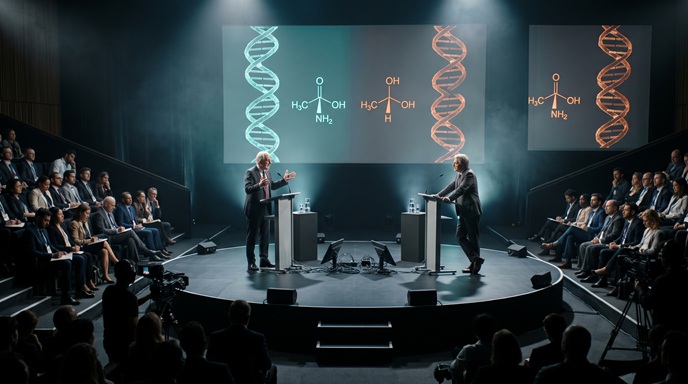
The tension at the heart of mirror biology is not whether science should advance. It is how we decide which advances are worth pursuing and which risks are too consequential to accept.
The potential benefits of mirror molecules are compelling. Longer lasting medications, improved diagnostics, novel antimicrobial treatments and advanced materials could deliver meaningful improvements to human health and technology.
Those are worthwhile objectives, but creating a self-replicating mirror organism is a different proposition. Its potential benefits are largely speculative, while the consequences of losing control could be extraordinarily difficult to reverse.
There is also a question of necessity. What scientific problem would require us to create an entirely self-replicating mirror organism when many of the potential benefits can be pursued using individual mirror molecules? If the same therapeutic or industrial objectives can be achieved without introducing an entirely new biological system, the justification for taking that additional risk becomes considerably harder to establish.
There is an important middle ground between banning an entire field of research and pursuing every possible technological achievement simply because we can. We can encourage research into useful mirror molecules while establishing clear boundaries around the development of self-replicating mirror organisms. We can invest in better detection methods, investigate possible countermeasures and establish international agreements before the technology becomes feasible.
We can also recognize that some scientific questions don’t require us to build the most dangerous possible version of a technology to answer them. This is not an argument against curiosity. It is an argument for applying the same intellectual discipline to the consequences of our discoveries that we apply to the discoveries themselves.
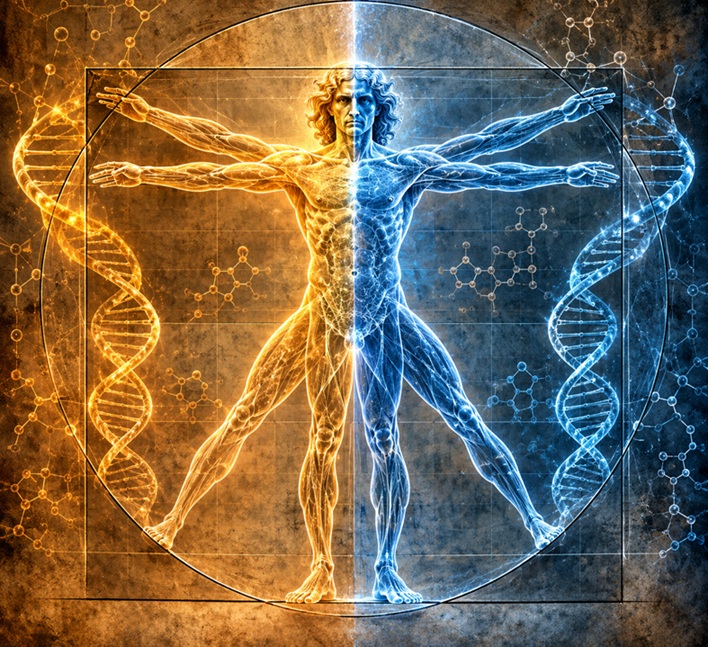
Thalidomide taught us that the smallest differences in molecular structure can have enormous biological consequences. Mirror biology takes that lesson to another level. Instead of changing one molecule and observing what happens, we are contemplating changing the molecular architecture of an entire living system.
Humanity has spent billions of years evolving alongside the biology of this planet. We understand a great deal about it, but we are still discovering how interconnected its systems really are.
We should be excited about the possibility of using mirror molecules to improve medicine and technology. We should also be extraordinarily cautious about creating something that might operate outside the biological systems that help keep our world functioning.
Scientific progress is not measured solely by what we manage to create. It is also measured by what we understand well enough to create responsibly. Sometimes the smartest thing we can do with a new capability is recognize where its benefits end and its risks begin.
Thalidomide taught us what can happen when our understanding of a technology fails to keep pace with its application. Mirror biology offers something different, an opportunity to recognize the risks before the technology reaches maturity. We don’t have to repeat the mistakes of the past simply because the possibilities of the future are exciting.
Just because we can turn life upside down doesn’t mean we should let it get out of hand.
Discover more from Tales of Many Things
Subscribe to get the latest posts sent to your email.