When we think about electricity, we tend to think in one direction. Power plants stay put. Electricity travels.
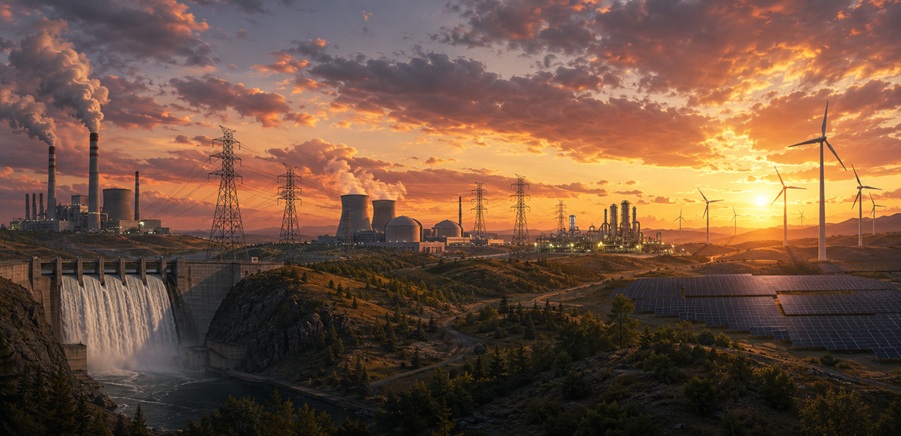
For more than a century, that’s how we’ve built civilization. We construct enormous coal plants, hydroelectric dams, natural gas stations, wind farms, nuclear reactors and solar arrays, then string tens of thousands of miles of transmission lines across the continent to bring power to our homes and businesses.
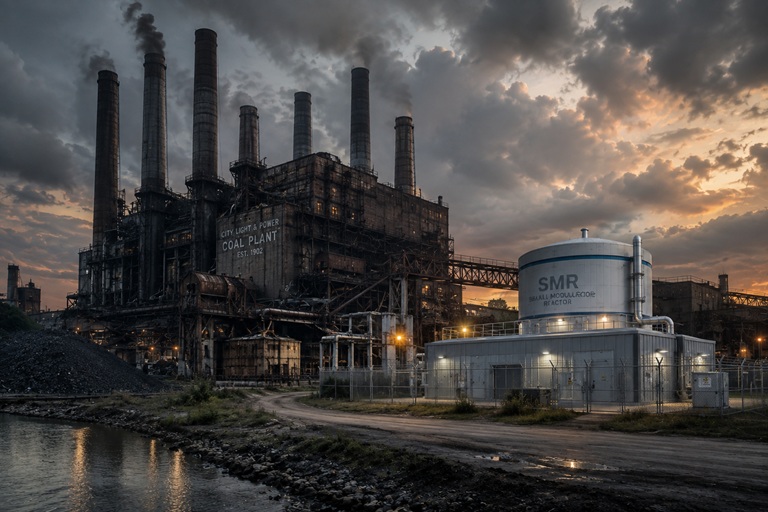
Small Modular Reactors (SMRs) ask a radically different question. Instead of asking how to extend the grid to reach a power plant, they ask how to bring generating capacity to the grid that already exists, even if it’s severed from the master grid.
It sounds like science fiction.
In reality, it’s a technology that’s been quietly operating for decades.
The Nuclear Elephant in the Room
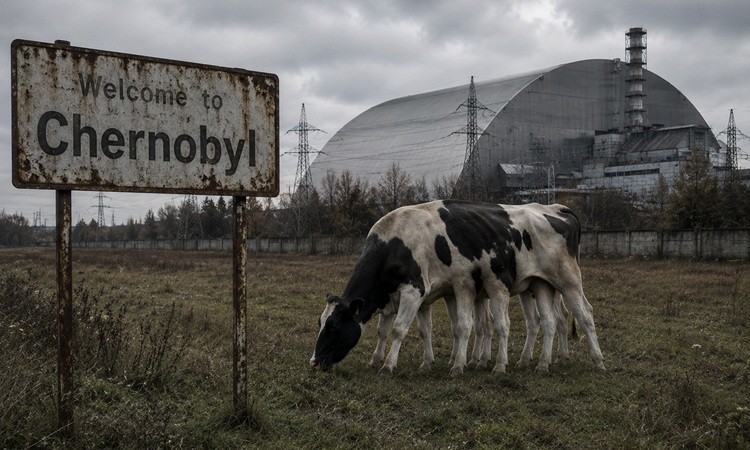
Mention nuclear power and most people immediately think of Three Mile Island, Chernobyl, Fukushima. That’s understandable. The conversation around nuclear energy is rarely a quiet one. People are either violently for it or violently against it. The fear is easy to understand.
When nuclear energy goes bad, it doesn’t just break. It creates a generational scar. It is a cinematic, terrifying kind of failure. But nuclear accidents are rare. When they happen, they capture the world’s attention in a way few other industrial disasters can. Radiation is invisible. Its effects can last decades. The fear is deeply rooted and entirely rational.
So when someone proposes putting small nuclear reactors closer to communities, the first reaction is often, “Absolutely not!” The idea of placing “mini nuclear power plants” closer to our neighborhoods feels, to some, like inviting a wolf into the backyard.
But that reaction assumes that an SMR is simply a miniature version of a conventional nuclear power plant. How new is this technology, really?
In many ways, it isn’t new at all.
A Technology That Isn’t New
The phrase Small Modular Reactor sounds like something invented last year, ready to be installed as a warp core on Space-X’s next moonshot.
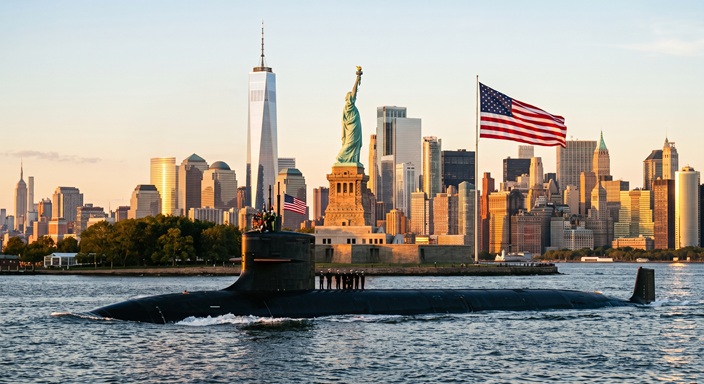
In reality, versions of the technology have existed for multiple generations. The U.S. Navy has operated nuclear-powered submarines since the 1950s. Aircraft carriers rely on compact reactors to remain at sea for years without refueling.
Collectively, navies around the world have accumulated thousands of reactor years of operating experience using reactors that are, in many respects, predecessors to today’s SMRs.
Think about that for a moment.
Every sailor aboard a nuclear submarine literally entrusts their life to one of these reactors. They sleep a few feet away from it. They sail beneath the ocean for months at a time with no possibility of simply stepping outside if something goes wrong.
If that sounds terrifying, it should also tell us something else. Small reactors are not an untested experiment. They are an evolution of a technology that has quietly been proving itself for decades.
If you live in a coastal city, an American nuclear submarine has almost certainly patrolled the waters just off your shore. Those submarines do not run on extension cords. They are powered by small, self-contained nuclear reactors. We don’t twitch when a submarine passes the harbor. Nobody panics. Nobody evacuates. We celebrate it. Yet, the moment we talk about putting that exact same physical footprint on dry land to power a hospital or a data center, the panic button gets pressed.
Smaller Doesn’t Mean More Dangerous
Traditional nuclear plants produce enormous amounts of electricity, often more than a gigawatt. They’re engineering marvels, but they’re also incredibly complex.
SMRs typically generate a fraction of that output. That smaller size changes the engineering.
Many designs rely on passive safety systems, using gravity, natural circulation and basic physics rather than pumps, backup generators and constant operator intervention. If power is lost, many proposed SMRs are designed to cool themselves without human action.
Some designs are buried underground, providing additional protection from natural disasters or deliberate attacks.
No technology is perfectly safe, but modern SMRs are being designed around a very different philosophy than the reactors built half a century ago.
The Real Innovation Isn’t Nuclear
Ironically, the most revolutionary thing about SMRs isn’t the nuclear technology. It’s the logistics.
Traditional nuclear plants are among the largest construction projects humanity undertakes. They can require billions of dollars, thousands of workers and close to a decade to complete.
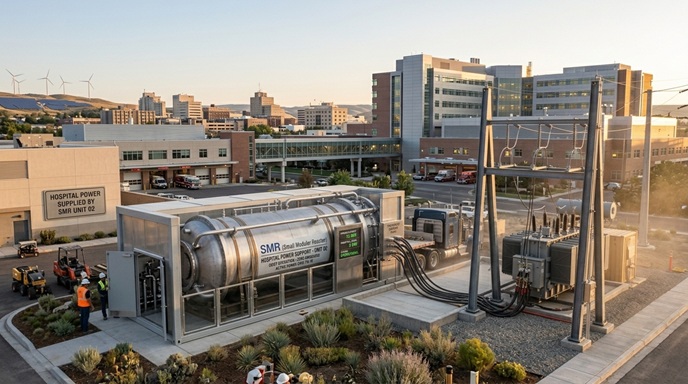
SMRs turn much of that process upside down. Instead of building everything from scratch on-site, the reactors are manufactured in factories, shipped as modules and assembled where they’re needed.
That dramatically changes where nuclear power becomes practical.
- An isolated island.
- A remote mining operation.
- A military installation.
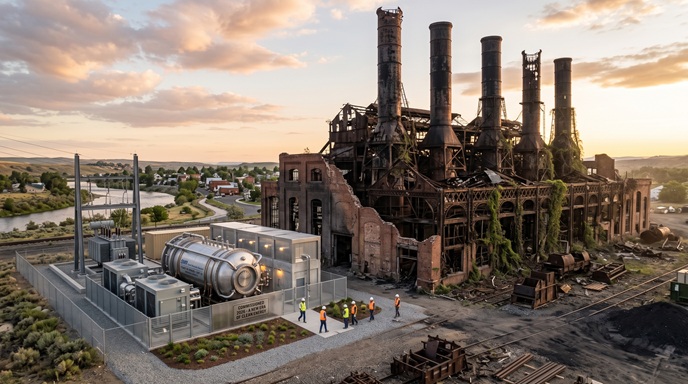
- A retiring coal plant.
- A rapidly growing industrial park.
Places that would never justify building a conventional nuclear power station might suddenly have another option.
Power as a Service
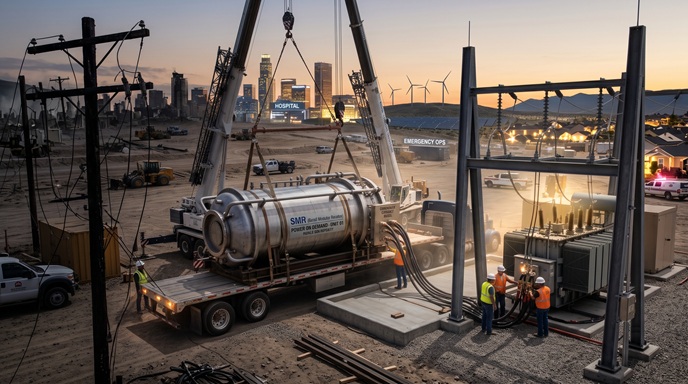
The idea becomes even more interesting during emergencies. Imagine a category 5 hurricane or a 7.0 earthquake devastates a city. Transmission lines are down. Fuel deliveries are disrupted. Hospitals need reliable electricity. Water treatment plants can’t operate. Communications infrastructure is failing. Your focus is no longer recovery driven by existing power infrastructure. You have to provide security and resources to people first.
Your only solution is mass evacuation of a major metropolis because you can not immediately ship in enough solar panels, wind turbines or millions of tons of coal to restore an entire city’s infrastructure in an afternoon. Historically, the solution has been fleets of noisy diesel generators and an endless stream of fuel trucks as an evacuation is under way. None of this goes fast, but SMRs suggest another possibility.
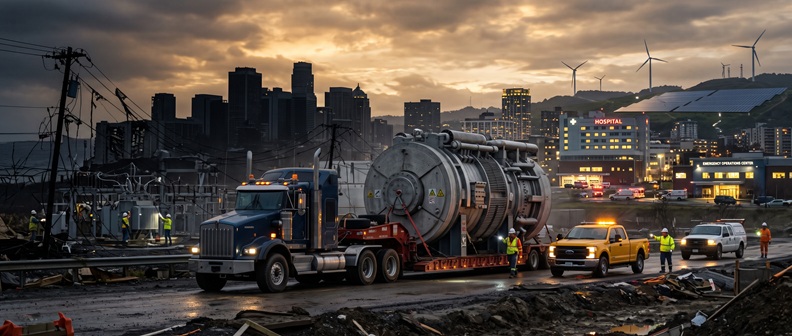
Some future transportable reactor designs envision shipment by heavy haul truck, rail or barge. Instead of constructing an entire power station from scratch, the generating unit itself could be delivered largely complete, reducing deployment from years to weeks or even days and, longer term, this technology can become “plug and play”, establishing a massive on demand stable power supply within days, if not hours.
Instead of transporting fuel to thousands of generators, you transport one compact power plant capable of supplying continuous electricity for decades.
It transforms energy from a permanent geological monument into a logistical asset. Power on Demand. Power as a Service.
It isn’t quite as simple as parking a trailer and flipping a switch. Civilian SMRs still require site preparation, regulatory approval and connection to the electrical grid, but the underlying concept represents a profound shift in how we think about energy infrastructure.
Instead of building one enormous power station intended to serve millions of people for decades, we begin thinking in terms of scalable building blocks that can be deployed where and when they’re needed.
It’s less like constructing a cathedral and more like assembling with Lego bricks. The ultimate allure of the SMR isn’t just about baseline electricity. It is about mobility.
The question isn’t whether small reactors are technically possible. We’ve known the answer to that for decades. This technology has been quietly humming underneath the ocean waves for decades. The real question is whether our institutions, our regulations and our collective psychology can handle a nuclear reactor that doesn’t sit behind a massive concrete cooling tower on the horizon, but arrives on the back of a truck and if we can deliver this economically at scale.
The Tradeoffs
That doesn’t mean SMRs are a silver bullet. They have real challenges.
Because they’re smaller, they lose some of the economies of scale enjoyed by traditional nuclear plants. The first commercial units are expected to produce electricity at a higher cost than today’s utility-scale wind and solar farms.
Some advanced designs require specialized HALEU (High-Assay Low-Enriched Uranium) fuel, whose commercial supply chain is still developing.
Radioactive waste remains a long-term responsibility and some studies suggest certain SMR designs could produce more waste per unit of electricity than conventional reactors.
Then there’s regulation. Nuclear licensing rightly moves cautiously, but that caution also means years of reviews before many new designs can be deployed commercially.
These are not trivial obstacles. They’re engineering, economic and political challenges that still need solutions.
How Do SMRs Compare with Renewables?
This is where the conversation often becomes unnecessarily polarized. People tend to frame the debate as nuclear versus renewables.
It doesn’t have to be.
Wind and solar are extraordinarily effective at producing inexpensive electricity when the weather cooperates.
SMRs excel somewhere else. They produce electricity twenty-four hours a day, regardless of whether the wind is blowing or the sun is shining. One technology provides abundant clean energy when conditions are favorable. The other provides reliable clean energy when they aren’t.
The future electrical grid will not belong to one technology. It will belong to all of them working together.
The economics tell the final story through the Levelized Cost of Energy, the lifetime cost of building and operating a system divided by its total output:
- Utility Scale Solar: ~$40 to $98 / MWh
- Onshore Wind: ~$37 to $99 / MWh
- Traditional Large Nuclear: $175 to $255 / MWh
- Small Modular Reactors (SMRs): $90 to $130+ / MWh for First-Of-A-Kind (FOAK) builds.
Projections suggest that if we reach mass commercial assembly lines, Nth-Of-A-Kind (NOAK) manufacturing, SMR costs could plummet to $60 to $80 per MWh, bringing SMRs right into the competitive ring.
A Different Way to Think About Energy
For over a century our answer to growing demand has been to build larger power plants. Larger dams. Larger coal stations. Larger nuclear reactors. Larger transmission networks.
SMRs represent a different philosophy.
Don’t build bigger. Build smarter. Build smaller. Build them in factories. Deliver them where they’re needed. Scale them like building blocks instead of monuments.
Whether SMRs ultimately become commonplace remains to be seen. They still face economic, regulatory and technical hurdles. But if they succeed, history may remember them not as a new kind of reactor, but as the moment electricity itself became modular.
SMRs challenge the assumption of permanent energy infrastructure. Instead of asking, “Where should we build the next giant power plant?” They ask, “Where is power needed today?”
Every major civilization has been shaped by how it produced energy. Wood built the ancient world. Coal powered the Industrial Revolution. Oil transformed the twentieth century. The twenty-first century may not be defined by a new fuel at all. It may be defined by a new idea, that power doesn’t always have to come from somewhere else.
Sometimes, the power plant can come to you.