
One of the comments I received after writing “The Age of Re-engineering: How Science Is Rewriting the Limits of Human Life” sparked a fascinating, if sobering, question. It was both simple and profound: “What happens if we actually succeed? What happens if people simply stop dying of old age? How do you manage the population explosion?”
It’s an uncomfortable question because it forces us to think beyond the miracle.
Imagine a world where science doesn’t merely extend life to 90 or 100 years, but to 500 or even 1,000. Cancer has become manageable. Alzheimer’s is a memory. Hearts, kidneys and livers can be repaired or replaced. Aging itself has become another disease that medicine learned to treat.
It sounds like paradise, until you do the math.
Eight billion people eventually becomes twenty.
Twenty becomes fifty.
One hundred billion no longer sounds impossible.
Could Earth survive that?
Perhaps. But not the way we’re living today. Not under the rules of the world we established.
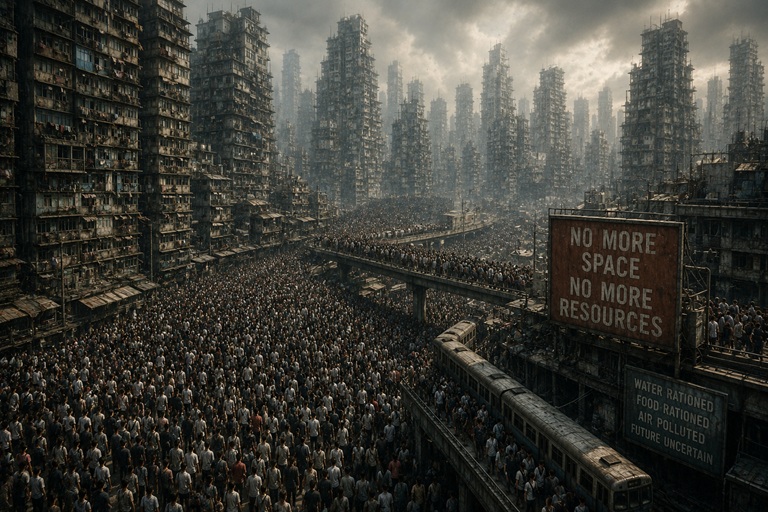
If the more optimistic biogerontologists are correct and the first person who could one day celebrate a thousandth birthday may already be alive, the demographic math changes overnight. Death has historically acted as nature’s merciless automated clear-out mechanism. Remove that mechanism without altering our birth rates or ecological footprint and the math becomes terrifyingly simple: population numbers stop cycling and start compounding indefinitely.
We could be staring down the barrel countless billions of beings sharing a single pale blue dot.
Let’s face it, managing a population explosion by turning Earth into a tightly rationed, hyper-processed concrete hive brings us uncomfortably close to Soylent Green. That is a dark, claustrophobic horizon for human civilization.
If we are going to solve the mortality problem, we must solve the spatial problem. We can not cure aging while locking ourselves inside a finite greenhouse set on burning us out.
The Hidden Assumption
Most discussions about longevity make one assumption without ever questioning it. Longer lives automatically mean catastrophic overpopulation. It seems obvious, but history suggests the answer may be more complicated.
Around the world, wealthier and more developed societies tend to have fewer children. Countries like Japan, South Korea, Italy and Germany are already struggling with declining birth rates. In many places, the concern isn’t overpopulation. It’s population decline.
Now imagine a world where people routinely live for centuries. Would couples still feel pressured to have children in their twenties? Or would they wait until they were 150? Would someone have four children during a 1,000 year lifetime? Or one child every hundred years?
No one knows.
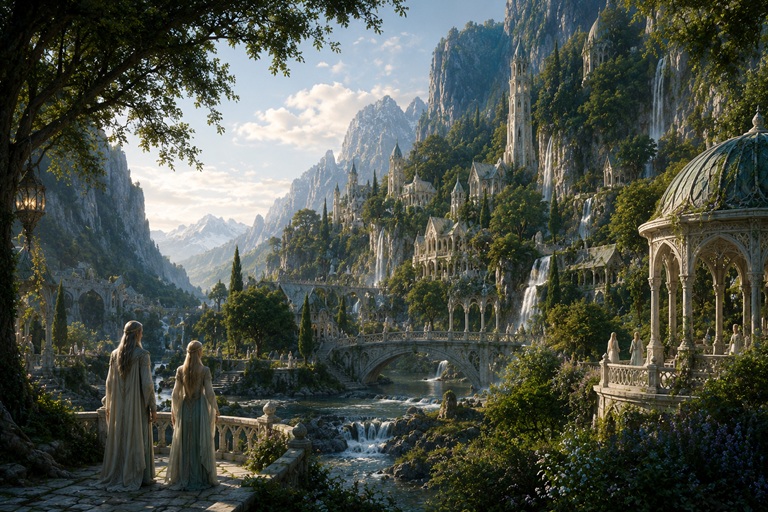
Perhaps the best fictional model for an exceptionally long-lived civilization isn’t found in science fiction at all. It’s found in Tolkien’s elves. The elves of Middle-earth are effectively immortal, unless killed by violence or grief, yet their population never overwhelms the world because they have remarkably few children. They marry rarely, have small families and reproduce only when they genuinely desire to. Their society isn’t driven by the urgency of a short lifespan. There is no biological clock relentlessly driving every major life decision. Whether Tolkien intended it or not, his elves hint at a fascinating possibility: if humans one day expect to live for centuries, our relationship with family, parenthood and time itself may change dramatically. Instead of population growing exponentially, longevity might naturally be balanced by declining birth rates as people choose to delay or simply have fewer children over the course of extraordinarily long lives.
Longevity doesn’t just change medicine. It changes human behavior. That uncertainty makes predicting the future remarkably difficult. Still, it’s worth exploring the possibilities.
Scenario One: The Population Explosion
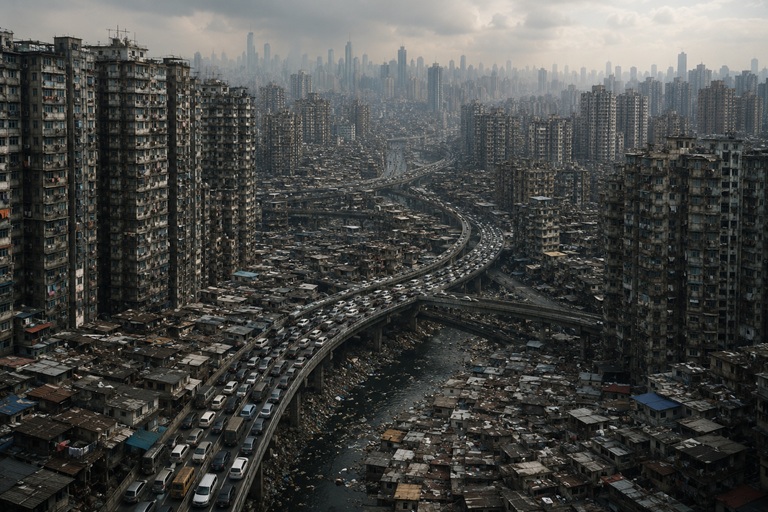
Let’s assume births remain relatively constant while deaths become increasingly rare. Humanity’s population begins climbing at an unprecedented rate. Suddenly, medicine is no longer our greatest challenge. Engineering is.
How do you provide food, clean water, energy, transportation, housing and meaningful work for tens of billions of people? The answer almost certainly isn’t “more of what we’re doing today.”
Higher population would require entirely new ways of feeding ourselves. Vertical farms instead of endless fields. Cultured meat instead of massive livestock operations. Algae providing food, fuel and biodegradable materials. Closed loop recycling systems where almost nothing is wasted. Energy sources capable of powering civilizations far larger than our own. Earth doesn’t necessarily run out of space.
It runs out of inefficiency.
Scenario Two: Population Stabilizes Itself
There’s another possibility that receives far less attention.
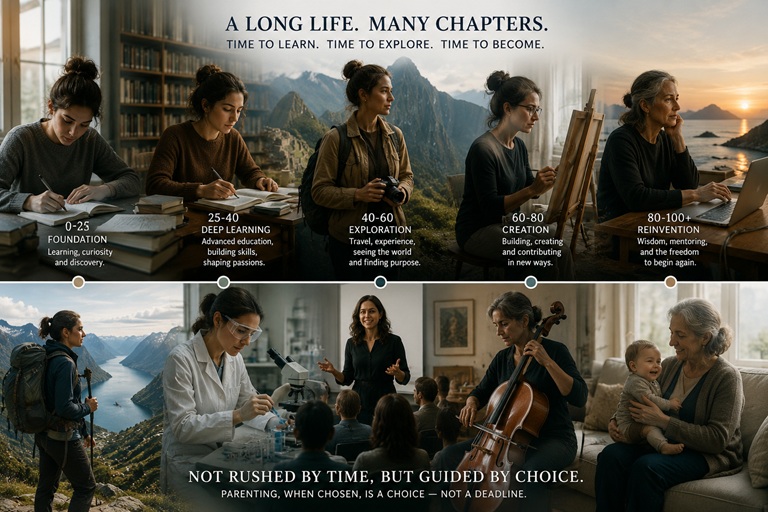
Perhaps birth rates continue falling. If people expect to live for centuries, there may be little urgency to start families early in life. Education could last decades. Careers might span a century. People might travel, learn, create and reinvent themselves multiple times before ever considering parenthood.
Ironically, extending human life might eventually reduce population growth instead of accelerating it. Nature has surprised us before. It may surprise us again.
Scenario Three: Humanity Expands Beyond Earth
This is where another thought returns to me. Earlier this year, I wrote about why humanity should become a spacefaring civilization.
Not because Earth is doomed. Because one planet has limits.
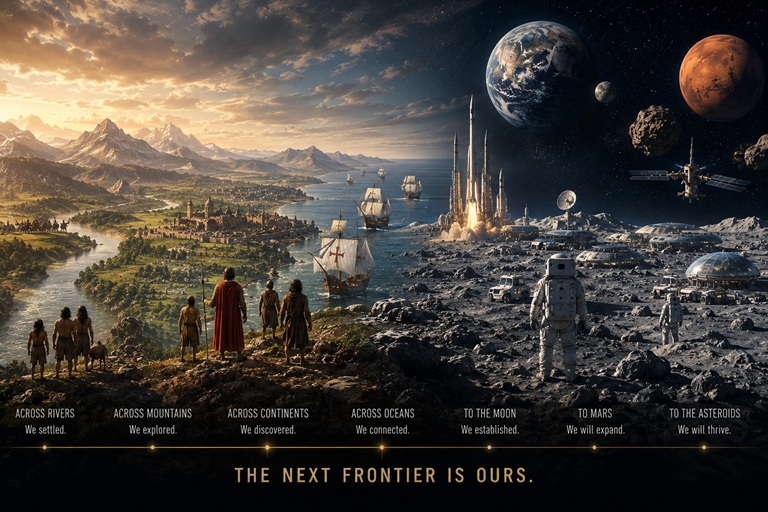
Every civilization throughout history expanded into new frontiers. Across rivers. Across mountain ranges. Across continents. Across oceans.
Eventually, there were no unexplored places left.
Space is the next frontier. The Moon is realistic. Mars is realistic. Asteroids are realistic. Each represents another step toward a civilization no longer confined to a single planet.
People often ask why we should spend money exploring space when we have problems here on Earth. This is one answer. If humanity succeeds in dramatically extending life, space exploration stops being a luxury. It becomes part of our long-term survival strategy.
Space exploration isn’t an expensive luxury for billionaires or an academic playground for scientists. It is the ultimate biological insurance policy and the necessary escape valve for an immortal species.
The Moon is a realistic first step. Mars is a realistic second step. They offer industrial footholds, stepping stones and proving grounds for closed loop life support.
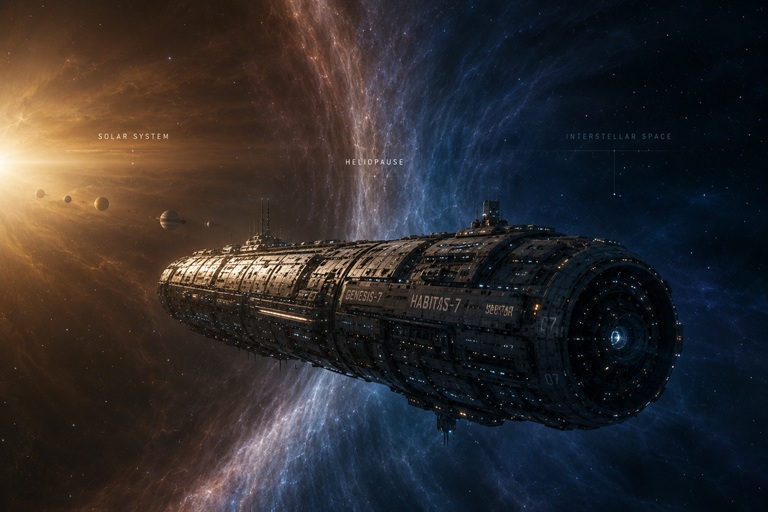
Beyond our neighborhood, if we fail to discover faster-than-light travel, interstellar migration will require massive generation ships, self-sustaining cosmic arks where generations are born, live and die (or live for centuries) en route to distant star systems. In an era of extended human lifespans, a two hundred year voyage across the void suddenly doesn’t sound like a multi-generational sacrifice. It becomes a single long term expedition for a single crew.
What About Venus?
Mars receives nearly all the attention. Venus deserves a second look. It’s almost Earth’s twin in size. Its gravity is remarkably similar. Unlike Mars, Venus retained a massive atmosphere despite lacking a global magnetic field. Its gravity is much closer to Earth’s, making it an intriguing, if an incredibly hostile candidate for future planetary engineering.
Venus’ problem isn’t that it’s far too small. The problem is that it’s far too hot. It is an inferno. Venus is wrapped in a crushing runaway thermal blanket of carbon dioxide, creating a runaway greenhouse effect unlike anything on Earth, with surface temperatures capable of melting lead.
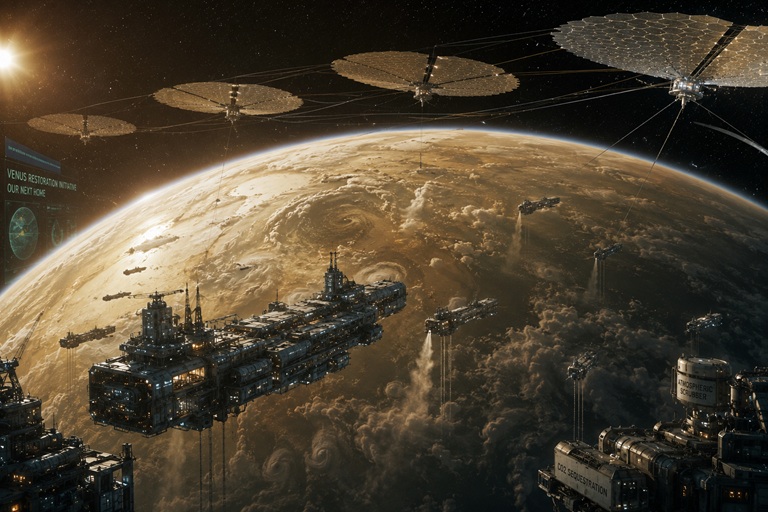
But if human ingenuity can figure out how to blow off that atmospheric thermal blanket using solar shades at the Lagrange points, atmospheric scrubbing or chemical sequestering, Venus becomes the ultimate home restoration project. Instead of building living domes under radiation heavy skies as on Mars, cooling Venus could give us a habitable twin planet one orbit over, complete with a thick oxygen rich atmosphere and comfortable gravity.
Today, the idea of transforming Venus into a habitable world belongs firmly in the realm of speculative science.
But so did powered flight.
So did landing on the Moon.
So did editing DNA.
Perhaps one day we’ll learn how to remove enough of Venus’s ambient carbon dioxide or otherwise cool the planet to transform it into something resembling a second Earth.
It’s an extraordinary challenge.
History suggests we shouldn’t underestimate what extraordinary generations can accomplish.
Building New Worlds
The biggest leap may not be colonizing another planet at all. It may be building entirely new ones. Not planets in the traditional sense. Habitats.
Imagine mining the asteroid belt for raw materials and constructing enormous rotating space habitats that generate artificial gravity.
Communities powered entirely by sunlight, self-contained ecosystems floating between the planets.
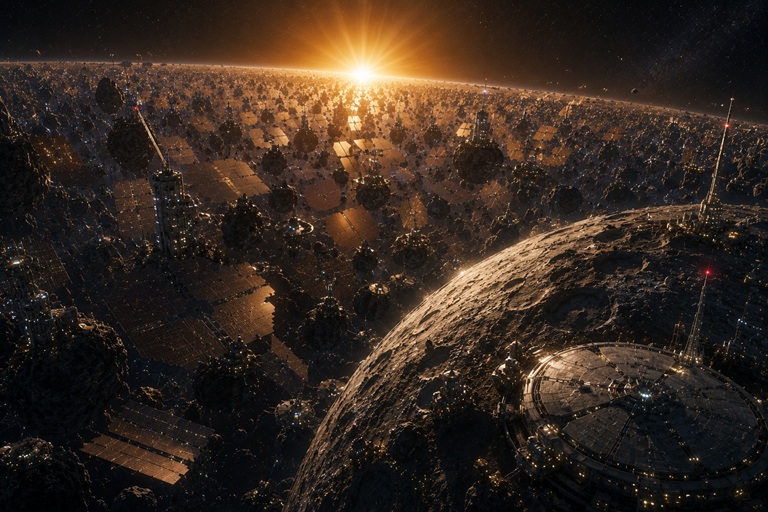
Take that vision far enough and you arrive at something even grander: a Dyson swarm, a vast collection of independent solar powered habitats and energy collectors orbiting the Sun. It isn’t the solid “Dyson Sphere” often portrayed in science fiction, but many engineers consider a swarm of countless independent structures far more plausible, each capturing fractionally infinite solar power and housing trillions in artificial habitats.
Every increase in civilization’s carrying capacity has ultimately been an increase in its ability to harness energy more efficiently.
If humanity survives long enough, today’s cities may someday seem as primitive as the first farming villages.
Imagine homesteading in the Dyson swarm, laying title for Sec 129 Rg 18 Trailing Lagrange Sub 2nd Ep. Congratulations. Just like in the days of America’s wild west, the land is free. All you need to do is build your own house.
Every Solution Creates Another Question
Is overpopulation an existential threat if we conquer aging? Absolutely.
If we choose to stay grounded on Earth while engineering ourselves to live for centuries, we will inevitably force a grim choice upon future generations: strict reproductive bans, severe resource rationing or systemic societal breakdown, an unending war for land and resources.
The alternative is to match our biological ambition with a technological and spatial ambition of equal scale.
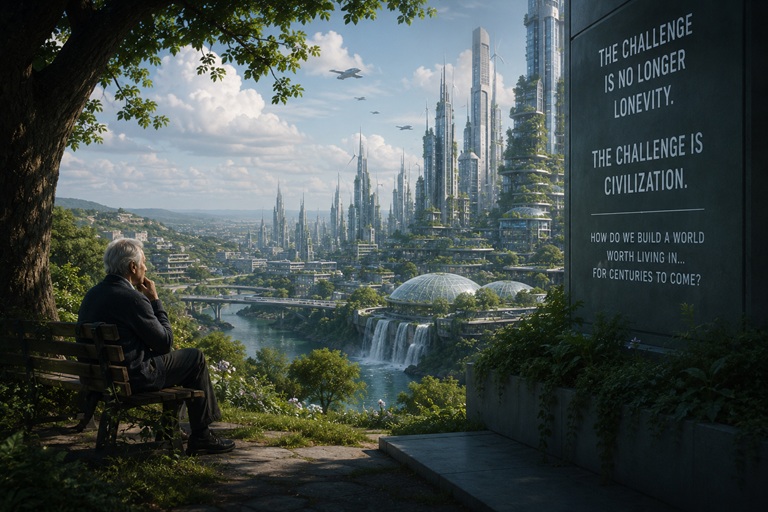
The more I think about longevity, the less I see it as a medical problem. It’s a civilization problem. If we eliminate aging, we don’t eliminate limits. We simply move them.
The challenge then shifts from “How do we keep people alive?” to “How do we build a civilization capable of supporting them?”
We don’t need to choose between curing disease and protecting our planet. We simply need to realize that Earth was always meant to be humanity’s cradle, not its permanent cage.
The question reaches far beyond medicine. It touches energy. Agriculture. Housing. Transportation. Environmental stewardship.
And ultimately, space.
Looking Beyond the Horizon
Overpopulation is a legitimate concern if humans begin living centuries longer. Ignoring that would be irresponsible.
But history offers another lesson.
Human civilization has repeatedly encountered what looked like absolute limits. We were going to run out of food. Then we transformed agriculture. We were going to run out of whale oil. Then we harnessed fossil fuels. We struggled to communicate across continents. Then we built global telecommunications networks.
Every generation inherits limits from the one before it. Every generation has the opportunity to redefine them. That doesn’t guarantee we’ll solve the challenges of a longer lived civilization. It simply reminds us that human progress has never been about accepting limits without question.
The real question isn’t how many people Earth can support. It’s how much human ingenuity can expand the definition of “Earth”.
Because if science one day conquers aging, our future won’t be determined by biology. It will be determined by our imagination.
Discover more from Tales of Many Things
Subscribe to get the latest posts sent to your email.