
Recently, we waded into the deep end of the genetic pool to talk about extreme human longevity. We looked at how medical engineering is steadily rewriting the limits of human life, and what happens to a finite planet when humans simply stop leaving it.
Out of that discussion came a much more personal and deeply practical series of questions from readers. If science actually cures aging, what happens to the back half of our lives? The following three questions are among the ones I received in response and, together, they are a variation on a single thought.
One reader asked, “Our Social Security is already a mess. What happens when everyone is on it?”
Another wandered into philosophical territory, “Time to retirement would vanish—instead of saving for 40 years, you’d accumulate skills & compound interest over centuries. Would boredom or curiosity kill you first?”
And yet a third simply asked, “What does retirement look like if you’re immortal?”
Those three may sound like three different questions, but they’re really the same one.
Just like the overpopulation dilemma, extreme longevity doesn’t just stretch our current problems, it completely obliterates the math they are built on. If death becomes optional, the traditional concept of retirement goes out the window with it.
What happens to retirement when death is no longer waiting at the end of it?
It turns out that retirement, like so many of our institutions, makes a lot more sense when human life has an expiration date. Remove the expiration date and the entire concept starts to look rather strange.
The Three Act Life
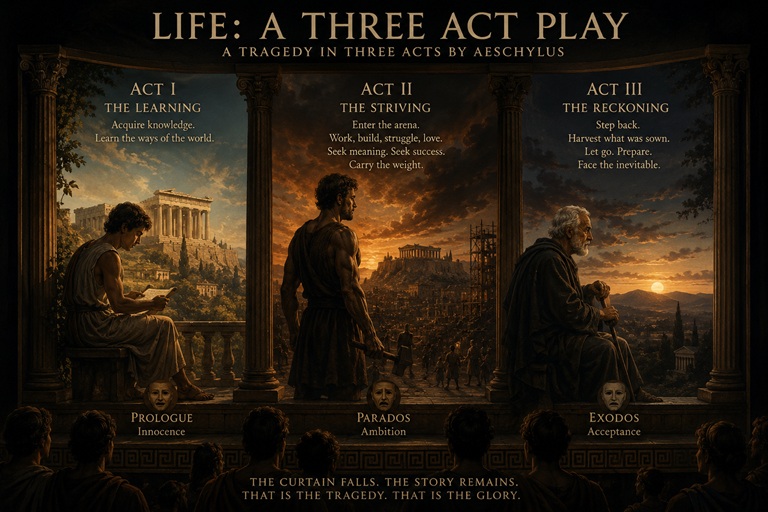
For most of modern history, we’ve organized adulthood into something resembling a three act play: Education. Work. Retirement. You can almost see this as a play written by Aeschylus himself, the Greek master of tragedies.
You spend your first couple of decades acquiring knowledge and skills. Then you spend roughly four decades converting those skills into money. Then, if you’ve been fortunate enough to save enough money and live to enjoy it, you stop working and spend the remaining years doing whatever you want. Eventually, you die.
The whole system is built around a fairly simple assumption that there aren’t that many years available, at least not an infinite number. Retirement exists because working forever isn’t particularly appealing and because eventually the human body stops cooperating.
So we created a financial mechanism that allows us to trade some of our productive years for some of our later, less productive ones.
Save while you’re young.
Spend while you’re old.
Die before the money runs out. Or at least bounce the last check that you write.
The concept of a government funded “end of work” period is a very recent human invention and it was built on a rather morbid mathematical foundation. When the retirement age was broadly set around 65 in the early 20th century, life expectancy was roughly exactly that. The system worked precisely because half the population was statistically expected to die before they could collect a dime.
It was a safety net designed for a brief twilight, not a three decade long vacation. Our modern system is failing because eligibility age did not keep up with life expectancy.
If the human lifespan extends to 500 or 1,000 years, the current model of Social Security doesn’t just bend under the weight. It vaporizes. No economic system on Earth can support a population where an individual works for forty years and then draws a state pension for the next five hundred. The idea of a permanent state sponsored retirement at age 65 will be viewed by future historians as a brief, 20th century anomaly that meant well, but whose gears started out rusty and were never fixed.
It’s not a particularly elegant system, but it works reasonably well when “old” means you probably have another 15 or 25 years left.
Now imagine that you don’t.
Imagine medicine eventually gives us a world where someone reaches 65, remains healthy and productive and has no particular reason to expect death at 85.
Or 100.
Or 150.
Or 300.
At some point, “retirement age” becomes a rather arbitrary number wrapped around a meaningless concept.
Why 65?
Why not 85?
Why not 120?
And if someone can remain healthy for 200 years or 500 years, why retire at all? That’s where things get weird.
Congratulations. You Are Now Retired for the Next 237 Years.
Let’s start with Social Security.
Our current Social Security system was designed around the concept of generations.
Workers pay into the system.
Retirees receive benefits.
Eventually, those retirees die.
The next generation takes their place.
It’s essentially a gigantic financial relay race.
But imagine a world in which people stop dying. Someone retires at 65 and lives another 150 years. They aren’t collecting Social Security for 20 years. They’re potentially collecting it for 150. And while they’re collecting it, the next generation is still arriving. The pool of retirees doesn’t naturally empty. It accumulates.
At some point, “retirement benefits” stop looking like old age insurance and start looking suspiciously like a universal basic income for people who have decided they don’t want to work anymore.
And that raises an awkward question, “Why should age determine eligibility?” If a healthy 140 year old can still work, why should that person receive a benefit simply because they’ve accumulated enough birthdays?
The answer can’t be “because they’re old”. Eventually, “old” stops meaning what it means today.
And then Social Security isn’t the only thing that breaks. Pensions break. Life insurance breaks. Annuities become very interesting financial instruments indeed. Estate planning becomes downright bizarre. And inheritance becomes a problem for a very different reason. Imagine telling your eighty year old child, “Don’t worry. You’ll inherit the house someday.” Then imagine realizing that “someday” might be 2186. Or 2386. Or maybe some time after the year 3000.

The Wealth Problem
There’s another little problem with living forever.
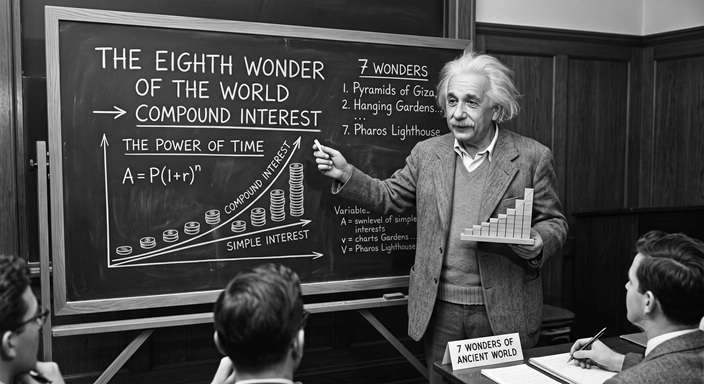
Compound interest. Albert Einstein reportedly called compound interest the eighth wonder of the world. Now, imagine applying it over four centuries.
We usually think about compound interest over thirty or forty years. That’s because that’s about how long we have to prepare for retirement.
But give someone 200 years. Or 500.
At that point, compound interest stops being a retirement strategy and starts becoming an existential threat to economic equality. A dollar compounded at 5% for 500 years would, mathematically, become an absurd amount of money.
Of course, that isn’t actually going to happen. The economy would change. Currencies would change. Tax laws would change. Companies would disappear. Entire industries would be born and die.
And nobody is going to let one person quietly accumulate the GDP of a small galaxy simply because they opened a brokerage account in 2026. There’s simply not enough money in our universe to pay off that one patient investor.
“And when Alexander saw the breadth of his domain, he wept, for there were no more worlds to conquer.” And that’s precisely the point. If you view life as a linear path: you go to school, you build a career, you stop working, you rest. Immortality sounds like an absolute nightmare. The human brain isn’t wired to play golf and complete crossword puzzles for four centuries. If you don’t have to work for money, what do you do with the time? There’s only so long that you can lay on a Florida beach.
The financial system would have to change because the assumptions underneath it had changed. Today, death eventually redistributes wealth. People die. Businesses change hands. Homes are inherited. Fortunes are divided among children. New generations get opportunities to build their own wealth.
Remove death and you remove one of the great mechanisms of economic turnover. A person who became extraordinarily wealthy at fifty could be even more extraordinarily wealthy at 250. And 450. And 650. Today, at 95, Warren Buffett is worth $145 billion. What do you think he’ll do if you give him another 500 years?
Suddenly, today’s arguments about generational wealth would look like a dress rehearsal. You could end up with people who aren’t merely wealthy. You could end up with people who have been uber wealthy for centuries. At some point, governments might have to decide that fortunes can’t simply persist indefinitely.
Perhaps wealth would be taxed periodically rather than primarily at death. It’s an estate tax that doesn’t wait for the estate. Imagine that you don’t have to die to discover the government is interested in your accumulated fortune. You just have to live long enough.
So What Exactly Are You Retiring From?
The financial problems are actually the easy part. The harder question is psychological.
Why retire?
At 65 retirement sounds wonderful. You’ve been working for forty years. You’ve raised children. You’ve paid mortgages. You’ve endured meetings that should have been emails. You’ve sat through meetings about meetings that should have been emails. You’ve spent about 20,000 hours commuting in traffic. Maybe 38,000. You are mortally tired. You would like to spend some time doing whatever the hell you want to do. The statistical abstract says you’ve got twenty years to do that.
Fair enough.
But suppose you retire and the aging problem has been solved. Now you’ve been retired for fifty years. What next?
You’ve traveled the world.
You’ve played over 200,000 holes of golf.
You’ve restored the old house. And the house after that. Then you’ve built one from scratch.
You’ve learned to paint.
You’ve written a novel. And a sequel.
You’ve taken up woodworking.
You’ve visited every national park. Eight times.
You’ve finally figured out how to use the television remote.
Now what?
This is where the question “Would boredom or curiosity kill you first?” gets interesting. Maybe curiosity wins.
Humans are extraordinarily good at finding things to become interested in. Give someone 500 years and they could become an engineer, then a musician, then a historian, then a biologist, then a teacher, then an entrepreneur, then a novelist, then an obsessive amateur astronomer, then something that doesn’t even exist yet.
Why should a person have only one career? Why should education happen primarily between ages 18 and 22? (Or 23, if you took a semester off to drink abroad.) Why should the skills you acquire at 25 determine what you do at 55? Or 155?
Those assumptions exist largely because time is scarce. If time isn’t scarce, they become increasingly difficult to justify.

Retirement Might Become a Sabbatical
This brings us to the final question, what does retirement actually look like?
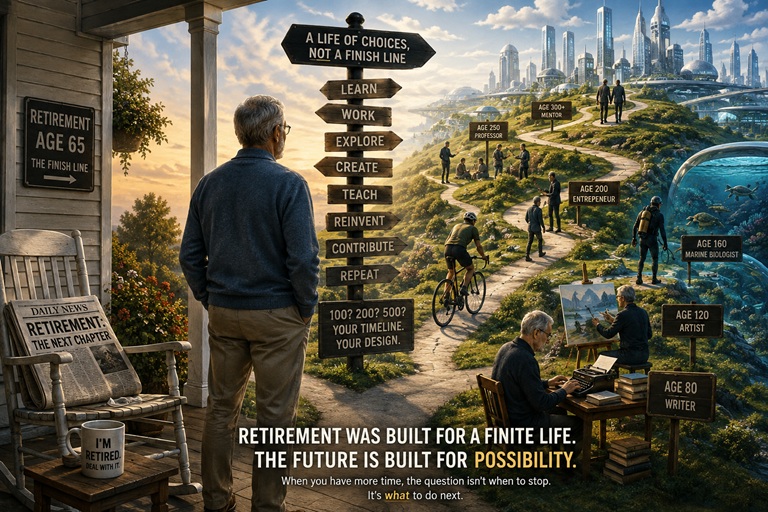
The answer is that “retirement” ceases to be a final destination. The word itself implies retreating or withdrawing from productive life because your biological battery is running out. When the battery no longer drains, the concept of a permanent retreat is meaningless.
Perhaps the answer isn’t that people stop working. Perhaps the answer is that work stops being a permanent phase of life.
Instead of Education → Career → Retirement → Death, we get something more like Learn → Work → Stop → Explore → Learn → Work → Reinvent → Stop → Create → Work → Lather → Rinse → Repeat.
A person might spend thirty years as an engineer, then take fifteen years off, then study biology, then spend forty years doing research, then become a teacher, then disappear for twenty years to travel, then start a company at 140, then retire from that company at 165, then decide they want to become a sculptor before taking two decades off to raise a family.
That’s not really retirement. It’s a life composed of chapters and that might be one of the most profound changes longevity would bring.
Instead of saving for the last twenty years of your life, you might be saving for the next chapter. Retirement becomes a sabbatical. Careers become temporary. Education becomes lifelong.
And “What do you want to be when you grow up?” becomes a question you can ask someone repeatedly, because like a six year old, they will give you a different answer every time. Becoming a starving artist or an entrepreneur today is a hard decision, but given immortality, it’s just an experimental phase in your life, like that semester of drinking abroad.

But There’s Still a Catch
There’s a dark side to having forever. When time is scarce, it creates urgency. If you know you have eighty years, you have to make choices. You have to decide which books to read, which places to visit, which people to love, which ambitions to pursue. You can’t do everything.
But if you have 500 years? Why not do everything eventually? Why climb Everest this year? You have another century. Why write the book? Next decade will have a gap in the calendar. Why learn Japanese? Eventually, maybe. Why start the new company? There’s always tomorrow.
Immortality might create the ultimate procrastination problem. When you have forever, nothing has to happen today. And that could fundamentally change human psychology.
Our bucket lists exist because the bucket has a bottom. Remove the bottom and the list becomes very different. Perhaps we become more curious. Perhaps we become less ambitious. Perhaps we become extraordinarily patient. Perhaps we become incredibly bored. Or perhaps something stranger happens.
Maybe humans discover that meaning doesn’t come from having limited time. Maybe it comes from choosing how to spend unlimited time.

The Workplace Has a Problem, Too
There’s another problem that isn’t immediately obvious. Promotion.
Today, people eventually leave organizations. Executives retire. CEOs step down. Professors give up tenure. Partners move on. Managers make room for the next generation.
Now imagine a company where nobody has to leave.
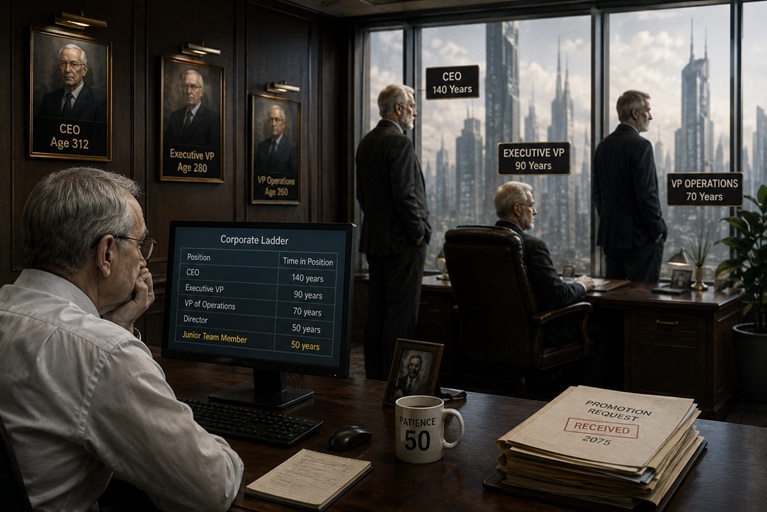
Your CEO has been CEO for 140 years. Your boss has been in the same position for ninety. The person above you has been waiting for the CEO to retire for seventy years. You’ve been on the team for fifty and you’re still the junior member. Good luck with that promotion.
Longevity could create the opposite problem from the one we have today. We worry now about people being forced out of productive careers because they are “too old”.
An immortal society might have to worry about people refusing to leave. That could force organizations to develop term limits, mandatory sabbaticals, rotational leadership or entirely new concepts of succession.
The question wouldn’t be “When are you too old to work?” It would become: “When is it time to make room for someone else?” That’s a very different philosophy.
Age Stops Being a Useful Number
Age may ultimately be the biggest conceptual change.
Today, chronological age is an incredibly useful shorthand. You’re 25. You’re 50. You’re 70.
We have a rough idea what those numbers mean, but if biological aging can be slowed, stopped or reversed, chronological age starts losing its predictive power.
A 100 year old might be a middle-aged professional. A 150 year old might be starting a company. A 200 year old might be returning to university. A 300 year old might decide they’ve finally had enough of accounting and become a musician. Age becomes less important than condition and intention.
Important questions change. Are you healthy? Are you capable? Do you want to work? Do you have something to contribute? Do you have enough resources to support yourself?
Those become much more meaningful inquiries than the number of times you’ve gone around the Sun.
And Then There Is the Generational Problem
This is where retirement connects back to my earlier article about longevity and the finite planet. If people stop dying, society doesn’t simply gain more years. It loses generational turnover. That matters, because generations aren’t just biological cohorts.
They’re economic units. Cultural units. Political units. Generations bring new ideas. They replace old institutions. They inherit property. They take over companies. They become parents. They eventually become grandparents. Then they disappear, making room for everyone who came after them to “advance”.
Death is terrible for the individual, but civilization has always relied upon it for orderly turnover. Remove it and you have to deliberately create the turnover that biology used to provide automatically.
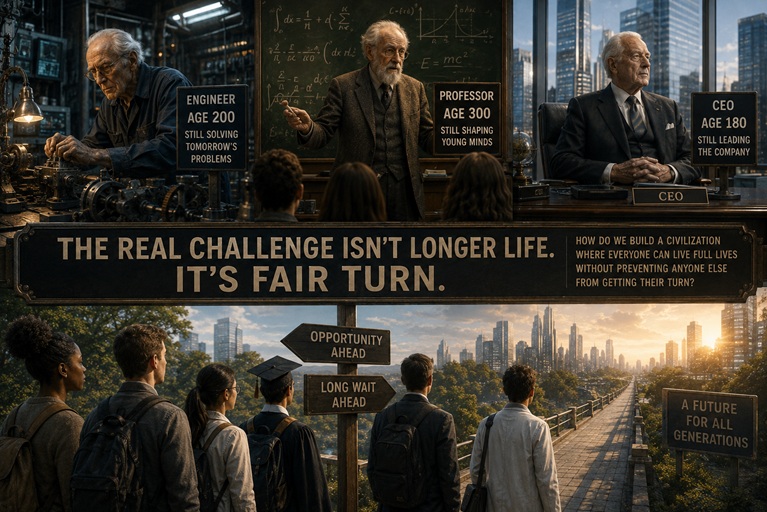
That’s true for population. It’s true for wealth. It’s true for politics. And it’s true for work. If a 200 year old engineer is still working and a 300 year old college professor is still teaching and a 180 year old CEO is still running the company, the problem isn’t simply that they don’t get to retire. The question becomes “How do we build a civilization in which people can keep living without preventing everyone else from getting their turn?”
Maybe Retirement Was Never the Point
Perhaps the strangest thing about all of this is that we may have misunderstood retirement from the beginning. Maybe retirement was never really about stopping work. Maybe it was about getting permission to stop doing one particular kind of work.
The problem is that we built the system around a biological deadline. You work until your body won’t let you anymore. Then you stop. Then you die.
Extreme longevity breaks that sequence and once it does, we might discover that a healthy human life doesn’t need to have one career, one profession or one retirement. It can have many. You can work. You can stop. You can learn. You can start over. You can become someone else. And then, decades later, you can do it again.
Maybe the future of retirement isn’t retirement at all. Maybe it’s reinvention.
The Retirement Question is Really a Time Question
The more I think about extreme longevity, the more I suspect that the biggest change won’t be financial. It will be psychological.
We have built an entire civilization around the assumption that time is running out. We save because time is running out. We hurry because time is running out. We retire because time is running out. We leave something behind because time is running out. We worry about what we haven’t accomplished because time is running out.
Take away the clock and we don’t simply get more life. We get an entirely different relationship with life and that may be the real retirement revolution.
Perhaps someday the question won’t be “When can I afford to retire?” It will be “What do I want to do next?” And if the answer changes every fifty or eighty years, that’s okay. You’ve got time.
For once, perhaps the hardest part won’t be figuring out how to make enough money to survive the rest of your life. It will be figuring out what you want to do with all of it.

Discover more from Tales of Many Things
Subscribe to get the latest posts sent to your email.