
A coworker of mine is furious at Elon Musk. It isn’t about electric cars, social media algorithms or controversial tweets. It’s about space.
It’s been about six weeks since SpaceX went public. The IPO was priced at $135 per share. If you weren’t an insider and bought in the secondary mania of the first day of trading after the market opened, you likely paid north of $160. Within a week the stock reached a high of $225.64. For anyone who got in early and sold quickly, it was an impressive return.
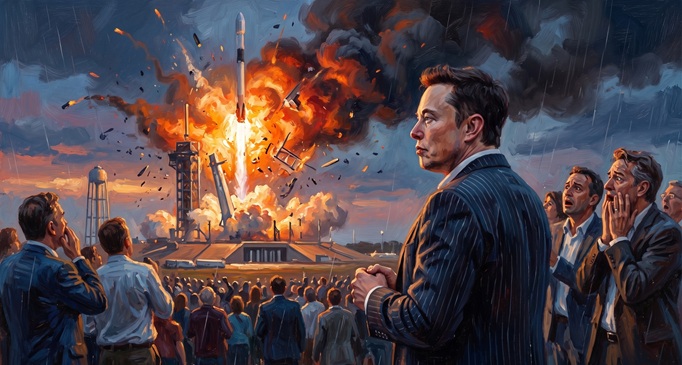
My coworker wasn’t one of the early buyers. At least not in the first few hours of the stock trading. He bought at $217. Today, the stock is trading around $108, well below its original IPO price. For the legions of retail investors who bought into the initial launch surge, their portfolios are under water. Naturally, the search for someone to blame began immediately.
How could a company building reusable rockets and global satellite constellations drop like a rock from Low Earth Orbit?
What happened? Nothing, really. The market simply shifted from pricing a dream to pricing a business, the way markets always do. And for that there is a reason. You simply have to look past the rockets and examine the ledger.
SpaceX is not profitable.
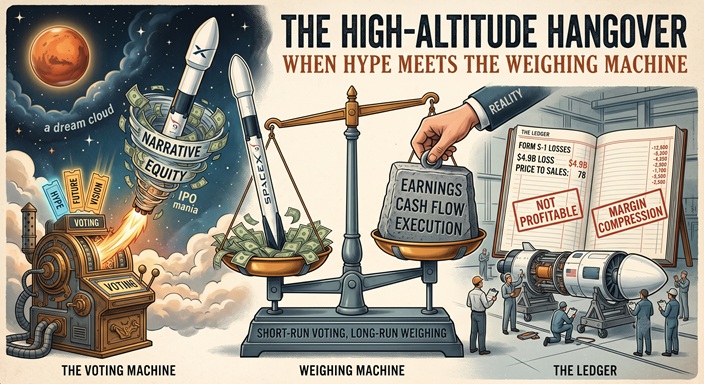
According to SpaceX’s S-1 filing, the company lost roughly $4.9 billion over the previous year and reported a loss of approximately $1.69 per share. Its price-to-earnings ratio is negative because there are no earnings. It also debuted with an extraordinarily high price-to-sales ratio of 78, meaning investors are willing to pay $78 today for every single dollar of revenue the company brings in. Revenue, not profit.
Think about the mathematical leap of faith required for that calculation. A price-to-sales ratio of 78 means investors are valuing the company at 78 times its annual revenue. For comparison, mature industrial companies often trade at a small fraction of that, often at price-to-sales ratios below 5. With SpaceX investors aren’t buying today’s business. They’re paying for extraordinary future growth that may never pan out.
I should note that the investment isn’t necessarily irrational. Many successful companies spent years losing money before becoming enormously profitable, but that does mean investors today are paying for what they believe the company will become in the future, not what it is today.
Benjamin Graham, Warren Buffett’s mentor, famously observed, “In the short run, the market is a voting machine, but in the long run, it is a weighing machine.” IPOs often begin as a full throttle voting machine. Hopeful investors vote with their emotions, their excitement and their fear of missing out. They buy the story. The voting machine rewards possibility. The weighing machine rewards execution. Between those two lies one of the most volatile periods in a company’s life.
But eventually, the fanfare dies down, the noise fades and the weighing machine turns on. The weighing machine doesn’t care about vision statements or launch videos. It only cares about cash flow. Every IPO is marketed around a compelling growth story. They are engineered to sell a speculative dream at the absolute peak of public interest. Over time, the weighing machine asks a different question, how much is this business actually worth?
Every IPO sells a dream. That’s not criticism. It’s simply the nature of a company going public. Investors are buying into a future that management believes it can create. That doesn’t mean the story is false. It does mean that the future is uncertain.
Elon Musk is a visionary mind, but he is also a master showman. He understands intuitively that modern valuation relies heavily on narrative equity. He operates on the classic promotional principle that attention is currency and that public enthusiasm can fund grand engineering ambitions long before the fundamentals justify the price tag. Is he selling a dream? Absolutely.
I’ve written before that many emerging technologies eventually become commodities. Railroads did. Automobiles did. Internet service did. AI is beginning to follow the same path.
Space launch may not be any different. SpaceX is competing with United Launch Alliance, Blue Origin, Rocket Lab, Boeing, Virgin Galactic and increasingly with state backed space programs around the world. Likewise, SpaceX’s AI ambitions face brutal competition from OpenAI, Anthropic, Google DeepMind, Mistral, Perplexity and many others. As markets mature, competition tends to compress margins and reduce the extraordinary profits that early investors often imagine. The weaker companies can not withstand margin compression and either sell out or simply fail.
SpaceX isn’t a unicorn in this industry. It is going up against some major heavy hitters. History suggests that not every company competing in a rapidly expanding industry survives. As competition increases, weaker business models tend to disappear through bankruptcy, acquisition or consolidation.
I used the analogy before of selling picks and shovels during a gold rush. If you’re the only supplier, you can charge almost anything. If six companies are selling nearly identical picks and shovels on the same block, price competition becomes unavoidable. That’s why four gas stations on the same intersection rarely become four wildly profitable businesses.
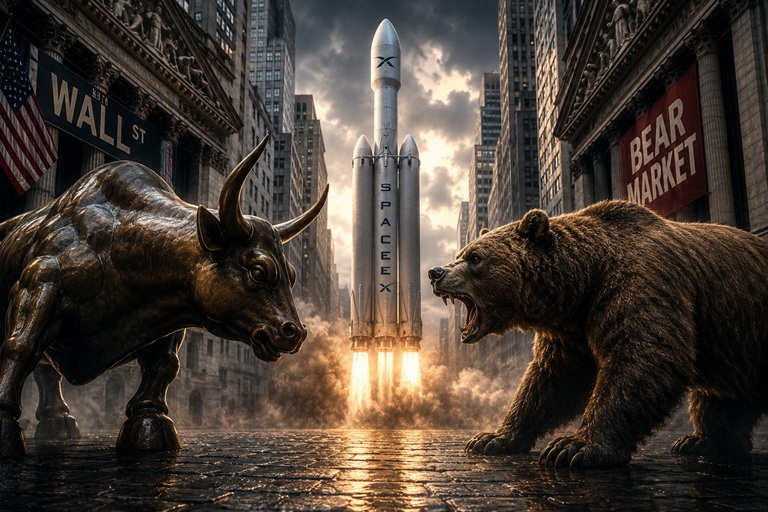
So should my coworker be angry at Elon Musk?
Personally, I don’t think so. Whether you admire Musk or dislike him, one thing is undeniable. He’s one of the most effective promoters of ambitious technological visions of our time. That’s part of what has made him extraordinarily successful.
But investors also have personal responsibilities. Before every IPO, companies file an S-1 with the SEC. It is a long, dry, legally binding document designed specifically to outline how the business operates and every single reason you might lose your money. That truth is required by law, to describe the business, its financial condition and, perhaps most importantly, the risks. Those risks aren’t hidden in fine print. They’re disclosed so investors can make informed decisions.
SpaceX’s S-1 laid out the capital burn, the operational dangers and the heavy competition. SpaceX is not operating in a vacuum, literally or economically.
Buying an IPO is, by definition, buying uncertainty. It’s buying a pitch. Imagine reading the first chapter of a novel and using that to decide what the rest of the book is like. I’ve had many disappointing days thinking that what I was reading is gold. The polished first chapter was. Until it wasn’t.
In the hype of the market, history suggests caution. Historically, many IPOs fail outright and an even larger percentage underperform the broader market over the following three to five years. Most IPOs underperform. Keep that fact on a notecard on top of your checkbook.
Meanwhile, Warren Buffett famously observed that a “know-nothing investor” can routinely outperform most financial professionals simply by holding a low cost S&P 500 index fund. His late partner, Charlie Munger, expressed a similar philosophy in his own memorable way: find a collection of great, proven businesses and “just sit on your ass”.
Could SpaceX ultimately justify its valuation? Absolutely.
Could it disappoint investors? Just as easily.
I have no special insight into which outcome is more likely, but the options are limited. SpaceX may very well conquer the aerospace industry, colonize space and eventually justify a multi trillion dollar market cap. Or it may remain a capital intensive utility operating in a crowded marketplace, burning cash until the funding runs out.
Markets are remarkably good at separating stories from businesses, but not immediately. IPO investors often discover they’re buying the story first and the business later.
No one knows the future of SpaceX or any other IPO company, but we do know the historical behavior of initial public offerings. IPOs have always been speculative investments. The excitement surrounding a new public company doesn’t eliminate the risks. It simply makes them easier to be overlooked.
That’s why you’ll never catch me buying an IPO. Not on day 1. Not on year 1. Show me how you do long term business under SEC’s public disclosure rules and I’ll show you the money. Or not.
Discover more from Tales of Many Things
Subscribe to get the latest posts sent to your email.