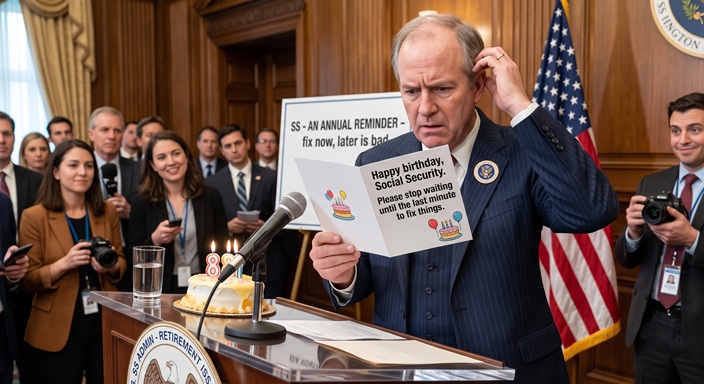
August 14, 2026, is the 91st anniversary of Social Security.
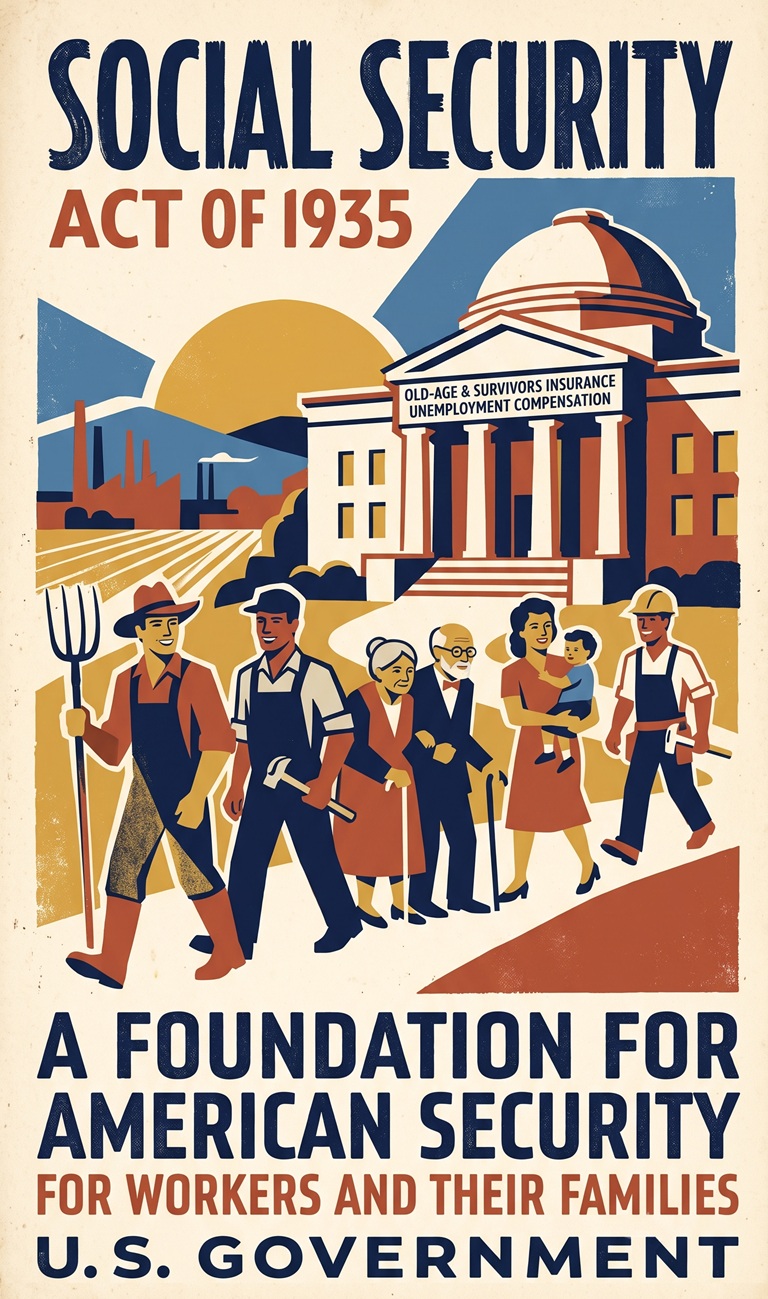
On August 14, 1935, President Franklin D. Roosevelt signed the Social Security Act into law. It was an ambitious idea for its time to create a national system that would provide some protection against the possibility of reaching old age with no income and no safety net.
Ninety-one years later, Social Security is still doing exactly that and we have a birthday present for it. A funding problem.
Don’t worry, Washington has a plan. It involves forming two committees, releasing seventeen reports, appearing on television, accusing the other political party of trying to murder grandma and then doing absolutely nothing until the problem is crawling up the Capitol steps.
At least, that’s the traditional approach. Maybe we can do better this time.
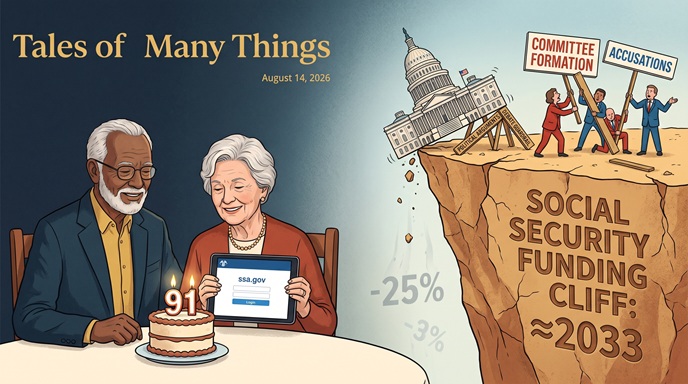
First, let’s celebrate the thing we’re trying to save
Before we talk about Social Security’s finances, it’s worth remembering what the program actually is. It isn’t a savings account with your name on it. It isn’t a 401(k). It isn’t a government investment portfolio waiting for you to withdraw what you personally deposited.
Social Security is social insurance. Today’s workers pay payroll taxes that finance benefits for today’s beneficiaries. In return, workers earn eligibility for benefits of their own in the future.
Social Security also does something a private retirement account doesn’t necessarily do very well. It protects people against risks they can not predict. You could live to 95. You could become disabled. You could die young and leave a spouse or children behind. You could spend your entire working life earning modest wages and arrive at retirement with very little accumulated wealth.
Social Security is designed to provide a floor underneath all of those possibilities. For millions of Americans, that floor matters enormously, so when we talk about “fixing Social Security”, we shouldn’t lose sight of the people standing on it.
What began as a modest social safety net forged during the desperation of the Great Depression has evolved into the financial bedrock of American retirement. It has pulled millions of seniors out of poverty and guaranteed that after half a century of alarm clocks, shift work and payroll deductions, you don’t face your golden years on a tightrope without a net.
The goal of fixing Social Security isn’t to win an ideological argument. The goal is to make sure the floor doesn’t disappear.
And that’s the problem
The Social Security Trustees are not predicting that Social Security will suddenly vanish. That’s an important distinction. The system will continue collecting payroll taxes.
The problem is that, under current law, those ongoing revenues eventually won’t be enough to pay the benefits that have been promised.
The latest Trustees Report projects that the Old Age and Survivors Insurance (OASI) Trust Fund will be depleted in the fourth quarter of 2032. At that point, continuing income would be sufficient to pay about 78% of scheduled OASI benefits.
The combined Social Security trust funds, OASI and Disability Insurance, are projected to remain able to pay full scheduled benefits until 2034. After that, continuing income would cover about 83% of scheduled benefits.
In other words, the check doesn’t go to zero, but without legislation, the law eventually requires the system to pay only what it can afford from incoming revenue. That means a very large automatic benefit reduction and that is the cliff.
It isn’t a cliff because Social Security suddenly stops existing. It’s a cliff because waiting makes the eventual solution dramatically more painful.
The Trustees themselves make this point. Their projections show that if policymakers wait until trust fund reserves are depleted, maintaining long term solvency would require something roughly equivalent to a 4.27% permanent increase in the combined payroll tax rate, a 25.8% reduction in scheduled benefits or some combination of the two.
That’s the difference between fixing a leak and waiting until the basement is underwater.

We’ve been here before
This isn’t the first time Social Security has stared down a financial crisis. In the early 1980s, the program was in serious trouble. Inflation was high. Unemployment was high. Demographic and economic assumptions had changed. A flawed indexing formula had contributed to the problem. The system was approaching the point where its reserves were dangerously low.
President Ronald Reagan and House Speaker Tip O’Neill did something that sounds almost mythical today. They negotiated. In December 1981, they created the National Commission on Social Security Reform, chaired by Alan Greenspan. The commission’s recommendations became the foundation for the 1983 bipartisan Social Security amendments.
The solution wasn’t one magical fix. It was a pile of things that different politicians could hate in different ways. Payroll taxes went up. The self-employment tax increased. The timing of annual cost of living adjustments was changed. Some Social Security benefits became subject to federal income taxation for higher income beneficiaries. The age for receiving unreduced retirement benefits was gradually increased from 65 to 67 for later generations.
It wasn’t pretty. It wasn’t painless. It was uncomfortable for everyone involved, which is usually the hallmark of an honest compromise.

The problem today is bigger
The 1983 problem was largely a financing problem that could be addressed with relatively near-term changes. Today’s problem has a deeper structural component.
There are fewer workers supporting each beneficiary than there were when Social Security was designed. In 1955, there were about 8.6 covered workers for every Social Security beneficiary. By 1983, that had fallen to about 3.1. Today, that ratio has sunk to about 2.7 workers per retiree. By the 2040s, it will drop closer to 2. That’s the fundamental problem. We built a system in an America where there were many workers for every retiree.
Now Americans are living longer, having fewer children and spending a larger portion of their lives in retirement. That is wonderful news for human beings, but it is considerably less wonderful news for a pay-as-you-go retirement system. In 1983 Congress patched a short-term liquidity leak. Today, we are dealing with a permanent demographic shift that is changing the foundation of the system.
And this connects directly to something I wrote about recently in The Retirement Problem: What Happens When You Don’t Have to Die? If we eventually solve aging itself, we will have a much bigger problem.
Immortality is a fascinating mental exercise. What does retirement look like if you live to be 500 or 1,000? But back in the present, biogerontology hasn’t eliminated the biological clock just yet. For the current generation of retirees and those staring down the runway over the next decade, those last twenty or thirty years of life are not a speculative sci-fi question. They are an immediate, month-to-month financial reality.
And right now, that reality is heading toward a cliff. We don’t have to live for 1,000 years to create a retirement problem. We only have to live longer than the people who designed the system expected.
The draining of the OASI Trust Fund means an automatic cut of around 20% to 25% of scheduled benefit levels, regardless of income or need. For a senior living on a fixed income where every dollar is calculated down to the grocery aisle, a 25% drop isn’t a minor budget adjustment. It’s a catastrophe.
So how do we fix it?
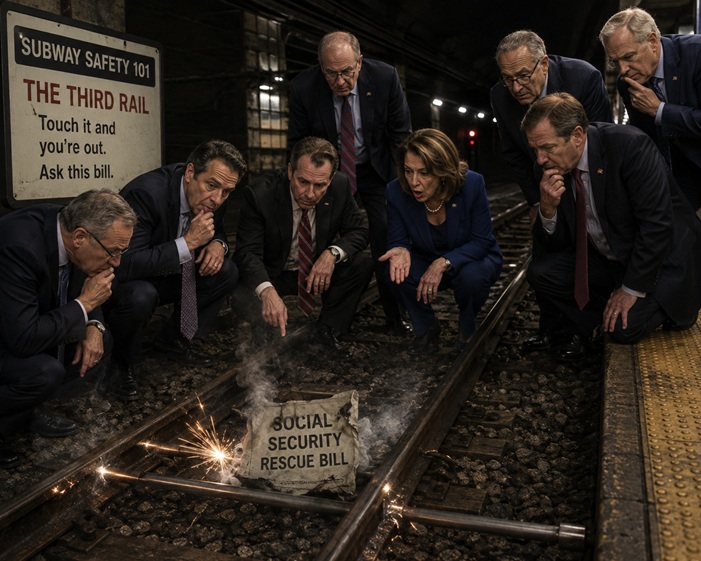
In Washington, Social Security is famously referred to as the “third rail” of American politics. Touch it and you die.
The resulting political behavior is a masterclass in collective cowardice. Lawmakers treat the program like a volatile explosive in a glass case. They bow in reverence to it on the campaign trail, promise never to look at it sideways and run in sheer panic if anyone suggests opening the box to perform routine maintenance.
Instead of treating Social Security as a vital engineering system that needs periodic calibration, politicians prefer to wait until the engine is shooting sparks into the cabin before touching a wrench.
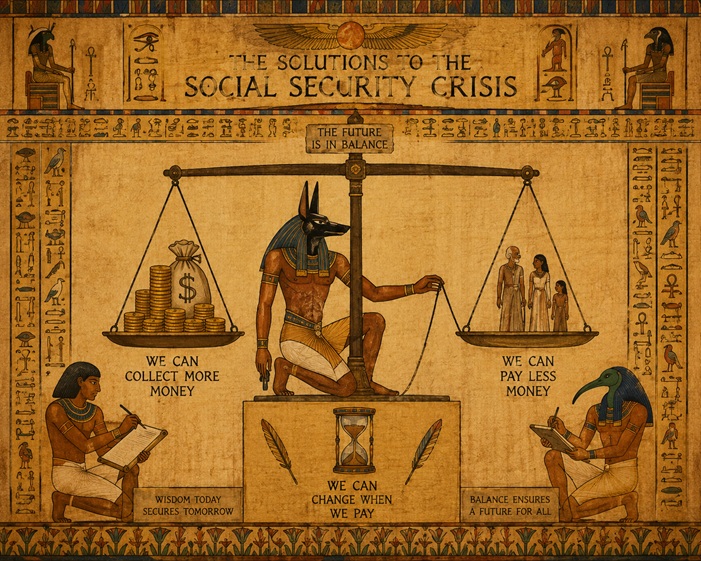
The truth is that there is no magic fix. Fundamentally there are really only three levers.
- We can collect more money.
- We can pay less money.
- We can change when we pay.
Everything else is merely a variation on those themes.
- Tax more earnings
In 2026, Social Security payroll taxes apply to the first $184,500 of wages. Earnings above that amount are not subject to the 6.2% Social Security payroll tax, although they are subject to Medicare taxes.
That creates an obvious question. Why $184,500 and what does it really represent?
The Social Security tax cap was originally established to limit both the taxes high earners paid and the maximum benefits they could receive, reflecting the program’s design as a baseline social safety net rather than a comprehensive welfare system. When President Franklin D. Roosevelt signed the Social Security Act into law in 1935, the original cap was set at $3,000 per year and it grew every year after that.
Millions of American workers earn more than the taxable maximum. Once they cross that threshold, their wages are no longer subject to the Social Security portion of the payroll tax. The people with the greatest ability to absorb additional taxation are also the people whose earnings escape the Social Security payroll tax once they cross the cap.
Congress could raise the taxable maximum or eliminate it all together. Or create a second taxable tier, essentially a “donut hole”, where wages above a higher threshold become subject to Social Security taxes again.
There are different ways to structure it and the details matter enormously because changing the taxable maximum also affects benefit calculations, but conceptually, the argument is simple:
- If you earn $50,000, you pay Social Security tax on all of it.
- If you earn $500,000, you don’t.
Congress could decide that the highest earners should contribute more.

- Raise the payroll tax
The combined employee and employer Social Security tax is currently 12.4%, split between worker and employer at 6.2% each.
Increasing it gradually would spread the cost across the working population. The political problem is obvious. Nobody wants to hear, “Good news! Your paycheck just got smaller!”
But that’s the nature of the problem. If we want to preserve today’s benefits for tomorrow’s retirees, someone has to pay for them. Taxes are not a particularly mysterious concept. Money has to come from somewhere.
I suppose there’s another option. We can convince Americans to have a lot more children. Unfortunately, those children won’t become productive taxpayers for roughly twenty years. But Social Security has a cash-flow problem now and babies are a remarkably slow financial instrument.
- Raise the retirement age
The full retirement age is already scheduled to reach 67 for people born in 1960 or later. Congress could gradually increase it further. The argument is straightforward. If Americans live longer, perhaps we should spend a little longer working before receiving full benefits.
The problem is that “life expectancy” isn’t the same for everyone. A professional who spends forty years behind a desk and a construction worker who spends forty years carrying heavy equipment don’t necessarily experience aging in the same way.
Neither does a nurse. Or a miner. Or a farm worker. Or someone who has spent decades doing physically demanding labor.
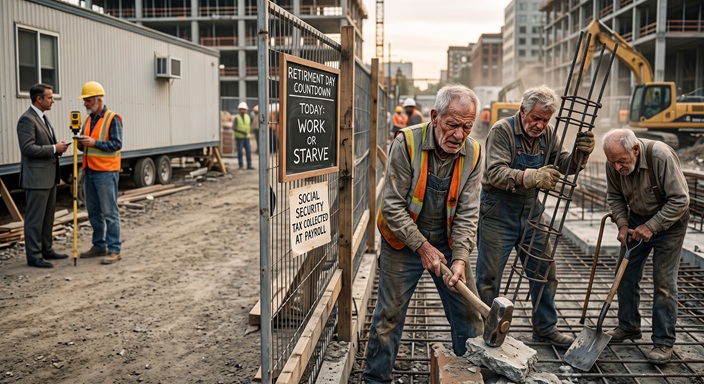
A higher retirement age therefore shouldn’t simply be treated as a universal number. If we go this route, we should think carefully about the people for whom “just work another three years” isn’t remotely equivalent to what it means for everyone else. It may not be reasonable to expect a 70 year old to be hauling bricks at a construction site.
- Change the COLA formula
Social Security’s annual cost of living adjustment currently uses the Consumer Price Index for Urban Wage Earners and Clerical Workers (the CPI-W).
One proposal is to use a chained version of the CPI instead. The basic argument is that consumers change what they buy when prices change. If beef becomes expensive, for example, people may buy more chicken. That produces a slightly lower measured inflation rate.
The difference in any one year is small. Over decades, however, small differences compound. That’s precisely why this proposal is controversial. A change that looks tiny to an economist can become very real to an 85 year old retiree.
And if we’re going to reduce the growth of benefits, we should be honest about what we’re doing. We’re not changing a formula. We’re reducing future benefits and moving a retiree from a good meal to a poor meal to the dogfood aisle. Let’s be honest, we want America to be more humane than this.
- Slow the growth of benefits for higher earners
Another approach is progressive price indexing.
The basic idea is to preserve stronger benefit growth for lower income workers while slowing the growth of benefits for higher earners.
This recognizes something important about Social Security. $1,000 means something very different to a retiree living on $20,000 a year than it does to someone with substantial investment income and a large pension, raking in a solid six figures per year.
We could preserve the program’s role as a basic retirement floor while asking wealthier retirees to accept slower benefit growth.
Of course people will legitimately say, “I’ve worked hard to earn what I have and you are reducing my benefits because of my hard work.”

- Means-test benefits
This takes the progressive indexing idea one step further.
If someone has substantial income from other sources, perhaps their Social Security benefit should be reduced. It’s politically attractive because it appears to target the people who need the money least. but there is a philosophical problem.
Social Security has always been structured as social insurance, not welfare. People pay into it and earn benefits. If we turn it into a program that says, “You made too much money, so you don’t get what you paid for,” we fundamentally change the nature of the program.
Maybe that’s a change worth making. Maybe it isn’t. But we shouldn’t pretend it isn’t a change. Every thread you pull in a web affects other threads.
What I would do
If I were designing the compromise, I wouldn’t look for one heroic solution. I’d build another 1983-style package and I’d make almost everyone share a little of the burden.
Gradually increase the taxable wage base. Increase payroll taxes modestly over time. Raise the full retirement age, but do it slowly and protect workers in physically demanding occupations. Preserve stronger benefit growth for lower-income workers. Slow benefit growth somewhat for higher income workers. Consider additional taxation of benefits for retirees with substantial outside income. And, critically, make the changes gradual and predictable.
- Give a 25 year old plenty of warning.
- Give a 45 year old less burden to adjust to.
- Give a 65 year old essentially no change.
That’s an important principle. If we’re going to change the rules, don’t change the rules on people who have already played most of the game. The people who have already retired shouldn’t be forced to rebuild a financial plan they executed over decades under an entirely different set of assumptions.
The politics are the ridiculous part
The math behind saving Social Security isn’t actually that complex. Actuaries at the Social Security Administration have modeled every variation of these policy levers down to the decimal point. The obstacle isn’t a lack of options. It’s the theatrical terror of our political system.
Here’s where I think we should stop pretending. Everyone in Washington knows the basic math. Republicans know taxes may have to rise. Democrats know benefits will eventually have to be adjusted. Republicans know that raising the retirement age is politically radioactive. Democrats know that eliminating the taxable maximum isn’t going to solve everything. Everybody knows this.
And yet we periodically get treated to political theater in which one side announces that the other side wants to destroy Social Security. Then the other side announces that the first side wants to destroy Social Security. Then both sides go home.
Meanwhile, the actuarial tables sit quietly in the corner. The tables don’t care about campaign slogans. They do not care whether the president has an R or a D after his name. They do not care which cable news network you watch. They certainly do not care about congressional fundraising emails.
They just keep adding up workers, wages, beneficiaries and dollars. And the math keeps moving toward us.
The funny thing is that Social Security doesn’t actually require political genius. It requires political courage. That’s a considerably rarer trait.
We don’t have to choose between “do nothing” and “destroy Social Security”
That is the false choice that makes this debate so frustrating. There is a huge space between those two extremes. We can preserve Social Security. We can protect current retirees. We can protect lower income workers. We can ask more from higher earners. We can ask workers to contribute a little more. We can ask future retirees to work a little longer. We can slow the growth of some benefits. And we can do it gradually enough that nobody gets thrown over a cliff.
The Social Security Trustees have been telling policymakers for decades that acting sooner makes the necessary changes smaller and gives people more time to adjust. That isn’t a partisan statement. It’s arithmetic.
So here’s what I want you to do on August 14
Don’t panic. Don’t write your congressman an angry letter declaring that Social Security is being “stolen”. Don’t put your retirement plan in the hands of whichever politician happens to be shouting loudest on television.
Instead, go look at your actual Social Security record. August 14 is the anniversary of the day the Social Security Act became law and AARP is calling it “My Social Security Day”. There’s a remarkably useful way to celebrate it. Go to the Social Security Administration’s website and create or log into your Social Security account. Look at your earnings history. Make sure the numbers are correct. Check your estimated benefits. See what happens if you claim at 62, at your full retirement age or at 70.
And then ask yourself a slightly uncomfortable question, “How much of my retirement plan assumes Social Security will be there exactly as it exists today?”
Your earnings record matters. The Social Security Administration specifically recommends reviewing it because errors or missing earnings can reduce the benefits you’re ultimately entitled to receive.
Your account also provides personalized estimates of future benefits and lets you compare different claiming ages.
Do it.
Then have your spouse do it. Have your parents do it. Have your kids do it.
Not because Social Security is about to disappear. It isn’t.
Do it because you should know what you’ve earned, what the government currently promises and how much of your retirement depends on a promise that Congress still needs to repair.

Ninety-one years is a pretty good run
Social Security has survived presidents, recessions, wars, inflation, political revolutions, pandemics, market bubbles, demographic changes and several generations of politicians insisting that the sky is falling.
It has also been changed repeatedly. That’s important. The Social Security Act of 1935 wasn’t carved into stone any more than our constitution. Neither were the rules created in 1983.
The program survived because Americans were willing to change it when circumstances changed.
We have different circumstances now. People live longer. Families are smaller. The worker-to-beneficiary ratio has changed. The economy has changed. Retirement has changed. America has changed. So Social Security has to change, too, but changing something isn’t the same as abandoning it. And fixing a problem isn’t the same as betraying the people who depend on the program.
The worst possible outcome isn’t raising taxes. It isn’t raising the retirement age. It isn’t slowing the growth of some benefits.
Our seniors did their part. They spent 45 years paying into a contract built on trust. They deserve stability, respect and predictable checks.
Younger generations are doing their part right now, watching a portion of every single paycheck head out the door to fund today’s benefits, while wondering what will be left when their own turn comes.
Social Security doesn’t need a miracle and it doesn’t need hyper-partisan warfare. It needs adults at the table willing to make a series of modest pragmatic adjustments before the clock runs out.
The worst outcome is waiting until there are no good choices left, because then politicians won’t be choosing between painful options. They’ll be choosing which painful option hurts the most and that’s a terrible way to run a retirement system.
So on August 14, let’s celebrate Social Security’s 91st birthday.
Check your account.
Check your earnings.
Check your benefits.
Then, perhaps, send a small birthday card to Congress.
It can say:
“Happy birthday, Social Security. Please stop waiting until the last minute to fix things.”