
Two hundred and fifty years.
That’s an impressive number, although admittedly less impressive if you’re standing next to an Egyptian pyramid, on a Roman road or in a Chinese temple that’s older than your entire civilization.
By the standards of global history, the United States is still a teenager. We’re not the world’s oldest culture. We’re not the oldest civilization. We’re not even the oldest country still in existence. We don’t have ancient ruins in our backyards. Our culture hasn’t simmered for millennia.
Human beings were building cities while our ancestors were still arguing about whose turn it was to discover fire.
Perspective matters.
And yet, two hundred and fifty years is still an extraordinary accomplishment. Nations, like people, don’t simply grow older. They survive.
That distinction matters because history is littered with countries that assumed tomorrow would look much like today.
It didn’t.
Empires collapsed. Kingdoms disappeared. Governments dissolved. Flags changed. Borders moved. Entire civilizations became chapters in history books.
Political scientists have spent decades studying why governments fail. The answer is never one thing. Wars. Economic collapse. Corruption. Demographic change. Foreign invasion. Internal division. Leaders who mistake temporary success for permanent immunity.
Building a nation is difficult. Keeping one together is far harder. America has somehow managed to do that for a quarter of a millennium under the same written Constitution.
That sentence deserves a moment to breathe.
The Constitution has been amended, interpreted, argued over, stretched, criticized, celebrated and occasionally treated as though it were either sacred scripture or an inconvenience to be explained away. But remarkably, it is still the governing document written by people who traveled primarily by horseback and believed electricity was an interesting laboratory trick.
Most countries haven’t been so fortunate.
While older nations have gone through regimes, monarchs, coups and total constitutional redesigns like a smartphone updates its operating system, our document has somehow survived. It has survived because it wasn’t built as a rigid monument. It was built as an institutional framework designed to withstand human nature.
Governments evolve. Constitutions are replaced. Entire political systems are scrapped and rebuilt.
The American Constitution has endured not because it was perfect — its authors knew it wasn’t — but because they had the humility to recognize that future generations would need to improve it.
Perhaps the greatest feature of the document isn’t what it says. It’s that it allows people who disagree profoundly to keep arguing without reaching for muskets.
Most days.

Writing the Declaration of Independence, 1776, by Jean Leon Gerome Ferris
The Engine of Opportunity
Of course, surviving 250 years doesn’t automatically make a nation successful. If longevity were the only metric, tortoises would run the world.
Most countries fail to reach this quarter-millennial milestone. History is a graveyard of empires and republics that flunked out early. If nation-building were the SATs, history suggests most countries panicked during the math section, flipped the desk over and crowned the loudest guy in the room king by lunchtime.
The American experiment survived its infancy because its first leader did something almost unprecedented in history: after winning a revolution, commanding an army and becoming the most powerful man in the country, he voluntarily gave up power and went home. That single act may have done more to preserve the Republic than any battle ever fought. By stepping down, George Washington proved that the system was bigger than the man. Nations that fail usually do so because they build their foundations on a person rather than a process. When the person breaks, the nation shatters. We chose the process. It’s clunky. It’s loud. It’s frequently frustrating. But it keeps the roof from collapsing.
So what has America actually accomplished?
One statistic always catches my attention. America has roughly five percent of the world’s population, yet American companies represent roughly half of the world’s publicly traded stock market value.
How does that happen?
Natural resources certainly helped. Geography helped. Being protected by two enormous oceans helped. But plenty of countries have resources. Many enjoy favorable geography. Few built an economic system capable of attracting so much of the world’s capital.
The world is full of resource-rich nations that are economically stagnant. The secret sauce of the American economy is a bizarre, volatile cocktail of institutional trust and relentless, almost pathological optimism.
America became wealthy because people could build things. Start businesses. Invent products. Fail spectacularly. Try again. Invest. Own property. Challenge established industries. Patent absurdly specific inventions. Create companies in garages that somehow end up worth more than the economies of entire nations.
It’s messy. Sometimes frustratingly so.
Our legal system, for all its flaws, enforces contracts. If you build something, you own it. If someone steals it, you can sue them. That sounds basic, but in the grand arc of history, a predictable legal framework is a superpower. Combine that with a cultural tolerance for failure. In many parts of the world, bankruptcy is a permanent stain. In America, it’s practically a rite of passage for a tech founder. We allow people to fail, pick themselves up and try again. We treat capital like energy. It has to keep moving, changing and disrupting the status quo.
Creative destruction is wonderful, unless you’re the one being creatively destroyed.
But that willingness to let new ideas replace old ones has repeatedly renewed the American economy. The country’s greatest export may not be products.
It may be opportunity.
Driving on a Flat
Politically, America is something of an odd duck.
Most nations operate with multiple political parties. Some have coalition governments assembled with enough moving pieces to make Swiss watches seem simple. Others effectively function under one dominant party.
Then there is our political system. We are relatively unique in our rigid adherence to a strict two-party system.
Whether this represents elegant stability or a software bug that somehow became a feature remains an open question. Our elections often resemble Thanksgiving dinner where everyone insists on discussing politics before dessert. Each side becomes convinced that the other will immediately destroy civilization if given control of the thermostat.
And somehow, the lights stay on. The markets open Monday morning. Children still catch school buses. People continue arguing on the internet as though this particular disagreement will finally settle everything.
Perhaps that’s the point.
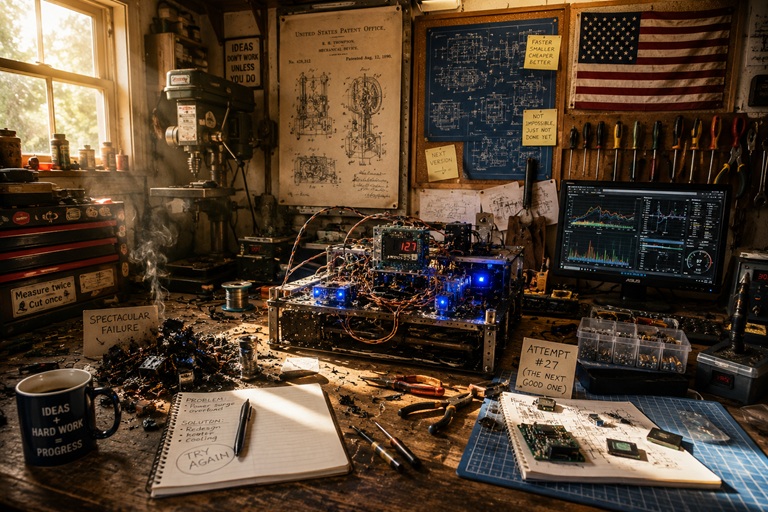
Did we prove that a two-party system works or are we just stubbornly driving on a flat tire, refusing to pull over because we like the rhythm of the thumping sound?
Lately, it feels like we’re driving on a flat tire. The system forces a massive, diverse, complicated nation of 340 million people into two ideological boxes. It turns nuance into a team sport. It creates a reality where we spend more time trying to defeat the other half of our own country than solving actual problems. But perhaps the hidden genius (or the lucky accident) of the two-party system is that it forces a brutal kind of stability. To win, both sides eventually have to pull toward the messy, compromised middle, even if they scream the entire way there. It is a terrible system, except when you look at the alternatives.
Democracy was never intended to eliminate disagreement. It was designed to survive it. The goal isn’t unanimous consensus. It’s peaceful succession. Power changes hands. The country continues. For 250 years, that’s been one of America’s greatest accomplishments.
Not perfection. Continuity.

The Living Dream
It’s fashionable today to catalog America’s flaws. There are certainly enough to choose from.
If you watch the evening news, you would think America is on the brink of an irrecoverable collapse. We are divided by culture, by class, by geography and by politics. We argue about everything.
We’ve stumbled. Sometimes we’ve sprinted enthusiastically in the wrong direction. We’ve made decisions future generations rightly questioned. We’ve failed to live up to our own ideals more than once. Probably more than hundreds of times.
But here’s something worth pondering.
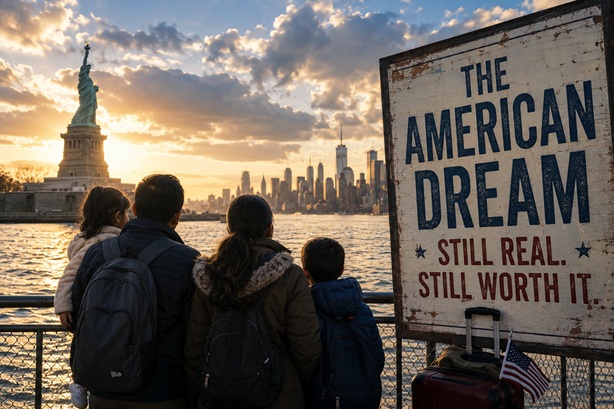
At this very moment, there are millions of people around the world who are quite literally dying to live here. People rarely risk everything to move somewhere worse. But they are risking treacherous seas, oppressive deserts and exploitative cartels just to get their feet onto American soil. Not because they believe America is perfect. No one who actually lives here believes that.
Why? Because the perception of the American Dream is still the most powerful brand on Earth. They come because they believe tomorrow might be better than today. That possibility has always been America’s most valuable natural resource.
Hope.
Have we lived up to that dream? Not perfectly. Not for everyone. Not nearly often enough. Our history is scarred with deep systemic failures, empty promises and moments where we fundamentally betrayed our own founding ideals. The American Dream has never been a guarantee. It was always an opportunity. Some achieved it. Others found the barriers much higher than promised. Still others never started the climb at all.
But the remarkable thing is that people across the world continue believing the dream is worth chasing. The people arriving at our borders don’t see our nightly political theater. They see a place where their children might have a baseline of security, opportunity and freedom that doesn’t exist where they left.
That says something.
Dreams don’t attract millions of people for 250 years unless they contain at least a measure of truth.
A Living Experiment
At 250 years old, America is grey at the temples, a little cynical and wrestling with a profound mid-life crisis. We have massive national debts, crumbling infrastructure and a social fabric that feels frayed at the edges.
But do not bet against the experiment just yet.
America remains great because we are built on an unfinished premise. The Declaration of Independence didn’t say we were perfect. It said we were chasing something better. We are a nation designed to be argued over, amended and re-evaluated by every generation.
Our flaws are entirely on display because our system allows us to scream about them from the rooftops. That isn’t a sign of weakness. It’s our greatest security mechanism. Tyrannies look solid right up until the day they shatter. Republics look like they are breaking every single day, but they bend, adapt and endure.
Perhaps that’s the real lesson of America’s first quarter millennium.
Countries are not great because they’re flawless.
They’re great because they possess the capacity to confront their flaws without abandoning the principles that made them worth building in the first place.
Patriotism isn’t pretending everything is wonderful. It isn’t ignoring mistakes or silencing criticism. A healthy nation should welcome honest criticism. After all, if you don’t care about something, you rarely bother trying to improve it.
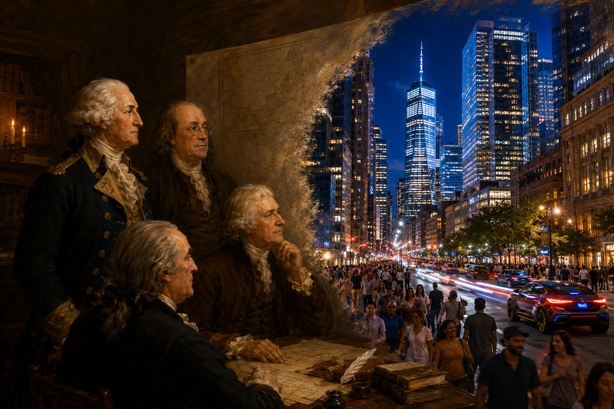
The Founding Fathers did not create a finished masterpiece. They created an experiment. An audacious one. Could free people govern themselves? Could liberty survive disagreement? Could a nation built not on ancestry, language or ethnicity, but on shared ideals, endure?
Two hundred and fifty years later, the experiment is still running. Sometimes elegantly. Sometimes awkwardly. Occasionally with the unmistakable smell of electrical smoke coming from somewhere behind the dashboard.
But it’s still running. And perhaps that’s America’s greatest achievement. Not that we’ve solved every problem. Not that we’ve always chosen wisely. Not even that we’ve become the richest or most powerful nation in history.
America has never been carried forward by presidents alone. It has been carried by farmers who planted next year’s crop, immigrants who opened neighborhood businesses, teachers who stayed late, soldiers who came home, scientists who kept asking questions, entrepreneurs who mortgaged everything on an impossible idea and millions of ordinary citizens who quietly did the next right thing. Nations don’t survive for 250 years because their governments are perfect. They survive because enough of their people keep choosing to build instead of burn.
Our greatest achievement is that after 250 years, we still believe tomorrow can be better than today.
That’s a remarkably American idea. It’s also one worth celebrating.
Happy 250th birthday, America!
Here’s to the next chapter.
Discover more from Tales of Many Things
Subscribe to get the latest posts sent to your email.