Ukraine’s Struggle for Independence: Why It Matters for the World’s Future

The full-scale invasion of Ukraine by Russia in 2022 was a shocking event that reverberated across the globe. For many, it seemed to come out of nowhere, an act of unprovoked aggression in the 21st century. But to understand the true significance of this conflict, we must look beyond recent events and delve into a history that has bound and divided these two nations for nearly 400 years. The current struggle isn’t just a modern territorial dispute. It’s the culmination of centuries of cultural suppression, political control and Ukraine’s long, arduous fight for self-determination.

Bucha main street after Russian invasion of Ukraine by Oleksandr Ratushniak/Wikimedia Commons

Bucha main street after Russian invasion of Ukraine by Oleksandr Ratushniak/Wikimedia Commons

A Long History of Russian Domination

The story begins not with modern states, but with a medieval realm. From the 9th to the 13th centuries, much of present-day Ukraine was the heartland of Kyivan Rus’, a powerful East Slavic state. Kyiv was already a thriving metropolis when Moscow was barely a village. However, following the Mongol invasion, these lands fell under the control of other powers, leading to centuries of fragmentation.

A pivotal turning point arrived in the 17th century. The Pereyaslav Agreement of 1654 was initially an alliance between the Ukrainian Cossack Hetmanate and the Russian Tsardom against the Polish-Lithuanian Commonwealth. The Cossacks viewed it as a military protectorate, but Russia saw an opportunity. Over time, this treaty became the justification for Russia’s gradual assertion of control, which was solidified in the 18th century. Under Catherine the Great, the last remnants of Ukrainian autonomy were systematically dismantled and the territory was fully integrated into the vast Russian Empire.

Decret of Hetman Bohdan Zynoviy Khmelnytsky - historical document/Wikimedia Commons.

Decret of Hetman Bohdan Zynoviy Khmelnytsky – historical document/Wikimedia Commons.

The 19th and early 20th centuries were marked by aggressive policies of Russification, which sought to suppress the Ukrainian language, literature and culture. Despite this, a vibrant intellectual and political movement continued to push for a distinct Ukrainian national identity. This push briefly succeeded after the fall of the Russian Empire in 1917, when Ukraine achieved independence as the Ukrainian People’s Republic. But this freedom was short-lived, as the country was conquered by the Bolsheviks and absorbed into the new Soviet Union.

Throughout the Soviet era, Ukraine was under Moscow’s firm control. This period included the horrific Holodomor, a man-made famine in the 1930s that killed millions of Ukrainians, and continued suppression of national identity. True, lasting independence finally came with the collapse of the Soviet Union in 1991. Since then, Ukraine has been on a path to strengthen its sovereignty and align itself with the West, a path that Russia has consistently tried to undermine, culminating in the 2014 annexation of Crimea and the full-scale invasion in 2022.

Holodomor - Starved peasants on a street in Kharkiv, 1933 - Wikimedia Commons.

Holodomor – Starved peasants on a street in Kharkiv, 1933 – Wikimedia Commons.

In short, for nearly four centuries, Ukraine has been under direct or indirect Russian domination. Its independence since 1991 marks not only a political reality, but the culmination of a centuries-long national aspiration.


Why Ukraine’s Independence Matters for Europe

  • Geopolitical Stability and Security

Ukraine is Europe’s frontline against Russian aggression. As a vast country between Russia and the European Union, its sovereignty creates a vital buffer. If Ukraine were to fall under Moscow’s control again, Russia’s military would sit directly on the borders of NATO members such as Poland, Romania and Slovakia. The fragile peace that Europe has enjoyed since the end of World War II would shatter.

A Russian victory would also embolden authoritarian regimes worldwide by proving that borders can be redrawn by force, treaties mean nothing and might makes right. For the world this would fundamentally destabilize the post–World War II security order built on peace, law and cooperation.

NATO North Atlantic Council Working Session - Wikimedia Commons

NATO North Atlantic Council Working Session – Wikimedia Commons

  • Economic Significance

Ukraine is the “breadbasket of Europe”. Its fertile black soil produces massive amounts of wheat, corn and sunflower oil. Disruptions caused by war would ripple across the globe, leading to food shortages in Africa, the Middle East, Asia and beyond.

Ukraine also plays a role in Europe’s energy security, serving as a key transit route for gas and oil pipelines. A weakened or occupied Ukraine would give Moscow even more leverage over Europe’s energy supplies. A silenced, occupied Ukraine would not only destabilize Europe, but shake the world economy.

Wheat fields in Ukraine - Raimond Spekking/Wikimedia Commons.

Wheat fields in Ukraine – Raimond Spekking/Wikimedia Commons.

  • Democratic Values and International Law

For Europe, Ukraine’s fight is not only about territory. It is about principles. Ukraine has chosen a path toward democracy, human rights and integration with Western institutions. Its people have repeatedly stood up for this choice, from the Orange Revolution (2004) to the Maidan protests (2013–14).

Supporting Ukraine means defending the principle that sovereign nations have the right to choose their own future. It also reinforces the global commitment to international law, territorial integrity and the rejection of conquest by force.

Most importantly, Ukraine’s fight is a fight for values. This is not just a war over land. It is a war over the principle that free people can choose their own future. Europe’s democratic project, its union built on law, human rights and mutual respect, depends on Ukraine’s survival.

Cambridge demonstration in support of Ukraine - AFirehawk/Wikimedia Commons.

Cambridge demonstration in support of Ukraine – AFirehawk/Wikimedia Commons.

Why Ukraine Matters for the United States

It is easy to ask: why should America care about a war thousands of miles away? The answer is simple: because what happens in Ukraine will shape the future of global freedom.

  • America’s Security

If Russia succeeds in conquering Ukraine, it will not stop there. Other nations once under Soviet rule — Estonia, Latvia, Lithuania — would be next. Unlike Ukraine, those countries are NATO members. That means American soldiers could be drawn into a direct war with Russia. Supporting Ukraine now is not charity. It is prevention.

  • America’s Economy

War in Europe will send shockwaves through global energy and food markets. Gas prices will rise, inflation will spike, supply chains will falter. Helping Ukraine defend itself is far less costly than living with a permanently destabilized Europe.

  • America’s Values

The United States has long defined itself as a defender of liberty. If we allow a democracy to be crushed by brute force, we send a signal to every authoritarian regime from Moscow to Beijing that aggression pays. Ukraine is not only defending its own land. It is standing on the front line of the global struggle between democracy and tyranny. Fates of Taiwan, Cyprus, Guyana, Kosovo and many others can depend on Ukraine’s outcome.

Freedom and Democracy for the Ukraine - Franzisko Hauser/Wikimedia Commons.

Freedom and Democracy for the Ukraine – Franzisko Hauser/Wikimedia Commons.

The Stakes of This War

Ukraine’s story is not just about history. It is about the kind of future we all want to live in. Do we want a world where powerful nations can simply erase their neighbors? Where famine, fear and dictatorship spread unchecked? Or do we want a world where nations, large and small, have the right to determine their own destiny?

The Ukrainian people have made their choice. They have chosen freedom, even at terrible cost. In doing so, they have reminded the world of something we sometimes forget: freedom is never free. It must be defended, sometimes with words, sometimes with sacrifice and sometimes, tragically, with blood.

For Europe, for America and for the entire international order, Ukraine’s independence is not just important. It is essential. Their fight is our fight. Their freedom is tied to ours.


Posted in World | Tagged , , , , , , | Leave a comment

The County Fair: Where Fun Meets First Aid

Every summer the county fair rolls into town with its smell of funnel cakes, squeal of livestock and the whirl of carnival rides. And every summer my search and rescue team trades our wilderness gear for matching team t-shirts and a booth at the fair. It’s a nice change of pace. We’re there to talk to people, show off our ropes and cool gear and teach some basic preventative SAR skills (such as carrying the Ten Essentials on a hike). We like to remind folks that while they may be the reigning champ of hide-and-seek, if they stay put, we can find them a lot faster. It’s not true search and rescue, but it’s a great way to meet the community and do a little recruiting.

Back in the day, the fair was all about the kids. We’d have a steady stream of lost children or, more often, their parents, as the kids, clever little survivalists that they are, were usually smart enough to come straight to us. We could easily handle half a dozen or more separated families a day. It was our predictable fair rhythm, a fun, wholesome challenge of reuniting families.

But over the years, something has changed. Lost children are still a part of the job, but they’ve been eclipsed by something far more common: medical emergencies. Our fair draws over twenty thousand people a day and it seems they’ve become increasingly creative in finding ways to get into trouble. Now, we’re not the only medical team on site. The fire department and the local ambulance service are there too, but we still get absolutely slammed. This year, the biggest hits were cuts and scrapes, but we also saw plenty of dehydration, heat exhaustion, diabetic complications, an accidental pepper spray discharge and one episode of chest pains. I often find myself wishing for the good old days when a kid on the midway would get ditched by their parents who wanted a “private moment” in the Ferris wheel gondola.

And this year’s medical was relatively tame. We’ve seen it all in the past: anaphylaxis, gunshot wounds, livestock bites, electrocutions and even cardiac arrests. The fair, for our team, has unfortunately become an annual mass casualty rodeo.

How to Stay Safe and Out of Our Tent

While we’re happy to help, we’d much rather see you enjoy the fair without visiting our tent. To help you avoid becoming one of our “patients”, we’ve put together a list of tips. You can help us go back to the days of just finding lost parents by following a few simple rules.

  • Hydrate, Hydrate, Hydrate. This is the number one issue we see. The summer heat, combined with a lot of walking, can sneak up on you. Skip the sugary soda and grab a water bottle. And if you’re going to mix alcohol with your fair food, be extra mindful of your water intake.
  • Dress for the Weather. Grab hats, sunglasses and sunscreen for the hot days and bring along light layers for the cooler evenings.
  • Know Your Vitals. If you have a known medical condition like diabetes or a heart issue, be proactive. Take your medications, monitor yourself and don’t push your limits. The fair is not the time to prove you can handle a twelve-hour day in the sun.
  • Mixing Medications and Alcohol? Just Don’t – We’ve seen far too many emergencies start this way.
  • Leave the Livestock Alone. The petting zoo is great, but remember that even the friendliest looking animals are still wild. Respect their space, follow all posted rules and don’t assume a cute sheep won’t bite if it feels threatened.
  • Mind the Midway. Rides are fun, but if you feel dizzy or have a history of motion sickness, take it easy. We’ve seen a number of people get sick after riding Alien Abduction one time too many. Also, be aware of your surroundings, especially if you have an allergy. That deep-fried onion ring stand might use the same oil as the fried cheese and you don’t want to find that out the hard way.
  • Have a Plan. This is where our preventative SAR training comes in. If you get separated from your group, have a designated meeting spot. This simple trick can save hours of anxiety and help our team focus on the people who really need our medical expertise. And remember, make sure your four year old knows that your real names are not “mom” and “dad” and can communicate this information and, perhaps, your phone number to us.  If you fail all of this, your rendezvous plan just might become our tent.

By following these tips, you can minimize your risk of becoming a medical emergency at the fair. And if you do need help, don’t hesitate to reach out to the medical teams on hand. We’re here to help you have a safe and enjoyable time at the fair.

The county fair is supposed to be about fun, community and maybe winning a giant stuffed animal you’ll regret having to carry. With a little preparation, you can make sure your fair memories are about the rides, the games and the fried Oreos, not the EMT who had to bandage you up.

The county fair is a ton of fun and we love being a part of it, so next year come say hello to us at our booth, swap some SAR stories and enjoy the fair safely. We’d love to see you, just hopefully not surfing up the midway on our stretcher.


Posted in Search and Rescue | Tagged , , , , | Leave a comment

When Humans Attack: A Cautionary Tale About Wildlife Encounters

A coworker of mine recently went to Yellowstone Bear World, a private animal reserve in West Yellowstone, Montana, to hold, pet and bottle feed bear cubs.  This seems wrong on so many levels.  We often see news stories about “adults”, who should know better, getting into trouble for trying to engage a wild animal in a social situation, much as a you would a member of your target sex at a bar.  This may work well when you’re trying to pick up a date, but having the same tryst with a bear, a majestic snacking machine wrapped in fur, will not yield the results you may be after.

We’ve all seen those adorable wildlife photos on Instagram: a curious bear cub sniffing a backpack, a playful dolphin leaping alongside a boat, a squirrel perched on a bird feeder, seemingly posing for the camera. These images paint a picture of harmonious coexistence between humans and nature, but the reality can be quite different.

Let’s face it, humans can be a bit overzealous when it comes to wildlife encounters. We want that perfect selfie, that Instagram-worthy video, those bragging rights for having come face-to-face with a wild creature. And sometimes, our desire for a close encounter can backfire spectacularly, in a close encounter sort of way.


🦫 The Belarus Beaver Brawl

Take the unfortunate incident of the Belarusian fisherman who met his demise at the teeth of a beaver. Instead of admiring the majestic rodent from a safe distance like a sane person, he decided he needed a photo with it, in his arms. The beaver disagreed. One bite later, a femoral artery was opened and, tragically, the man died, the only documented human death attributed to a beaver. Beavers aren’t exactly known for their cuddly dispositions. They generally keep to themselves, unless being hugged by an enthusiastic tourist.

Sadly, this is not an isolated incident, it’s just the tip of the iceberg. Humans have a long and illustrious history of pushing their luck with wildlife, often with hilarious (and usually painful) consequences:


🦬 Yellowstone’s Annual Bison Toss

Every year, the bison in Yellowstone National Park star in a reality show called “Tourists Gone Wild”. There was the woman who tried to pet a bison. The guy who posed next to one. The child whose parents encouraged him to get “just a little closer”. And then there was the guy who thought it’d be hilarious to high-five a bison at Yellowstone National Park. The result? People getting flipped into the air like rag dolls at a rodeo.

🐻 Bear with Me, This Won’t End Well

Let’s talk about the man who tried to feed a bear a sandwich. Yes, an actual, full-grown man offered a large black bear a peanut butter sandwich from the confines of his tent. The bear, being a bear, accepted the sandwich. Then it decided it also wanted the sleeping bag, the cooler and possibly the man’s foot.  A hiker, attempting to show off his “connection with nature”, tried to give a bear a hug. The bear, understandably, did not comprehend this display of affection, but responded in kind, anyway. Then there’s the couple who posed for a photo with a bear in Romania, only to realize too late that the bear wasn’t exactly thrilled about the photo shoot. They narrowly escaped with their lives, but not before the bear swiped at them.  Keep in mind, a swing and a miss is considered assault.  A swing and a hit is considered battery.  Shockingly, the bear was blamed for being the villain.

🐊 The Alligator Wrestler

A Florida man, convinced of his “man vs. nature” prowess, decided to imitate Crocodile Dundee and wrestle an alligator.  The odds were with the alligator that day.  And then there was the Florida man who simply tried to pet a wild alligator. That’s not the same as just attempting to pin it down, right? Because reaching out to touch a huge reptile with razor-sharp teeth and a bone crushing bite is basically the same as petting a kitten. He learned the hard way that alligators don’t do snuggles. Alligators don’t hate humans. They just think of us the way we might think of a chicken nugget that wandered into our kitchen — unexpected, slightly confusing, but ultimately kind of tasty.

🐘 The Elephant Who Had Enough

Somewhere in Asia, a man thought it would be fun to get out of his safari vehicle and slap an elephant on the rear for his TikTok feed. Now, elephants are generally patient creatures, but given a potential proctology exam, this one voiced a protest. The man was promptly chased, caught and tossed into a bush like an empty soda can.

So, Why Do We Keep Doing This?

Because humans, bless our Instagram-loving hearts, often mistake wild animals for Disney characters.  We forget that:

  • Beavers are not stuffed toys.
  • Bison aren’t just furry cows.
  • Bears recognize us at the weirdest, noisiest trail mix that ever lived.
  • Alligators don’t really care that we’re not shaped like fish.
  • Elephants probably view us the same way that we would view an overly caffeinated squirrel, wearing clothes.

And ultimately, nature doesn’t care how many likes you’ll get on your posts.  Mother Nature truly doesn’t care if yet another monkey, in a loud Hawaiian shirt, loses a limb.  Or four.


A Few Rules for the Wild (That Shouldn’t Need Saying)

  • If it has claws, horns, fangs or an attitude — admire from afar.
  • Selfies are not worth stitches, unless you’re trying to get a selfie of stitches.
  • Feeding wild animals teaches them that humans are a source of snacks and not in a good way.
  • Wild animals are not your friends. They have not seen your YouTube channel. They don’t care about your social influencer status.


A Few Words of Wisdom

These are just a few – a few too many – examples of humans getting a little too close for comfort with our wild neighbors. It’s important to remember that wildlife are wild animals. They are not domesticated pets and they should be treated with respect and caution.

So, the next time you encounter a wild animal, at the lake, in the woods or just at a wildlife sanctuary, remember to keep your distance, put down the camera and resist the urge to become an impromptu wildlife rehabilitator. Your safety and the well-being of the animal will thank you for it.

Posted in Animals | Tagged , , , , , , , , , , , , | Leave a comment

Unpacking the Sweet Truth: Are Artificial Sweeteners Really Safe?

Coca-Cola Zero by Jorge Barrios/Wikimedia Commons.

Coca-Cola Zero by Jorge Barrios/Wikimedia Commons.

I wrote a couple of days ago about the hype of replacing high-fructose corn syrup with cane sugar and what it really means to our bodies.  A natural extension of that article is considering the use of artificial sweeteners.  The natural reaction, if you can’t use option A safely, is to go all in on option B, but is this really the right choice?

In our quest for healthier lifestyles and reduced sugar intake, artificial sweeteners (also known as non-sugar sweeteners or NSS) have become ubiquitous. From diet sodas to sugar-free yogurts, these calorie-free or low-calorie alternatives promise sweetness without the guilt, but as their presence in our diets grows, so do questions about their safety. Are they truly harmless, or are there hidden risks?

Let’s delve into the science behind some of the most common artificial sweeteners and what health authorities and ongoing research say about them.


Aspartame: The Controversial Classic

Aspartame is one of the most widely recognized artificial sweeteners, found in thousands of products.

  • Regulatory Consensus: The U.S. Food and Drug Administration (FDA), European Food Safety Authority (EFSA) and Health Canada consistently affirm that aspartame is safe for the general population when used within its established Acceptable Daily Intake (ADI). The FDA’s ADI is 50 milligrams per kilogram of body weight per day (50 mg/kg/day), while EFSA and Health Canada set it at 40 mg/kg/day.
  • The Cancer Debate: In July 2023, the International Agency for Research on Cancer (IARC), a specialized cancer agency of the World Health Organization (WHO), classified aspartame as “possibly carcinogenic to humans”, placing it in Group 2B. This classification was based on “limited evidence” from human and animal studies. It’s crucial to understand that IARC identifies hazards (what can cause cancer), not risk (the likelihood of cancer at typical exposure).
  • Risk Assessment vs. Hazard Identification: Simultaneously, the Joint FAO/WHO Expert Committee on Food Additives (JECFA), which assesses the risk of food additives, reaffirmed the existing ADI of 0 to 40 mg/kg/day for aspartame. JECFA concluded that the evidence linking aspartame consumption to cancer in humans is “not convincing” at current levels of use.
  • Practical ADI: To exceed the JECFA/EFSA ADI of 40 mg/kg/day, an adult weighing 70 kilograms (approximately 154 pounds) would need to consume more than 9 to 14 cans of diet soft drink daily (assuming 200-300 mg of aspartame per can), without other aspartame sources. This demonstrates that typical consumption is well within safe limits.
  • Other Considerations: Aspartame breaks down into amino acids (phenylalanine and aspartic acid) and a small amount of methanol. It is not safe for individuals with phenylketonuria (PKU), a rare genetic disorder, due to their inability to metabolize phenylalanine. Some anecdotal reports and limited studies have explored potential links to headaches, dizziness or mood changes, but these findings are inconsistent and not definitively proven at typical consumption levels.


Sucralose: The Heat-Stable Sweetener

Sucralose, widely known as Splenda, is another popular artificial sweetener.

  • Regulatory Consensus: The FDA, EFSA and JECFA all approve sucralose as safe for the general population, including children and individuals with diabetes, when used under approved conditions. The established ADI is 5 mg per kilogram of body weight per day (5 mg/kg/day).
  • Heating and Baking Concerns: While sucralose is often marketed as heat-stable, some research suggests that at high temperatures (e.g., above 120°C or 250°F), it can break down and react with other ingredients to form potentially harmful chlorinated compounds. This area requires more definitive research.
  • Gut Microbiome: Studies on sucralose’s impact on the gut microbiome have yielded mixed results. Some animal and preliminary human studies suggest potential negative effects on beneficial gut bacteria at high doses or long-term consumption, while short-term human studies often show no significant impact.
  • Blood Sugar and Insulin: Generally, sucralose is considered to have minimal direct impact on blood sugar and insulin levels. However, some studies, particularly in individuals with obesity who are not accustomed to artificial sweeteners, have observed increases in blood sugar and insulin after sucralose consumption.
  • WHO Guidance: The WHO’s broader guidance in May 2023 discouraged the long-term use of non-sugar sweeteners for weight control, citing insufficient evidence of benefit and potential associations with increased risk of type 2 diabetes and cardiovascular diseases. This applies to sucralose as well.


Acesulfame Potassium (Ace-K): The Often-Paired Sweetener

Acesulfame K is frequently combined with other sweeteners to achieve a more sugar-like taste.

  • Regulatory Consensus: The FDA, EFSA, Health Canada and JECFA all deem Acesulfame K safe. The FDA and JECFA set the ADI at 15 mg/kg/day, while EFSA’s ADI is 9 mg/kg/day. To exceed the FDA’s ADI, a person weighing 150 pounds (68 kg) would need to consume more than 26 individual tabletop sweetener packets daily over their lifetime.
  • Cancer Risk: Early studies in the 1970s raised concerns about Acesulfame K’s potential carcinogenicity, but subsequent, more robust research has not consistently supported these findings in humans. While some recent observational studies have shown a slight association with overall cancer risk, these findings are not conclusive and do not prove causation.
  • Gut Microbiome and Metabolic Effects: Some animal studies suggest that Acesulfame K might alter gut flora and could be linked to weight gain and inflammation. However, human data is limited and the overall impact on blood sugar and insulin is generally considered minimal, though it’s part of the broader discussion on NSS and type 2 diabetes risk.


Saccharin: The Sweetener with a Past

Saccharin is one of the oldest artificial sweeteners, known for its distinct taste and controversial history.

  • Cancer Controversy Resolved: In the 1970s, studies linked high doses of saccharin to bladder cancer in rats. This led to warning labels. However, later research revealed that the mechanism of cancer development in rats was not relevant to humans. Consequently, saccharin was removed from carcinogen lists by the U.S. National Toxicology Program in 2000.
  • Current Safety: The FDA, WHO/JECFA and EFSA now consider saccharin safe for use as a food additive. The ADI is 5 mg/kg/day. An adult weighing 154 pounds (70 kg) could safely consume up to 350 mg of saccharin daily, far exceeding typical intake.
  • Gut Microbiome: Similar to other NSS, some studies have explored saccharin’s potential to disrupt the gut microbiome, but overall evidence is mixed and inconclusive.
  • Other Side Effects: Saccharin can sometimes leave a metallic or bitter aftertaste. Very high doses might lead to mild gastrointestinal issues.


Stevia: The “Natural” Sweetener

Stevia is often perceived as a healthier alternative because it’s derived from a plant.

  • Approved Form: It’s crucial to differentiate: only highly purified steviol glycosides (the sweet compounds extracted from the stevia leaf) are approved by major regulatory bodies like the FDA, JECFA, EFSA and Health Canada. Whole-leaf stevia or crude extracts are not approved due to insufficient safety data.
  • ADI: The ADI for steviol equivalents is generally 4 mg/kg/day, a generous amount that is difficult to exceed through normal consumption.
  • Gut Microbiome: Research on stevia’s impact on the gut microbiome is mixed. Some studies suggest potential benefits or no harm, while others raise questions, indicating a need for more human research.
  • Blood Sugar and Insulin: Stevia itself does not raise blood sugar or insulin levels, making it a popular choice for individuals managing diabetes.
  • Potential Benefits: Preliminary research suggests stevia may have antioxidant and anti-inflammatory properties and some studies explore its potential benefits for blood pressure and kidney health. These areas require further robust human trials.
  • Digestive Issues: While generally well-tolerated, some stevia products may contain added sugar alcohols (like erythritol) that can cause digestive discomfort in sensitive individuals if consumed in large amounts.


Sorbitol: The Sugar Alcohol

Sorbitol is a polyol, a type of carbohydrate that is not fully absorbed by the body.

  • Regulatory Consensus: The FDA recognizes sorbitol as “Generally Recognized As Safe” (GRAS). JECFA has given it an “acceptable daily intake (ADI) of ‘not specified’,” which is the safest category, indicating no health hazard at levels necessary for its intended use.
  • Primary Side Effect: Digestive Issues: This is the most notable aspect of sorbitol. Because it’s incompletely absorbed, large amounts reaching the large intestine can be fermented by gut bacteria, leading to gas bloating, and a laxative effect. Foods containing significant amounts of polyols like sorbitol are often required to carry a warning about potential laxative effects.
  • Blood Sugar and Insulin: Sorbitol has a low glycemic index and a minimal impact on blood sugar levels, making it suitable for people with diabetes.
  • Dental Health: It is non-cariogenic (read this word carefully – it is not “carcinogenic”), meaning it does not promote tooth decay.
  • Other Considerations: Sorbitol is found naturally in some fruits. While generally safe, its primary limitation is the potential for gastrointestinal discomfort with higher consumption. Unlike some other artificial sweeteners, direct links to inflammation, cancer risk or hormone disruption are not primary concerns for sorbitol itself, though the broader category of sugar alcohols is continually studied.

The Sweet Conclusion: Moderation is Key

Artificial sweeteners, when consumed within recommended limits, are considered safe by all major health authorities worldwide. The scary headlines you see are often based on animal studies using unrealistically high doses or misinterpretations of risk classifications.

That said, no sweetener — artificial or natural — is a free pass for unlimited consumption. Artificial sweeteners may help with calorie reduction and blood sugar control, but they can also reinforce a preference for sweet flavors and lead to overconsumption of other high-calorie foods.

The scientific landscape surrounding artificial sweeteners is complex and constantly evolving. While regulatory bodies generally affirm their safety within established ADIs, ongoing research continues to explore potential long-term effects, particularly concerning the gut microbiome, metabolic health and the impact of high consumption.

For most people, consuming these sweeteners in moderation, as part of a balanced diet, is considered safe. However, they are not a magic bullet for health. They offer sweetness without calories, but they don’t provide the essential nutrients found in whole foods.

If you enjoy them occasionally, you’re fine. But if you’re downing a dozen diet sodas every day, it might be time to reassess, not because of cancer, but because it probably isn’t the healthiest habit overall.

The overarching message from health experts remains consistent: focus on reducing your overall intake of added sugars, whether from cane sugar, high-fructose corn syrup or artificial sweeteners. Opt for water and embrace the natural sweetness of fruits and vegetables. Making these smart choices will benefit your body far more in the long run than debating the nuanced differences between various sweeteners.


Posted in Science | Tagged , , , , , , , , , , , | Leave a comment

Sweet Deception? Unpacking Coca-Cola’s Switch from HFCS to Cane Sugar

There’s been a noticeable buzz in the media recently about Coca-Cola’s decision to sweeten some of its drinks with cane sugar instead of high-fructose corn syrup (HFCS). For many health-conscious consumers, this move feels like a positive step, a return to “natural” ingredients and a win in the ongoing debate about what we put into our bodies. But is this change truly as significant as it seems? Let’s dive into the nutritional science to understand the real difference.

Cane Sugar vs. High Fructose Corn Syrup: A Tale of Two Sweeteners

At first glance, the two sweeteners appear quite distinct.

  • Cane Sugar, chemically known as sucrose, is a disaccharide. This means it’s composed of two simpler sugar molecules – 50% glucose and 50% fructose – chemically bonded together, typically derived from sugarcane or sugar beets.
  • High Fructose Corn Syrup (HFCS), often referred to as isoglucose, is a liquid sweetener made from corn starch. The most common form used in beverages, HFCS 55, consists of approximately 55% fructose and 45% glucose. Unlike sucrose, the glucose and fructose in HFCS are not chemically bonded. They exist as free monosaccharides.
glucose (left) and fructose (right)

glucose (left) and fructose (right)

How Our Bodies Process Sweeteners

The minor structural difference between sucrose and HFCS leads to slightly different initial processing in the body, though the end result is largely similar.

When you consume cane sugar (sucrose), enzymes in your digestive system quickly break the bond, splitting it into its constituent glucose and fructose molecules. These then enter your bloodstream.

With HFCS, since the glucose and fructose are already separate, they don’t require this initial enzymatic breakdown. However, for all practical purposes, this difference in initial processing speed is often considered negligible in terms of overall absorption and metabolic impact in the grand scheme of digestion.

Once absorbed:

  • Glucose is the body’s preferred energy source. It enters the bloodstream directly and is transported to cells with the help of insulin, where it’s used for immediate energy or stored as glycogen.
  • Fructose is primarily metabolized in the liver. While some fructose can be used for energy, excess fructose, especially when consumed rapidly and in large quantities, can be converted into fat through a process called lipogenesis. This is why diets consistently high in fructose are linked to an increased risk of fatty liver disease and other metabolic issues.

Both glucose and fructose contribute to raising blood sugar levels. While glucose causes a more direct and rapid increase in blood sugar, the fructose component from either sweetener can contribute to metabolic stress, particularly on the liver, and potentially lead to insulin resistance over time if consumed in excess.


The Calorie Conundrum: Empty Calories

From a caloric perspective, both glucose and fructose provide roughly four calories per gram, which is standard for carbohydrates. For comparison, proteins also provide about four calories per gram, while fats are more calorie-dense at nine calories per gram.

The real problem with these sugars isn’t necessarily their caloric density compared to other macronutrients, but rather their lack of nutritional value. They are often referred to as “empty calories” because they provide energy without offering essential vitamins, minerals or fiber. It’s just a spoonful of calories, with no added benefit for your body’s vital functions.

The Bottom Line: Quantity Over Source

For all practical purposes, your body treats the glucose and fructose from cane sugar and HFCS very similarly once they are absorbed. Excess consumption of either can contribute to a range of health risks, including:

  • Weight gain and obesity: Consuming excess calories from added sugars can lead to weight gain.
  • Insulin resistance and Type 2 diabetes: Regularly consuming high amounts of added sugars can increase the risk of developing insulin resistance.
  • Cardiovascular risks: High sugar intake is linked to increased triglyceride levels and cardiovascular disease risk.
  • Fatty liver disease: Excessive fructose consumption can lead to fat accumulation in the liver.
  • Tooth decay: Both sweeteners provide fuel for bacteria in the mouth, contributing to tooth decay.

The argument that HFCS might be “worse” often stems from its prevalence in highly palatable, processed beverages that people tend to consume in large quantities without feeling satiated. This ease of overconsumption, rather than a fundamental difference in how the body processes the sugar molecules themselves, is what has made HFCS a target for health concerns. If there’s an argument that HFCS is “worse”, it’s mostly contextual: it’s cheaper and more prevalent in processed foods and drinks, which means people consume more of it.

Ultimately, Coca-Cola’s shift in sweetener is likely much ado about nothing from a health perspective. The core issue isn’t whether the sugar comes from a cane or a cornfield, but the sheer volume of added sugars in our diets. Both cane sugar and high-fructose corn syrup are added sugars with no inherent nutritional benefit. The small difference in their glucose-fructose ratio is generally not considered nutritionally significant when evaluating overall dietary impact.

So, when you see those bold advertising signs for Coke made with cane sugar, most likely at a premium price, remember the fundamental truth about added sugars. Instead of debating the merits of one “empty calorie” source over another, consider making the truly smart choice for your long-term health: pass on the spoonfuls of sugar and grab a bottle of water. While an occasional soft drink indulgence won’t ruin your health, making water your go-to beverage is one of the simplest, most impactful changes you can make for long-term wellness. So, skip the hype and maybe skip the soda. Your future self will thank you.

Glucose vs fructose infographic.

Glucose vs fructose infographic.

Posted in Science | Tagged , , , , , , , , , , , , , , | Leave a comment

AAA and the Afterlife

I’ve been a loyal customer of AAA since dinosaurs roamed the Earth, or at least since I got my driver’s license, which some days feels like the same thing. Over the years, they’ve pulled me out of more jams than you find in a jar of Smucker’s: flat tires that materialized out of thin air, dead batteries that decided to stage a silent protest, phantom fuel gauges (it said I had 30 miles left…) and the occasional “my car just doesn’t feel like existing today” moments. I lost a fuel pump in the middle of a rescue mission once.

Seriously, the AAA roadside techs are modern-day knights, only instead of armor and horses, they rock steel-toe boots and arrive in trucks with more tools than Batman’s utility belt. I’m always grateful when one shows up, like a beacon of hope, to rescue me from whatever vehicular nonsense I’ve gotten myself into. Seriously, you guys are the best at what you do.

But then there’s the other side of AAA. The side that apparently believes my life is an endless, gaping void of unmet consumer needs, just waiting to be filled by whatever product rolls off their perpetually moving conveyor belt of offers. For all the noble rescuing, AAA also has this slightly clingy ex-girlfriend energy when it comes to selling me things I don’t want.

Out-of-season tires?
No thanks, unless I suddenly decide to rally race in February.

An oil change?
I have a guy for that. He smells like motor grease and coffee, but I trust him with my engine and the secrets I hide in my center console storage compartment.

Artisanal cheeses?
Is my car breaking down a sign that my charcuterie board is lacking? I’m picturing a tow truck pulling up and instead of jumper cables, the guy’s got a wedge of aged gouda. “Here, sir, for your troubles. Pairs wonderfully with a dead battery.” Seriously, will a wedge of brie fix a busted radiator?

Car insurance. Home insurance. Pet psychic recommendations. I mean, at this point I wouldn’t be surprised if AAA offered me a subscription box called “Surprise Junk Trunk” for just $29.95 a month.

But this week… This week was special.  Nothing prepared me for this call. AAA called me, ever so thoughtful, to offer me life insurance.

Cue the ominous music.

Now, I’m not naive. I know life insurance is a real product that real people need. I also do search and rescue, so trust me when I say I’ve seen some weird stuff. Yes, weird, bad, totally-random-stuff happens. I’ve seen it all. If it were fiction, Stephen King would say, “Dial it back a bit.”

But it was the way they pitched it that got me.

The agent hit me with:
“You can try it free for 30 days, and if you like it, we’ll keep you in the program and bill you.”

Seriously? My brain did a full 360-degree spin, then backflipped into a philosophical abyss. I didn’t even need to think. The words just came out without considering the full ramifications of test-driving life insurance. With the most innocent tone I could muster, I asked:
“How would I know I like it? Without actually trying it, I mean?”

A long pause. A pause so long, I could hear the artisanal cheese aging in the background.
“Uh… what?”  I clearly threw him off his script.

Did I really have to explain this? “Like, how do I know I’m satisfied with your product unless I, you know, die and see how it goes?”

Another, even longer, more profound pause. I could hear the hamster wheel spinning in his head, probably squeaking under pressure, chasing that distant wedge of cheese.

“That’s not … how we mean it…” he finally managed, his voice a little strained.

Oh, but sure you do, buddy. If you’re offering me a “try before you buy” on a product whose core utility is only realized post-mortem, then yes, that’s exactly how you mean it. You’re giving me a trial period and the only way to experience the product is to kick the bucket. That doesn’t seem like a great selling point.

“Otherwise,” I continued helpfully, “you’re just offering me a free month on a 30-year commitment that only someone else gets to review. It’s not like Netflix where I can cancel after episode one.”

“So… can I sign you up?” You have to admire the tenacity. Did he just skip to the bottom of his script?

I passed. Respectfully. Some things, you just don’t want to “try out” to see if they’re a good fit.

If AAA wants to give me a free month of emergency pepper jack, I’m all in. I’ll give that a whirl. I’ll road test their cheeses for a month any day. But life insurance? Not something I’m interested in test-driving for obvious reasons.

I love AAA when my engine dies.  I’m less enthused when I have to die to make use of their latest offer.

Let’s stick to jumpstarts and spare tires, guys. And maybe, just maybe, a bonus wedge of cheddar on those more complicated rescues.

Posted in Retail | Tagged , , , | Leave a comment

Bluetooth or Bonkers – the Perilous Puzzle of Public Perception

There was a time, not so long ago, when it was relatively easy to distinguish the eccentric from the executive. You’d be strolling down Main Street, enjoying your ice cream cone or contemplating your lunch options, when suddenly you’d spot that guy — arms flailing, voice booming, passionately arguing about alien conspiracies or asking the birds to repay a debt. You’d subtly (or not so subtly, depending on their volume) cross to the other side of the street. You’d let the “crazy people who talk to themselves” have their clear, unencumbered path, perhaps offering a silent nod of respectful avoidance. It was the polite thing to do, for both of you. It was a simpler time, a time of clear social indicators.

Back then, identifying the unsound mind was a community sport. “See a screamer, change your demeanor” was the unspoken rule. I used to be a master of street psychology. I’d stroll down the sidewalk, effortlessly categorizing passersby into two distinct groups: the sane and the, well, let’s just say “enthusiastic”. But now? Good luck! Those halcyon days are behind us. Now, I’m left scratching my head, wondering if the disheveled guy yelling at his earpiece is having a heated debate with his accountant or negotiating with the voices in his head. It’s like the world has decided to play a game of “Guess Who’s Sane?” and I’m perpetually losing.  My elementary school education emphasized the importance of eye contact and facial expressions. Apparently, those skills are now as useful as a flip phone in a smartphone world.

It started innocently enough with the rise of mobile phones. Sure, early adopters carried bricks the size of a shoebox and practically screamed “I own stock in IBM” as they yelled into their Motorola monstrosities. Clearly on the phone, clearly a titan of industry, probably coordinating a rendezvous with his personal jet-powered limo. No misperception there. You didn’t confuse them with the local bus stop philosopher. They were too well-dressed and, more importantly, tethered to their devices.

Then came the smartphones — sleek, tiny, barely visible. At first, you could still tell: people held them to their ears like civilized humans. But then the ultimate social disruptor arrived: the Bluetooth earpiece.

The Bluetooth. The bane of public perception. Suddenly, it wasn’t just the Tech Bros and the Wall Street Warriors talking into invisible microphones. It’s everyone. And now? Now, I pass someone on the street having a heated conversation with no person in sight, no phone visible, no context provided. He’s red-faced, gesturing wildly and pacing like he’s defusing a hostage situation. Do I call the cops? Offer a tissue? Applaud? I don’t know anymore!

It’s my inner conflict is coming across a disheveled, slightly portly gentleman. His arm is waving wildly, his voice loud, excited, perhaps even a tad indignant. He’s clearly in the midst of a passionate monologue. And I am utterly, hopelessly lost. Is he complaining to someone on the phone that may or may not be nestled in his back pocket? Is he having a heated debate with an invisible friend about the merits of artisanal cheese? Or is he, perhaps, just having a very spirited internal dialogue with that other person occupying the same body as he? The possibilities are endless and my internal “Crazy-o-Meter” is officially broken.

The problem is further complicated by our pandemic-era social skills erosion. We all spent two years perfecting our communication with emoji, thumbs-up reactions and muting ourselves on Zoom when we needed to issue that primal scream into the void. Now that we’re back outside, the old rules of facial expression and body language just don’t compute. Is that group laughing at a joke? Or have they joined a laughing cult and I’m their next target? It’s getting harder and harder to figure people out these days. Society, it seems, no longer functions like it used to. The subtle cues, the unspoken rules, the very fabric of public interaction has been replaced by a cacophony of potential conversations with unseen entities. And honestly, it makes interacting with people really, really hard.

I’m starting to think the only way to tell who’s sane anymore is by whether or not they make eye contact and even that could go either way. Is that grandmotherly woman giving me a kind smile? Or silently threatening me with her eyes?

We used to laugh at the thought of talking to ourselves in public. Now, we schedule time to record ourselves talking to ourselves, upload it to TikTok and hope it goes viral.

So what’s the takeaway here?

We’ve reached a point in civilization where you can’t tell the difference between someone on a conference call and someone on a conference call with a higher power (virtual or real), an imaginary friend or telepathic aliens. Technology has democratized insanity and I, for one, am not sure whether to be impressed or very, very afraid.

Is this the first step in the fall of civilization? Will we all eventually be wandering around, shouting into the void, unsure if anyone is actually listening? Or are we just part of a grand, collective, public performance art piece?

Next time you pass someone on the sidewalk loudly whispering about lizard people and hummus, maybe don’t judge. Maybe he’s just on a call with the National Security Council. Or maybe he knows something you really don’t want to. Either way, smile politely, nod and cross the street. Just to be safe.


Posted in Society | Tagged , , , | Leave a comment

Freedom, Fireworks and Founding Fathers

As the calendar pages turn towards July, a familiar tension begins to build in my solidly middle-class neighborhood. It’s not the anticipation of barbecues and parades, not entirely. It’s the low, rumbling dread of what’s to come: the unofficial, unsanctioned and utterly unhinged celebration of American independence.

In the days leading up to the Fourth of July and for a good few days after, my usually quiet street transforms. My neighbors, many of whom I’ve reluctantly come to mentally label as “hoodlum rednecks” (a term I use with a sigh, not a sneer, born of sheer exhaustion), seem to possess an arsenal that would make a modern Army platoon blush. They detonate more explosives than a small nation at war and they do it at seemingly random times of day. And night. There’s truly nothing quite like being jolted awake at two in the morning by a massive explosion, your heart pounding, wondering if that concussive blast outside your window warrants an emergency response or a psychiatric intervention.

Then comes the morning of July 5th. As an early riser, I often hit the bike trails to escape the lingering haze of gunpowder and regret. What I find is a landscape of post-apocalyptic revelry: tons of debris – plastic, cardboard, spent casings – from the previous night’s festivities. And, more alarmingly, the tell-tale scorched circles and blackened patches of grass where fireworks inevitably got out of control. It’s a stark, sobering tableau of celebration gone awry.

fireworks debris littering a neighborhood

fireworks debris littering a neighborhood

And there’s another, increasingly prevalent, issue: the rise of drunken revelry. While a celebratory drink is one thing, the sheer volume of intoxication that accompanies some of these Fourth of July celebrations leads to an amazing, and frankly, disgusting, amount of damage. This ranges from the random bodily fluid blowouts discovered on lawns and sidewalks (yes, really) to the more catastrophic consequences of impaired driving, resulting in cars wrapped around trees, often taking out other vehicles in their destructive wake.

Drive Smart Nebraska Campaign

Drive Smart Nebraska Campaign

All of this leaves me with a persistent, nagging question, one that echoes louder with each premature bang and each piece of litter: Is this what our Founding Fathers truly envisioned as the celebration of our country’s founding?

I try to imagine John Adams, penning a letter to Abigail, describing the future of American festivity. Would he speak of skies ablaze with uncontrolled pyrotechnics, shaking the very foundations of homes at ungodly hours? Would Thomas Jefferson, in his quiet contemplation, foresee a nation celebrating its intellectual and political liberation with widespread public intoxication and property destruction? Would Benjamin Franklin, ever the pragmatist, nod approvingly at the sheer waste of resources, the environmental blight and the strain on emergency services?

Picture this: 1776, Philadelphia. Thomas Jefferson leans back in his chair, quill in hand, wiping ink from his fingers, as he pens the final lines of the Declaration of Independence. John Adams walks in, pausing to admire the document before saying, “Tom, you know what this calls for? Barely regulated explosives, public intoxication and someone vomiting on a flaming slip-n-slide in a Walmart parking lot! Should we write it in?”

It’s safe to say that didn’t happen. Yet here we are.

Writing the Declaration of Independence, 1776, by Jean Leon Gerome Ferris

Writing the Declaration of Independence, 1776, by Jean Leon Gerome Ferris

The Fourth of July is supposed to commemorate the adoption of the Declaration of Independence, a bold thoughtful stand for liberty and self-governance, rooted in reason, justice and human dignity. It was a turning point in the history of the world, the birth of a new nation, an experiment in democracy. But as I weave through my neighborhood on July 5th dodging firework debris, spotting blackened patches of scorched lawn and noting the charred remnants of Roman candles like some post-battle historian, I can’t help but wonder: What happened to the reverence?

The spirit of 1776 was one of profound thought, courageous debate and a deep, if sometimes flawed, commitment to principles of liberty, self-governance and the pursuit of a more perfect union. The Declaration of Independence, the very document we celebrate, is not a call to chaotic abandon. It’s a meticulously reasoned argument for freedom, a testament to the power of ideas and a solemn pledge of lives, fortunes and sacred honor.

While John Adams famously predicted that Independence Day would be celebrated with “pomp and parade, with shows, games, sports, guns, bells, bonfires and illuminations from one end of this continent to the other,” I believe his vision was one of ordered celebration, of communal joy and a respectful remembrance of the immense sacrifice involved. He envisioned citizens uniting in gratitude and shared purpose, not descending into a cacophony of random explosions and dangerous recklessness. The “illuminations” he spoke of were likely grand, controlled displays, not backyard arsenals threatening life and limb.

Our independence was hard-won, built on the ideals of self-control, civic responsibility and the collective good. It was about establishing a society where rights were protected and order prevailed, allowing for the flourishing of individuals and communities. To celebrate this profound legacy with actions that endanger our neighbors, pollute our shared spaces and strain our public services feels, to me, deeply antithetical to the very principles we claim to honor.

So, as we approach this Fourth of July, I want to urge everyone reading this to celebrate responsibly. Stay safe, be mindful of your neighbors, your environment and the laws designed to protect us all. But most importantly, take a moment to truly remember the actual meaning of Independence Day. It’s a day to reflect on the ideals of liberty, the responsibilities that come with freedom and the ongoing work required to build a more just and perfect society. Let our celebrations be a testament to our values, not a chaotic caricature of them. After all, freedom isn’t just the right to party. It’s the right to be better.


Posted in Holidays | Tagged , , , , , , , , , , , , , | Leave a comment

The New Power Suit

When I was in graduate school, I landed a job with an international corporation.  It was suit and tie and I loved it.  I wasn’t just pretending to be an adult.  I made it.  I was the first of my high school friends to go corporate, but by the time they were in the same position, I was getting a little bothered under the collar.  Suits, for some reason, are not designed to be comfortable (or maybe I just don’t know how to pick them).  I was looking forward to those casual Fridays when the jacket did not need to match the pants and instead of sporting a sensible tie, the top button of my shirt could be undone.

I’m still corporate, working for a very different international corporation, and all these years later corporate dress has changed.  My business attire these days is a clean pair of boots, Columbia Sportswear’s Titanium or Silver Ridge pants (with Omni-Shade) and a company logoed polo.  I’m pushing the dress code limits, but no one dares complain because I’m “flying the company flag”. Going after my pants and shoes would be unpatriotic.

And yet, much as I feel I’m pushing corporate culture, it doesn’t feel like I’ve kept up.  On a recent crisp early morning, the sun barely awake, I was pedaling along on my trusty bicycle, dodging squirrels and misplaced sprinklers. That’s when I saw her: a woman walking her dog in full pajama regalia — flannel pants, fuzzy slippers and a sleepy top that proudly proclaimed, “Don’t Talk to Me Before Coffee”. Classic. Functional. Confusing. When I was a kid, even contemplating going outside before washing up and putting on appropriate clothes would get me grounded for the day. Definitely confusing.

I chalked it up to a quirky start-of-day ritual. After all, who among us hasn’t shuffled out in sleepwear to grab the paper (when we still read those) or chase down a runaway trash can (before we started recycling just about everything)? Except we were in a city park, a significant distance from homes. I told myself that I get it. Sometimes the dog just has to go and formal wear is not a priority.

But then, like an oddly patterned domino effect, it kept happening.  Maybe it’s just recency bias, but all of a sudden, I started noticing it.

Later that same day, I saw another pajama-clad citizen perusing the cereal aisle of my local grocery store. She was calm, composed and contemplating an assortment of wheat bran cereals, to go with the carton of almond milk in her cart. She seemed to be completely oblivious to the fact she was in Cookie Monster pants and bunny slippers. I almost suggested that maybe she should check out the Cookie Crisp cereal boxes a few feet away.

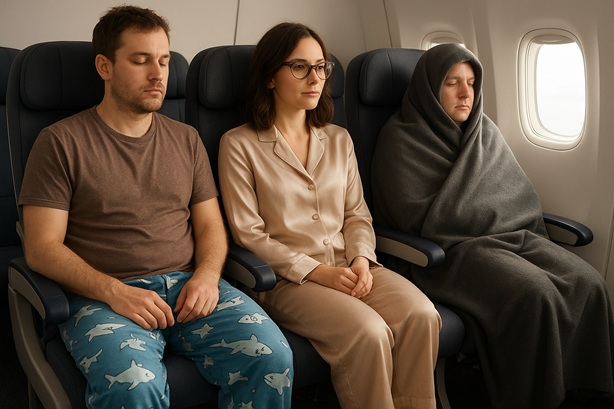
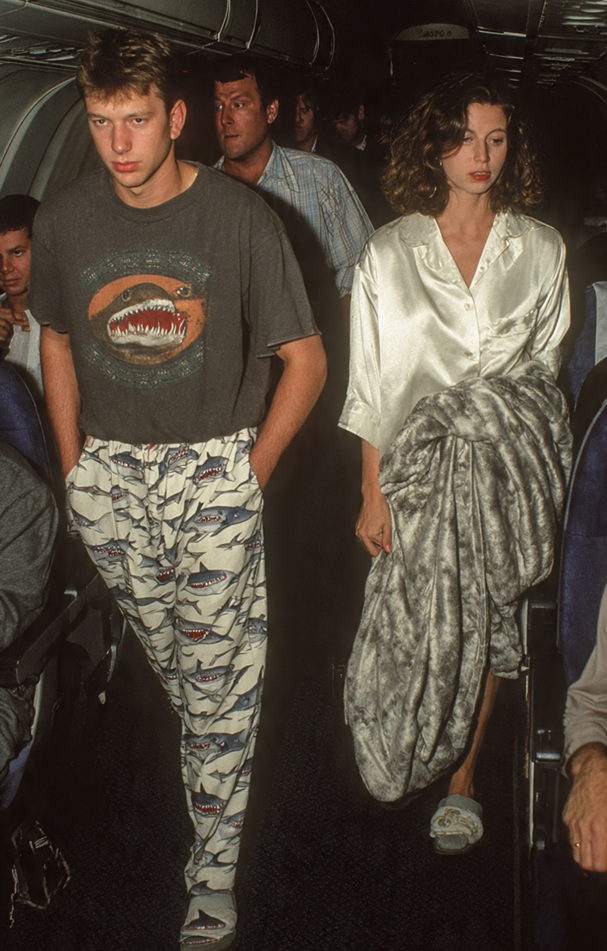
But that wasn’t the conclusion of my recency bias experience. A few days later, at the airport, boarding a commercial flight, was a woman in what could only be described as satin bedtime finery. She didn’t glance sideways. She didn’t smirk. No shame, no irony. Just a woman, a neck pillow and what appeared to be a matching pajama-travel set. She was sauntering down the jet bridge, carry-on rolling behind her, looking utterly unbothered.

We are in the era of the Pajama Culture and I don’t really know what that means. When did this sneak up on us? Somewhere between Zoom meetings and home baking, society decided that comfort supersedes convention. If we’re going to be exhausted and emotionally overdrawn, at least we can do it in flannel.

And to be fair, pajama tech has come a long way. These aren’t your grandma’s ankle-length nightgowns. We’re talking microfleece, bamboo cotton, athleisure hybrids and enough elastic waistband innovation to make the space program jealous.

There appears to be a social shift that pajamas are no longer just for sleeping. They’re for thriving. Walking the dog? PJs. Getting groceries? PJs. Brunch? You bet your bunny slippers.

Is it a quiet rebellion against the pressures of adulting? Is it the natural evolution of fashion after athleisure? Is it rebellion against Puritan upbringing? I hazard to guess that it’s a slippery slope for someone thinking, “For tonight’s gala, I’ll be wearing my finest penguin-print jammies and a tiara.” Could pajamas become formal wear? Picture the red-carpet interviews:

Reporter: “Tell us, who are you wearing tonight?”
Starlet: “Target, from the Cozy Nights collection. These cloud-print drawstring pants are machine washable and fierce.”

Honestly? A decade ago I would have called this a far-fetched fantasy, but now I’m leerily eyeing this fashion trend. We’re just one pair of monogrammed sleep pants away from full pajama diplomacy.  I can see it now: late night boardroom meetings resembling a slumber party, the evening news reporters talking about the day’s game results while wearing pajamas in the style of their favorite teams, the district judge trading his court robes for a more comfortable, albeit more awkward fleece nightgown, with a frilly trim.

Are we abandoning all sense of decency? Are we embracing the “I don’t care about your opinion” attitude? Are pajamas the new formal wear? I’m not sure what’s more alarming – the fact that people are wearing pajamas in public or the fact that it’s becoming increasingly acceptable.

Is Star Wars doing this to us? Let’s be honest, every Jedi Knight looks like they just walked out of a galactic pajama party. Robes, tunics and that “I hit snooze five times” hairstyle. No wonder the galaxy’s always on the brink of collapse. You can’t fight the Sith with bedhead and bathroom slippers. And yet, somehow, it works. Maybe that’s the secret. The more comfortable you are, the stronger the Force flows. Or maybe it’s just a cautionary tale. If you give up fashion for comfort, you might end up raising a Darth.

I need to go back and reread my college history books to recall how the Roman Empire fell. Sleepwear might have been a factor.

La morte di Cesare by Vincenzo Camuccini

La morte di Cesare by Vincenzo Camuccini

In a world filled with chaos, perhaps the rise of pajamas is our collective protest for peace and quiet and harmony. A silent, but comfy rebellion against belts, buttons and all things restrictive. The next time you see someone pushing a shopping cart in their bedtime best, don’t scoff. Bellbottoms have been teetering for a while.  Perhaps these people are pioneers of a new lifestyle.

I should check with HR. Would pajamas with a collar count as “business casual”?


Posted in Culture | Tagged , , , , , , , , | Leave a comment

Why Sometimes Doing Nothing is Pure Genius

Not long ago a friend nearing retirement confided in me with a heavy heart, his voice carrying a note of genuine surprise, a blend of disappointment and some bewilderment. While the market had soared in recent years, his retirement portfolio was disappointingly flat. With just a few questions, the picture became clearer: he had entrusted a significant portion of his hard-earned savings to a company specializing in actively managed funds.

It’s a frustrating irony. During a period when the S&P 500 had made generous strides, he saw little benefit. The culprit? High fees, frequent trading and a lack of long-term discipline, hallmarks of the churning of securities held in actively managed funds. This means frequent buying and selling, which translates directly into short-term capital gains taxes and a steady stream of trading fees for the fund managers, all piled on top of already hefty management fees.

His experience is a stark reminder of the importance of low-cost, passive investing strategies. It’s a common tale and my friend’s experience is not unique. It serves as a powerful, albeit painful, reminder of some fundamental investing truths. So, grab a metaphorical (or actual) low-cost index fund and let’s delve into the lessons.

Warren Buffett’s Million-Dollar Bet

Let’s start with the undisputed heavyweight champion of common-sense investing, Mr. Warren Buffett. Back in 2007, the Oracle of Omaha, known for his down-to-earth wisdom and deep pockets, made a $1 million wager that a simple, low-cost S&P 500 index fund would outperform a curated selection of hedge funds over a decade.

Ted Seides of Protégé Partners, was brave enough to take on Buffett. He accepted the challenge by selecting five hedge funds. Surely, staffed by brilliant minds armed with complex algorithms and insider insights, these funds stood a chance to take down Warren Buffett himself. Their competitor was the meek Vanguard 500, an S&P 500 index fund, a fund that just buys a tiny piece of every company in the S&P 500 and calls it a day. No fancy footwork, no expensive suits.

The result? By 2017, plowing through the housing bubble market meltdown, the Vanguard 500 had delivered an average annual return of about 7.1%. The high-flying hedge fund portfolio? A rather deflated 2.2%. Over ten years that’s a lag of 60% on your investment!

Seides, a gentleman to the core, conceded before the bet officially concluded. Buffett won, proving that, for most investors, the silent killer isn’t market volatility, but the incessant, corrosive drip of fees. After fees, taxes and trading costs, even highly paid professionals, the smartest men in the room, have trouble outperforming the market. For most investors, a low-cost, diversified index fund is not just sufficient — it’s optimal.

 

The Dangers of Overtrading

You’d think after seeing the professionals stumble, individual investors would learn to keep their hands in their pockets. But human nature, bless its optimistic (and often delusional) heart, tends to believe we are different. We’re luckier, smarter, better suited to make investing decisions.

Academics Brad Barber and Terrance Odean studied individual investor behavior and published their now-famous work: “Trading Is Hazardous to Your Wealth”. Now you know that if a study title sounds like a warning label on a pack of cigarettes, you’re in for some fun facts.

Using actual trading data from 1991 to 1996, Barber and Odean found that individuals who traded stocks frequently experienced substantially lower returns than those who adopted a more patient approach. While the overall market was returning a robust 17.9% annually, the most active traders were clocking in at a rather pedestrian 11.4%. Over five years, that’s a beat by a third.

Why the shortfall? Active traders’ returns are often eroded by transaction costs, taxes and emotional decision-making. We think we’re smarter than the market, better at picking winners and quicker to react. But in reality, all that “action” just racks up transaction costs and taxes, slowly but surely eating away at any potential gains. It’s like constantly re-arranging the furniture in your house to “optimize flow” but having to pay a moving crew every time. Eventually, you’ve spent more on movers than the house is worth.

The study’s findings suggest that overconfidence bias can lead to excessive trading, resulting in poor performance. This study aligns with what my friend experienced: a well-meaning, but ultimately costly attempt to “beat the market” through an active strategy turned into a lesson in the dangers of over-management.


The Case of the Dead Investors

And now, for the most delightfully morbid, yet profoundly wise, investing lesson of all: the infamous Fidelity Investments study. One of the more ironic investing insights comes from an internal Fidelity study. It found that the accounts with the best performance over a 10-year period (2003–2013) belonged to investors who were either dead or had forgotten they even had an account.

Yes, you read that right. The market’s titans weren’t hedge fund managers or hyperactive day traders. They were literally six feet under, or busy living their lives, oblivious to their brokerage statements being mailed to the wrong address.

Why this macabre success?

  • No Costs, No Taxes: When you’re deceased or forgetful, you’re not trading. No trading means no transaction fees and no short-term capital gains taxes. It’s the ultimate low-cost, tax-efficient strategy.
  • Pure Compounding Power: These “dead” or “distracted” investors inherently adopted a “buy and hold” approach. Their investments were left untouched, allowing the magic of compounding to work its uninterrupted wonders over years, sometimes decades.
  • Immunity to Emotional Myopia: The market is a rollercoaster of fear and greed. Active investors are constantly tempted to sell during downturns (fear!) or buy into speculative bubbles (greed!). Our deceased or forgetful friends, however, were immune to these pitfalls. They simply weren’t around (or aware) to panic sell or to chase fleeting trends.

These individuals succeeded not because of genius strategy, but precisely because they did nothing. They didn’t panic-sell during downturns. They didn’t chase the latest fads. They didn’t fiddle.

In other words, inaction became a strategy and it outperformed most investors who tried to time the market or tweak their portfolios into perfection.

Best Practices for Long-Term Investing

What can we learn from all this? These lessons highlight the importance of patience, discipline and low costs in investing. Whether you’re a seasoned investor or just getting started, here are some key takeaways to build the foundation of your investment strategy:

  • Costs matter. High fees and transaction costs are silent killers of long-term returns. Syphoning away just 1% of your return over ten years adds up to a loss of 10%. And with a fund that eats away a “negligible” 3% every year, thirty years later your losses are 2.3 times more than what your gains could have been.  That’s a difference of $100,000 on an initial $10,000 investment!
  • Time in the market beats timing the market. Chasing performance or predicting downturns rarely works. Resist the urge to constantly tinker with your portfolio. Frequent trading is a wealth destroyer. Avoid reacting to short-term market noise. Adopt a “buy and hold” mindset, making adjustments only when your financial goals or life circumstances fundamentally change. Think in decades, not days.
  • Diversify and simplify. Broad index funds are often more effective than complex actively managed fund structures. These funds offer broad diversification and lower fees compared to actively managed funds.
  • Don’t overlook behavior. Avoid excessive trading, which can lead to higher costs, taxes and poor performance. Investor psychology — fear, greed, impatience — is often the greatest risk to your portfolio.
  • Automate and Forget (Almost): Set up automatic contributions to your retirement accounts and investment vehicles. Then, periodically review your overall asset allocation (maybe once a year, or after significant life events), but avoid daily or weekly checking. The less you react to market noise, the better.

By embracing these principles, investors can increase their chances of success and achieve their long-term financial goals. As the evidence suggests, sometimes the best investment strategy is simply to adopt a hands-off approach and let time work in your favor.


The Path to Investment Serenity

My friend’s story is painful, but instructive. It is a cautionary tale that provides invaluable wisdom. In a time when simply being in the market would have meant strong gains, he paid the price, literally, for chasing complexity. In the world of the intricate financial landscape, sometimes the most genius move isn’t about outsmarting the market, but simply about getting out of its way.

Investing doesn’t have to be exciting to be effective. In fact, boring is often better. If you understand your strategy, keep your costs low and stay disciplined. The odds are already stacked in your favor. The market rewards patience, not performance-chasing. And sometimes the best action is no action at all.

Here’s to simple strategies, low fees and, perhaps, a touch of healthy neglect when it comes to your investments. Your future self (and potentially your beneficiaries) will thank you.


Posted in Investing | Tagged , , , , , , , , , , , , | Leave a comment