
I recently met up with a friend for lunch to catch up. He mocked me.
“It didn’t fail,” he said, struggling to contain himself.
“What didn’t fail?” I asked.
“Gravity. It didn’t turn off.” Then he laughed uncontrollably.
This was a reference to the prediction that gravity would supposedly turn off for seven seconds on August 12, sending humanity into chaos and causing us all to fall into the sky. Except, of course, for the bunker protected elite, who would apparently be safe underground, because when you are inventing a global catastrophe involving the fundamental structure of the universe suddenly malfunctioning, you should always remember to include a secret underground survival program for rich people and, apparently, the aluminum foil hatted enthusiasts who secured their own shelters and waited anxiously for the gravity flip.
This adds realism to the conspiracy.
Anyone who had taken an introductory physics course understood the absurdity of the claim. Everyone else? Well, I have little doubt that somewhere, someone secured their bunker, wrapped their head in aluminum foil and waited anxiously for the Great Gravity Flip.
Then August 12 came.
Gravity stubbornly continued doing its job. People remained attached to the Earth. Coffee stayed in coffee cups. Airplanes did not suddenly accelerate toward Alpha Centauri. The planet continued its long and apparently uneventful tradition of not turning fundamental physics into a seven second prank.
I am curious how long the conspiracy theorists sat chained to the wall in the dark, diligently snacking on beef jerky, waiting for the Great Gravity Flip to end the world. You have to figure that there’s a point where they say, “maybe that’s not going to happen”. Was it August 13? 14? September 12? Patiently waiting a full month is definitive, isn’t it?
My friend found this hilarious. Unfortunately, there is a more serious point hiding underneath the joke.
People struggle with gravity. It takes a physical toll. It takes an intellectual toll, particularly if you don’t know any better. And apparently, for some people, it takes a psychological toll severe enough that they become convinced the universe has an off switch that somebody forgot to password protect.
The strange thing is that gravity really is difficult, not because scientists don’t understand it. We understand an enormous amount about how gravity behaves. It is difficult because every day human intuition about gravity is wrong in ways that would surprise most people.
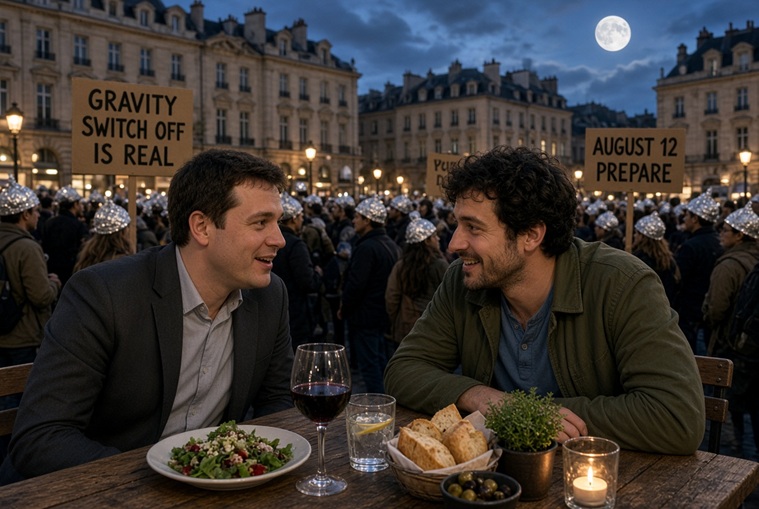
The Ground Is Pushing Against You
Let’s start with something that sounds completely backwards. You are not standing on the Earth because you are simply being pulled downward by a magical invisible suction force. Not exactly.
According to Einstein’s theory of general relativity, a freely falling object is doing something remarkably natural. It is following the closest thing possible to a straight path through curved spacetime.
Try to visualize this. The thing we call falling is, in a very real sense, the natural motion. The thing preventing you from falling is the ground.
When you jump out of an airplane, setting aside air resistance, you feel weightless. That is not because gravity has disappeared. Gravity is still very much there. You and the airplane are simply moving along paths determined by the geometry of spacetime. For a brief period, nothing is holding you up. You are in free fall and strangely enough, freefall feels weightless.
Now consider what happens when you stand on the ground. Your natural freefall path would take you toward the center of the Earth, but the Earth objects. Take that literally.
The atoms in the ground resist being pushed through one another. Electromagnetic forces prevent your feet from passing through the floor and continuing along their freefall path. The ground pushes upward on you. We’ll look at electromagnetic resistance when we talk about nuclear fusion in a couple of weeks.
That upward force is what you experience as weight. Near the Earth’s surface, the proper acceleration associated with standing on the ground is approximately 9.8 meters per second squared.
Then there is the bizarre part. When you are standing perfectly still on the ground, you are not following a force free path through spacetime. The ground is constantly interfering with you.
Gravity is not merely hard on your feet. From a certain perspective, your feet spend your entire life engaged in a furious argument with the planet. Spend a day hiking and you’ll probably concede that point.
Newton Wasn’t Wrong
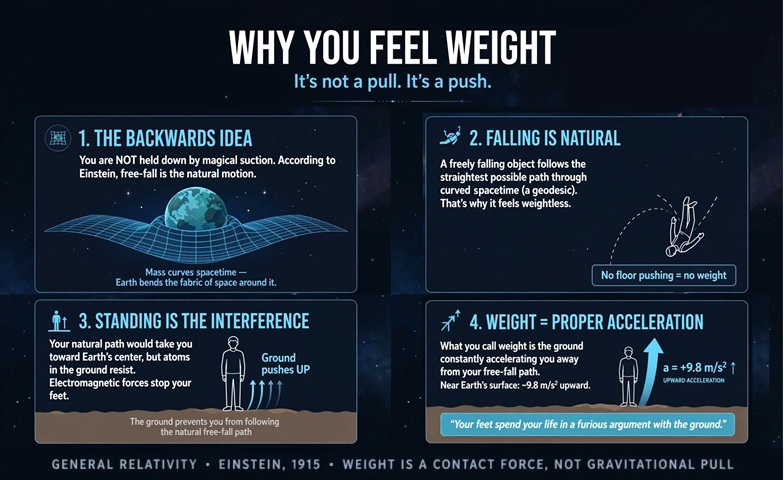
At this point, Sir Isaac Newton deserves a defense. Newton described gravity as an attractive force between masses. The Earth attracts you. You attract the Earth. The Earth wins that particular argument because it has considerably more mass.
Newton’s explanation is not nonsense and it is not obsolete. Newtonian gravity remains astonishingly useful and astonishingly correct. Engineers use it. Astronomers use it. Space missions rely on it. It predicts an enormous range of everyday phenomena with extraordinary precision. NASA still notes that Newtonian physics works extremely well for spacecraft operating at ordinary solar system velocities, with relativistic corrections becoming important when greater precision is required.
If you are calculating the trajectory of a baseball, you do not need to solve Einstein’s field equations. You could use them, but that would be like hiring a symphony orchestra to play “Happy Birthday” for sixty seconds. Technically impressive, but wildly unnecessary.
Newton’s theory does have limits. It becomes inadequate when gravity is extremely strong or when measurements become sufficiently precise that relativistic effects matter. That is where Albert Einstein enters the story.

Einstein Didn’t Find a Giant Cosmic Vacuum Cleaner
Newton described what gravity does extremely well. Einstein provided a deeper description of how gravity works.
In general relativity, matter and energy affect the geometry of spacetime. The Earth changes the geometry of the spacetime around itself. The Sun changes it more. Black holes change it so dramatically that our ordinary intuition starts smoking and asking for a break. Blackholes probably deserve their own article.
Objects moving freely through this curved geometry follow paths called geodesics. You can think of a geodesic as the straightest possible path through a curved geometry. The problem is that “straight” stops meaning quite what you think it means when spacetime itself is curved. To the object following a geodesic, its path is locally perfectly straight. An observer using a different reference frame may describe that same path as curved or accelerated.
That is why the famous image of a bowling ball sitting on a stretched rubber sheet is useful, but also misleading. It helps people visualize curvature, but it also makes people ask what is pulling the bowling ball downward to create the dent in the first place.
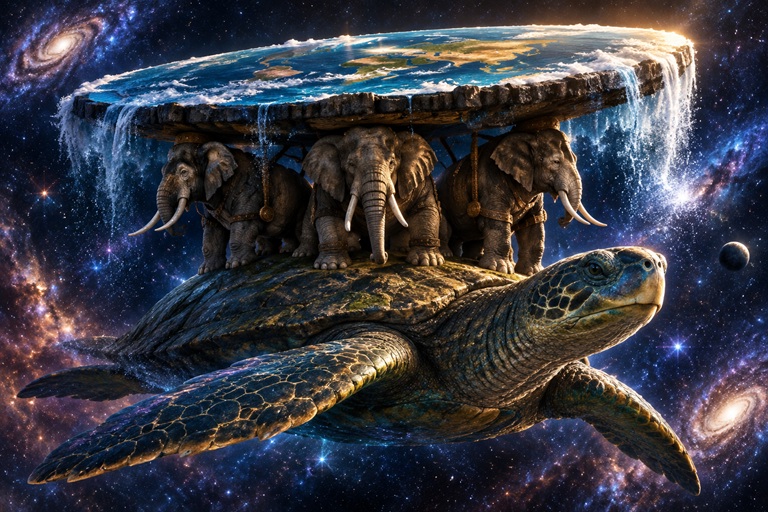
The answer, unfortunately, is not another rubber sheet. Nor is the universe resting on a giant cosmic trampoline supported by three elephants standing on a turtle.
Physics has rigid standards. Usually.
The important point is that the Earth is not simply sucking you downward like a celestial vacuum cleaner. In general relativity, freely falling objects move through curved spacetime along their natural paths. The ground prevents you from doing that and that resistance is what you feel.
So, strangely enough, the feeling of standing still is not quite as physically simple as it appears.
Physics has an Annoying Habit
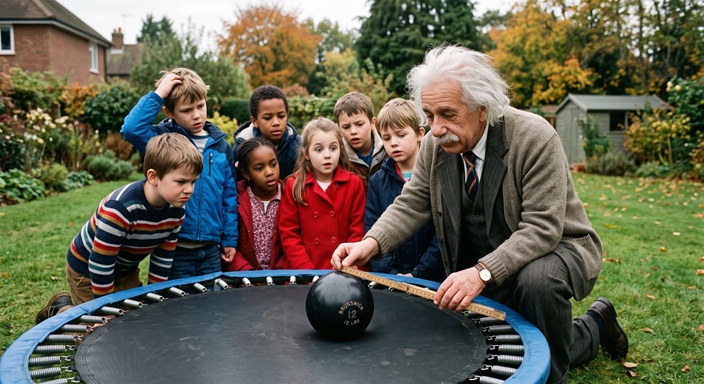
Physics is an odd scientific discipline in that it answers questions by asking other questions. Physics is often described as the science of understanding how the universe works, but it also addresses a particular kind of “why”.
Not the philosophical why, not the spiritual why, not the metaphysical “Why are we here?” Physics is unlikely to answer those questions, no matter how good we get at it.
Physics is more interested in questions like “Why does this object accelerate?” or “Why does light bend near a massive object?” or “Why did my coffee fall off the table immediately after I assured everyone that gravity was not going to turn off?”
Physics answers those questions through cause and effect, mathematical models and natural laws. It also has a particularly annoying habit in that every time it answers a question, it immediately creates another one.
Why do things fall? Gravity.
Why does gravity behave the way it does? It relies on the geometry of spacetime and its relationship with matter and energy.
Why does spacetime have those properties? Well, now we’re getting somewhere interesting.
Why do particles have mass? Some of the answer involves their interaction with the Higgs field, but that isn’t the whole story. Most of the mass of ordinary matter, such as protons and neutrons, comes from the energy associated with the strong nuclear force and the motion and interactions of their constituent particles.
Why do fundamental particles and fields exist at all? Well … we can do this all night. Eventually, someone will have to order dessert.
This is one of the great frustrations and joys of science.
There is no final PowerPoint slide labeled:
CONGRATULATIONS.
YOU NOW KNOW EVERYTHING.
Every answer opens another door. Behind that door is another question. Behind that question is another equation. Behind that equation is probably a physicist who hasn’t slept since 1979.
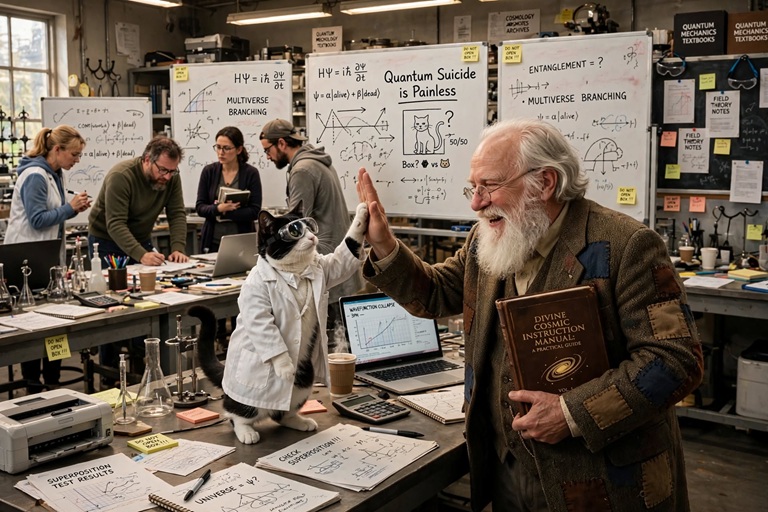
Physics was Supposed to Be Almost Finished
There is a famous story about Max Planck.
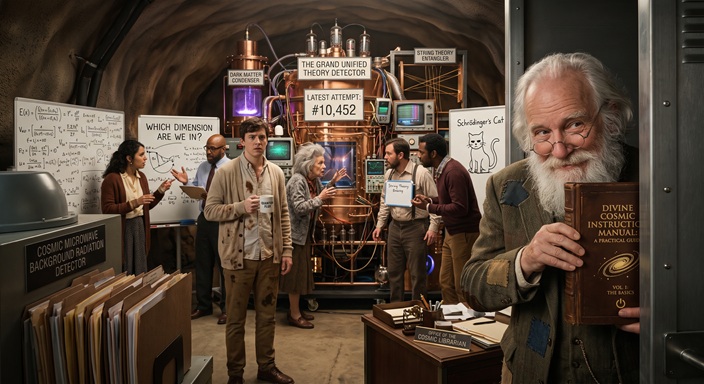
When Planck began studying physics in Munich in 1874, his professor, Philipp von Jolly, reportedly portrayed physics as an almost fully developed science and encouraged Plank to seek a different field of study. He said there were still things to clean up, but the basic structure was largely complete. Planck went into physics anyway, claiming that he simply wanted to understand.
This view of physics as being almost complete was not as ridiculous as it sounds. Newtonian mechanics were enormously successful. Maxwell’s equations had unified electricity and magnetism. Thermodynamics was well established. The universe appeared to be following a reasonably orderly instruction manual.
Then physics discovered a few minor problems. Atoms, relativity, quantum mechanics, radioactivity, the structure of matter, the uncertainty principle, the fact that particles sometimes behave like waves, the fact that measuring something can affect what you measure. And the minor inconvenience that our two most successful theories of fundamental physics, quantum mechanics and general relativity, still do not fit together into a complete theory of quantum gravity. Other than that, everything was basically done.
Planck helped launch the quantum revolution. Einstein transformed our understanding of space, time and gravity. Niels Bohr, Erwin Schrödinger, Werner Heisenberg, Wolfgang Pauli, Richard Feynman and countless others expanded our understanding of reality into territory that would have sounded completely insane just a few generations earlier.
Sit down, Doctor von Jolly. Your performance evaluation won’t be smooth.
For all we know, we still have enormous unanswered questions. We don’t know exactly how to reconcile quantum mechanics and general relativity into a complete theory of quantum gravity. We don’t fully understand dark matter. We don’t know what dark energy actually is, although we have to acknowledge that it is less “dark” and more “invisible”. We don’t know why the fundamental constants of nature have precisely the values they do. We do not know everything about the universe. Not even close. And that is the point.
For all our accumulated knowledge, we are still scratching the surface of what the universe has left to reveal.
Ignorance is Not the Same as a Conspiracy
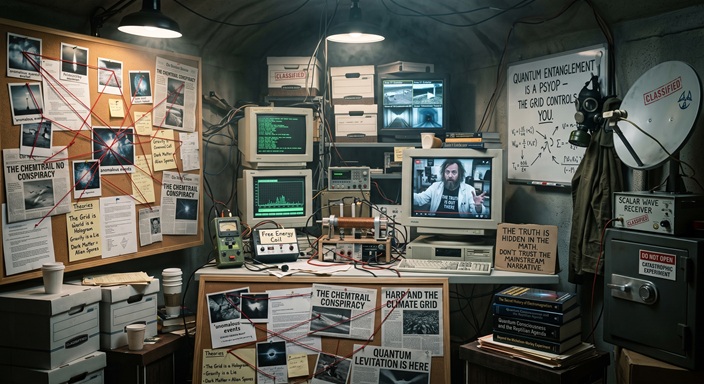
There is an important difference between saying, “scientists don’t yet know everything about gravity” and saying, “therefore gravity might turn off for seven seconds because the government is hiding the truth from you.” One represents intellectual humility. The other represents intellectual malpractice with an Instagram account.
Science does not claim to possess every answer. Science claims something much more modest and much more powerful. It provides a method for testing ideas against reality.
You make a prediction, you perform an experiment, you gather evidence. Other people try to prove you wrong. If the idea survives that process, it earns a little more confidence. Not eternal certainty. Not infallibility. Just a little more confidence.
That distinction matters because a scientific theory is not something scientists believe because it feels right. It is a model that survives repeated attempts to demonstrate that it is wrong by a bunch of competitive jerks, otherwise known as scientists, who would really prefer to get to the finish line first.
Gravity has been tested repeatedly and extensively. We have tested it with falling objects, planets, spacecraft, atomic clocks, gravitational waves and satellite systems. GPS, for example, has to account for both special and general relativity to maintain its accuracy.
Gravity has been subjected to far more scrutiny than most people put into reading their Facebook feed and yet a viral social media post can still convince someone that gravity is scheduled for a seven second maintenance outage.
The Real Problem Isn’t That People Ask Questions
Asking questions is good. Doubting is good. Questioning authority is sometimes essential. Science itself is built on skepticism. If Albert Einstein had accepted every scientific assumption handed to him, he would have had a much quieter career, probably staying a patent clerk for the rest of his life.
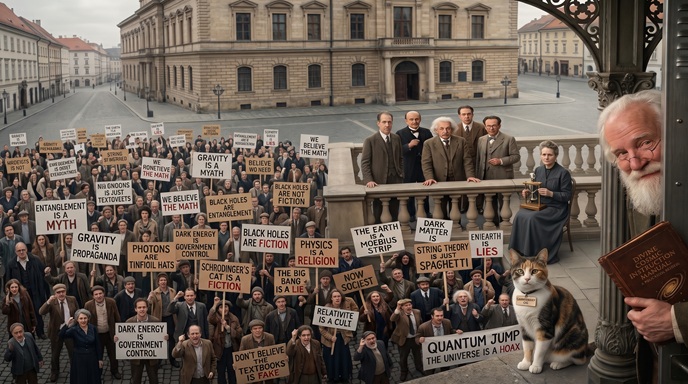
The problem is what happens when skepticism becomes selective. Scientists? Suspicious. Universities? Corrupt. NASA? Obviously hiding something. Tens of thousands of physicists working independently across scores of countries? Part of the conspiracy.
A guy with a profile picture of smoke rings explaining quantum gravity from the passenger seat of a pickup truck? Finally, an unbiased source.
Real skepticism applies the same standards to the things we want to believe as the things we want to reject. That is difficult. It requires admitting that we can be wrong. It requires changing our minds. It requires occasionally discovering that the person we mocked yesterday was correct and then being humble about it. Science can not survive without humility.
My friend and I have laughed about this gravity conspiracy for a good six months and he will undoubtedly continue reminding me of it for years to come. Gravity did not turn off. There is no known mechanism by which gravity can simply take a seven second coffee break.
That is a very different statement from saying that physics has solved every mystery surrounding gravity. It has not.
Small Minds Prefer Simple Conspiracies
Perhaps that is what bothers me most about treating gravity as a conspiracy theory.
The universe is already astonishing. We live on a small rocky planet orbiting a massive nuclear furnace whose mass curves the spacetime around it. That curvature influences the paths of planets, stars and light. We have learned to detect ripples in spacetime produced by collisions between black holes billions of light years away. We have placed atomic clocks in satellites and discovered that time passes at different rates depending on motion and gravity. GPS would not work properly without accounting for relativistic effects.
We have discovered particles so strange that even professional physicists sometimes have to stop and say, with astonishment, “Yes, that really is what the experiment says.”
Reality does not need to be made more exciting with imaginary secret bunkers and seven second gravity failures. The truth is already weird enough. Conspiracy theories offer something science often refuses to provide. Certainty, simple villains, hidden knowledge and, best of all, the opportunity to feel smarter than everyone else without doing the exhausting work of actually learning something.
That is the tragedy of the small mind. It looks at a universe filled with mystery and sees only a conspiracy. It looks at unanswered questions and mistakes uncertainty for weakness. It confuses “we don’t know yet” for “anything is possible”. But anything is not possible.
Reality has rules and although we may not yet understand all of them, we will spend centuries discovering new ones. We may discover that some of the things we currently believe require revision.
That is not science failing. That is science working.
Science is not a secret plot designed by the bunker dwelling elite. It is the collective, occasionally messy, frequently argumentative and remarkably successful effort to lay a few more inches of asphalt across the map of human understanding.
Gravity did not turn off on August 12. No one fell into the sky. The elite did not emerge triumphantly from their secret bunkers. The Earth continued rotating. The Moon continued orbiting. The universe continued behaving according to physical laws that took generations of human curiosity, mathematics, experimentation, argument, failure and genius to begin understanding. Tomorrow, gravity will almost certainly continue doing exactly the same thing.
Almost certainly, because science always leaves room for evidence. If someone tells you that gravity is scheduled to turn off again next Tuesday, don’t start building a bunker. Start by asking for their source. Then ask them how gravity is supposed to turn itself back on.
Those are reasonable questions. They are also the sort of questions that science is good at answering.
Until we cultivate some basic scientific literacy, however, the human appetite for sensational nonsense probably won’t turn off any more readily than gravity itself.
Discover more from Tales of Many Things
Subscribe to get the latest posts sent to your email.