
I like science fiction, but not all of it. A great deal of science fiction is little more than technological window dressing wrapped around a familiar story. Somebody gets a spaceship, somebody else gets a laser gun, somebody discovers a mysterious power and eventually somebody blows something up. That’s not a story. That’s a sequence of special effects.
There is nothing inherently wrong with that. Sometimes you want popcorn. Other times you want Shakespeare. The problem is when popcorn is mistaken for philosophy.
The science fiction that interests me is the kind that asks uncomfortable questions about where technology is taking us and, more importantly, where we are taking technology.
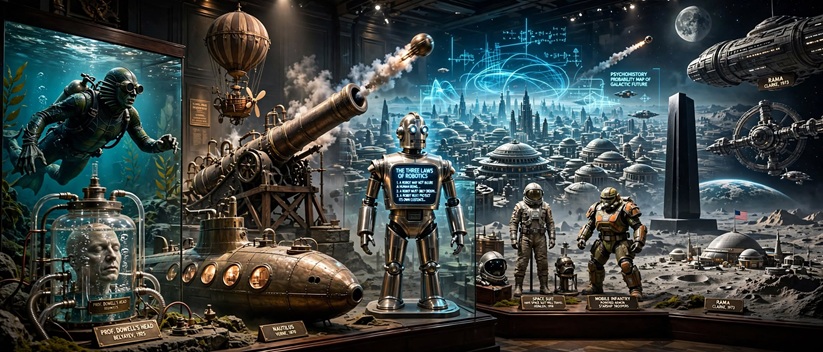
Isaac Asimov, Robert A. Heinlein and Arthur C. Clarke asked these questions in very different philosophical ways. Jules Verne imagined technologies that did not yet exist and then explored what humanity might do with them. Alexander Belyaev similarly used speculative technology to examine the consequences of changing the boundaries of human capability.
All of them wrestled with the evolution of humanity running parallel to the evolution of technology. They examined how human ethics, societal structures and moral responsibility stretch when confronted with machine intelligence, deep space or automated power. While some of those early literary works could be structurally dry, their core inquiry was vital, “What happens to human nature when our capability outpaces our wisdom?”
Their stories were not simply about the machines. They were about us. What happens when technology changes faster than society? What happens when we acquire capabilities that our institutions, ethics and psychology are not prepared to handle? What happens when humanity becomes more powerful without becoming more mature?
Those are the questions I love about science fiction and they are the reason I keep coming back to Star Trek.
A Different Kind of Space Opera
I have written quite a bit about Star Wars over the years, most of it with varying degrees of affection and mockery.
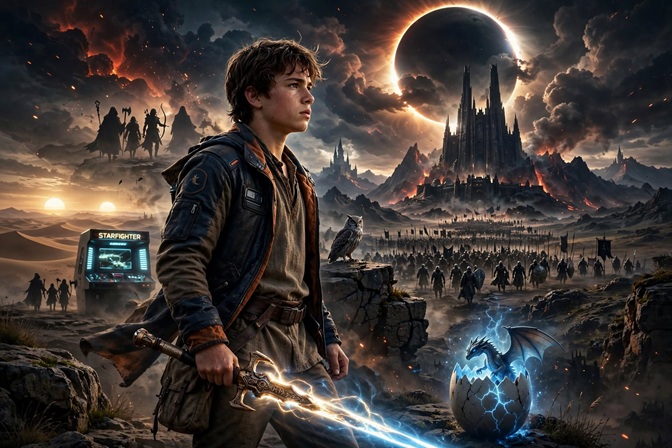
I enjoy Star Wars, but I have never understood the insistence that it is some profound exploration of the human condition. At its heart, Star Wars is a classic good-versus-evil story. A young hero discovers a special destiny, acquires a mentor, joins a rebellion and confronts a tyrant. It is a wonderful story. It is also a very old one.
Dune gives us a young man on a desert planet who discovers a special destiny and eventually leads a rebellion against an empire.
The Last Starfighter gives us a young man who discovers that his videogame skills qualify him to fight an actual interstellar war.
The Lord of the Rings gives us a small humble young man who leaves his quiet home, receives the help of a wise mentor and embarks on a quest to destroy a powerful evil.
Harry Potter gives us an ordinary orphan who discovers that he possesses extraordinary powers, enters a hidden world and eventually confronts a dark wizard.
Eragon gives us a poor farm boy who discovers a mystical object, receives training from an older mentor and joins a rebellion against a tyrant.
There is nothing inherently wrong with classic archetypes and there is absolutely nothing wrong with this formula. It is a great formula, but it is a formula and in Star Wars we essentially get variations of the same basic story three times in three trilogies, operating on familiar, predictable tracks.
Different heroes, different villains, different planets, same mythological machinery, all linked together by the same thread.
Star Trek was doing something fundamentally different. It wasn’t asking “who is the chosen one?” It was asking, “What kind of civilization do we become if we survive long enough to reach the stars?”
That’s a much more interesting question.
The Future as a Mirror
When Star Trek premiered on September 8, 1966, America was a very different place. The United States was wrestling with civil rights, racial violence, the Vietnam War, Cold War paranoia and profound social upheaval.
Television was filled with westerns, family comedies and conventional dramas. And then along came a television show about a starship traveling through the galaxy and in it the aliens were often the least important part.
The real subject was us. The genius of Star Trek was that it used the future to talk about the present. The stars were the setting. Humanity was the topic.
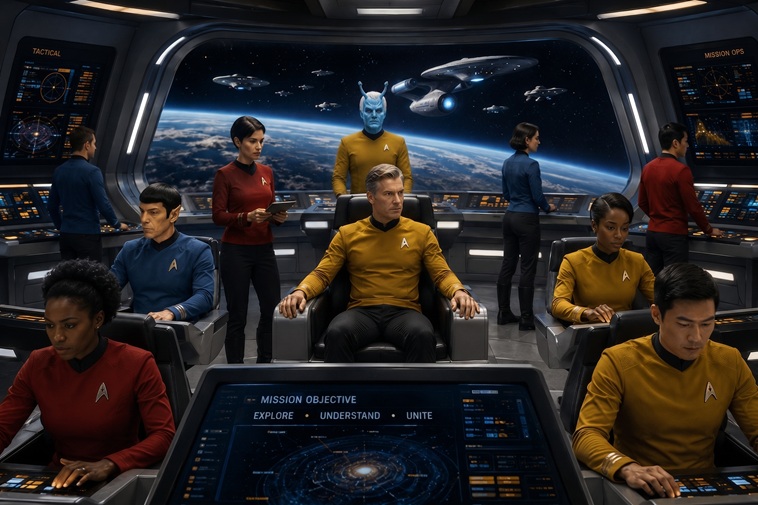
The Enterprise carried something extraordinary into the future, a crew that represented a world that had not yet arrived. Nyota Uhura was a black woman serving as a respected bridge officer. Hikaru Sulu was Japanese. Pavel Chekov was Russian. Spock was half human and half Vulcan.
They weren’t there as symbolic mascots of the show. They were professionals. They were scientists, engineers, officers, navigators and communicators. They worked together. They argued. They saved one another. They trusted one another. They were simply members of the crew. Instead of presenting a dystopian wasteland or a story of endless conquest, Star Trek imagined a future where humanity had overcome many of its oldest divisions and ventured into the cosmos not simply to conquer, but to learn.
The National Air and Space Museum notes that the show’s depiction of a racially integrated multinational crew working successfully together, alongside its treatment of contemporary social and political issues, pushed the boundaries of network television.
That wasn’t merely representation. It was a proposition that this is what the future could look like.
Nichelle Nichols later recalled that Martin Luther King Jr encouraged her not to leave the show because of the significance of Uhura’s role. NASA would eventually recruit Nichols to help attract women and minorities to its astronaut program and the agency credits her campaign with helping inspire hundreds of applicants.
Think about the impact of this. A fictional television character helped influence real people who would eventually explore actual space. That’s more than entertainment. That’s feedback between imagination and reality.
The Aliens Were Us
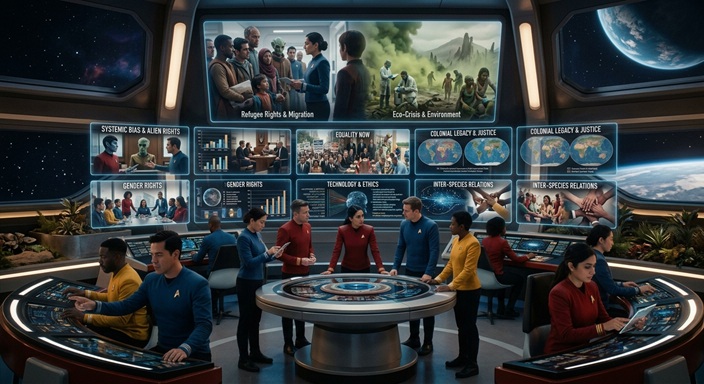
The genius of Star Trek was that it could talk about almost anything without appearing to talk about it. The Enterprise could encounter an alien civilization and suddenly the writers could ask whether racism was rational. They could encounter a strange culture and suddenly they could ask whether our assumptions about gender, sexuality or social class were actually universal or merely familiar. They could encounter a planet in crisis and ask what happens when economic interests collide with environmental survival. They could encounter an enemy and ask whether war changes the morality of the people fighting it.
The famous example from the original series is almost comically unsubtle. In the show’s last season the crew meets two aliens who hate one another because each has black skin on one side of his body and white skin on the other. Their markings are reversed. That’s it. That is the entire metaphor. And yet it worked, because the absurdity of the premise exposes the absurdity of the prejudice.
Star Trek didn’t need to tell us that racism was irrational. It gave racism a different costume and let us recognize ourselves.
The franchise kept doing this.
The Next Generation explored McCarthyism and political hysteria. It examined PTSD and the treatment of veterans. It confronted gender identity and sexual conformity.
Deep Space Nine went even further. It openly dealt with racism, colonialism, war, religious extremism, economic inequality and the morality of fighting an existential conflict. The Ferengi become a vehicle for discussing labor organizing. Starfleet’s supposedly enlightened morality collided with the ugly compromises of wartime. The question was no longer simply whether the Federation is good. The question became, “What happens when good people are forced to make terrible choices?”
That’s science fiction I can sink my teeth into.
Even environmental issues became part of the conversation. Star Trek repeatedly explored pollution, resource exploitation, ecological collapse and the tension between economic interests and environmental survival.
The formula was remarkably consistent. Identify a flaw in ourselves. Dress it as an alien problem. Put it on television. Let humanity recognize itself.
Then There Was the Technology
There is another reason Star Trek mattered.
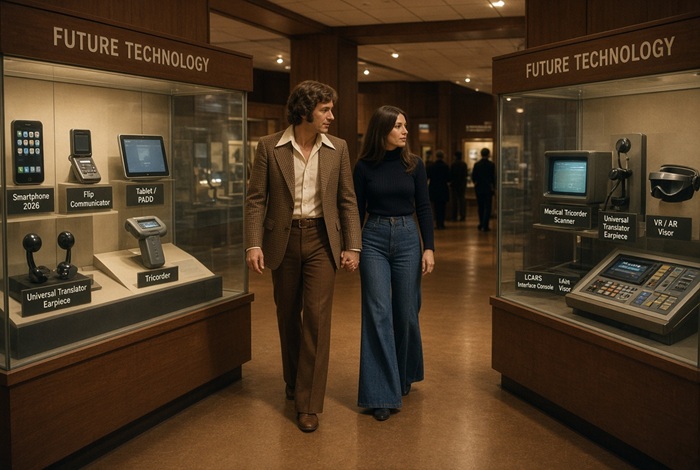
It didn’t just imagine a better society. It imagined better tools. The communicator looked ridiculous until people started carrying mobile phones. The tricorder imagined portable medical and scientific sensing. The PADD looked suspiciously like a tablet computer decades before tablets became commonplace. Replicators made things. They developed needle-free medicine. The ship’s computer talked to its crew. Doors opened automatically. People conducted video conversations across enormous distances. Universal translation was treated as a mundane engineering problem. Computers became ubiquitous rather than mysterious.
Many of these ideas were not simply inventions that Star Trek magically predicted. The relationship between science fiction and technology is more interesting than that. Science fiction gives engineers something to imagine.
The Smithsonian’s National Air and Space Museum notes, for example, that Motorola’s StarTAC flip phone was explicitly a nod to the Star Trek communicator. That influence goes in both directions. Technology inspires science fiction. Science fiction inspires technology. Then technology changes what science fiction can imagine.
That feedback loop is one of the most fascinating things about our civilization.
There is a temptation to give Star Trek credit for inventing the future. That’s not quite right. Automatic doors were not invented by Gene Roddenberry. Neither were mobile phones, tablets or video conferencing.
But Star Trek did something almost as important. It normalized them. It showed generations of viewers what a technologically integrated future might look like and gave engineers, scientists and entrepreneurs something concrete to imagine.
Of course, Star Trek got plenty wrong, too. We still don’t have transporters. We haven’t invented warp drive. And, frankly, I am perfectly happy not to have time travel. The implications of that are terrifying.
Then there is one particularly amusing miss. In Star Trek: The Next Generation, Jean-Luc Picard worked on Fermat’s Last Theorem, describing it as an 800 year old unsolved problem. It wasn’t. Andrew Wiles proved Fermat’s Last Theorem in 1994, with the proof formally published in 1995.
Clearly, Picard skipped algebraic number theory that day and ended up in an embarrassing situation on screen.
Why Did I Love It?
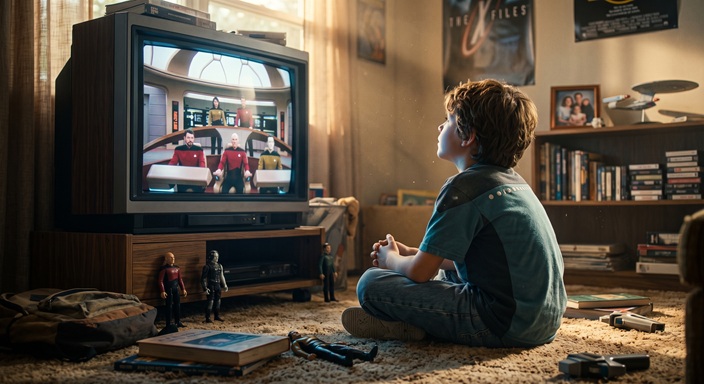
The original Star Trek came and went before I was born, but when I was a middle school kid, the syndicated episodes became appointment television. I would run home from school to watch a show that had been canceled before I ever existed and I have occasionally wondered why.
The acting was frequently melodramatic. The special effects were primitive. The monsters were people wearing rubber suits. The aliens often looked suspiciously like humans with decorative forehead appliances. And yet something about it worked.
Perhaps it was the sense of possibility. Perhaps it was the Enterprise itself, a machine that could leave Earth behind and simply go looking. Perhaps it was Spock, teaching a kid that being different wasn’t necessarily a weakness. Perhaps it was Uhura and Sulu and Chekov, quietly presenting a future in which the divisions that seemed so enormous in my own world had become irrelevant. Perhaps it was the idea that the people on that bridge were not fighting over who owned the universe. They were exploring it.
Maybe that was what captured me. The future wasn’t presented as something to fear. It was presented as somewhere we might actually want to go.
The Part That Hasn’t Aged
I have not watched the newer Star Trek shows on Paramount+. I simply don’t have the time to binge watch television and there is only so much television one can consume before it begins consuming one’s life.
I also wasn’t particularly impressed by J.J. Abrams’ reboot. It was exciting. It was fast. It was spectacular. I felt he was much more interested in making Star Trek into an action movie than in making it into a philosophical one. To be fair, it did have its moments and I give it credit for continuing to push the characters in directions the original television series could not have explored as openly, but for me, something was missing.
The old Star Trek could spend an hour arguing about whether a machine had a soul. It could put two civilizations on opposite sides of an ethical dilemma and refuse to give the audience an easy answer. It could have Kirk, Spock and McCoy standing in a room talking and somehow that could be enough.
That is increasingly rare television and perhaps increasingly rare culture. We have become remarkably good at reacting to one another and remarkably bad at talking with one another.
Sixty Years Later
The greatest accomplishment of Star Trek might be that it didn’t simply predict some of our technology. It predicted a way of thinking about the future. It imagined that humanity might eventually become powerful without becoming monstrous, that technology might serve people rather than merely entertain them, that nations that once hated one another might eventually cooperate, that diversity could be an advantage rather than a threat, that exploration could be more important than conquest, that science could be something to celebrate, that diplomacy could be more heroic than violence and that the future could be better than the present, not because technology would magically fix us, but because we might choose to fix ourselves.
Not all of those predictions have come true. Some are still painfully far away. Some may never come true. And that’s okay, because perhaps the purpose of great science fiction isn’t to tell us exactly what tomorrow will look like. Perhaps its purpose is to give us something to aim at.
When I was twelve years old, I watched people step onto the bridge of the Enterprise and look toward the stars. Sixty years after Star Trek first appeared on television, we have not reached its 23rd century. We have, however, inherited pieces of its imagination. We carry communicators in our pockets. We talk to computers. We hold entire libraries in our hands. We video chat with people on the other side of the planet. We can edit genes, land spacecraft on other worlds and look backward through billions of years of cosmic history.
And yet the most important part of Star Trek still isn’t the technology. It is the assumption underneath all of it that we can become better. That is an extraordinarily optimistic thing to believe about humanity. It may also be one of the most necessary, because the future is not something waiting for us. We are building it.
Every technology we create, every institution we preserve, every prejudice we abandon, every problem we decide is worth solving, every child who looks at the stars and thinks, “I want to go there”, is a reflection of this imaginary future.
Science fiction can give us weapons. It can give us monsters. It can give us empires and rebellions and chosen ones and dark lords, but the best science fiction gives us something much more difficult. It gives us a reason to believe that tomorrow might be worth building.
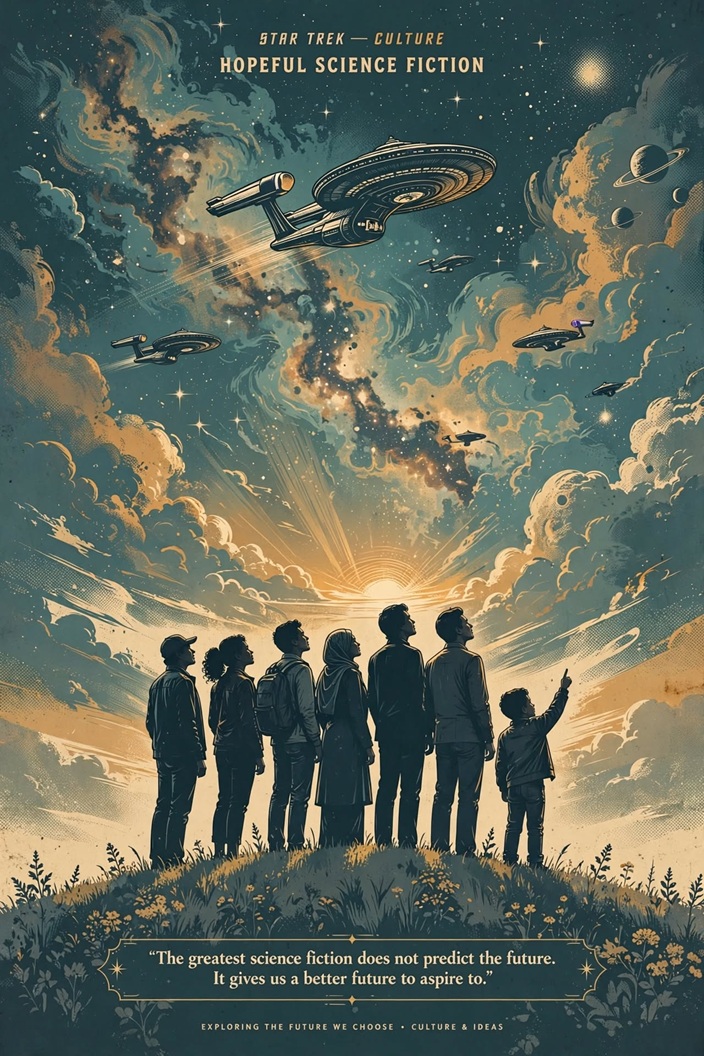
Sixty years ago, Star Trek invited us aboard and years later, after watching those syndicated reruns after school, the quiet optimism of this vision still holds its power for me. I’m still looking up to the stars. The greatest science fiction does not predict the future. It gives us a better future to aspire to.
Happy 60th birthday, Star Trek.
Discover more from Tales of Many Things
Subscribe to get the latest posts sent to your email.