
It’s that time of the year. International Bat Night is August 29 to 30, 2026. Caves have everything Halloween has taught us to love. Darkness. Mystery. Bats. And the possibility that something unearthly is lurking just around the corner. Okay, maybe that last one is mostly Hollywood.
But if you’re thinking about exploring a wild cave because you’ve always wanted to see what is down there, #TakeTheExtraMinute before you go batty, because caves are fascinating places to explore, but they are not simply hiking trails with a roof.
While bats navigate total darkness with effortless echolocation, humans lack built-in sonar. Entering a cave without preparation turns an exciting subterranean adventure into a high stakes search and rescue operation, so if you’ve never been caving before, curiosity is not a replacement for experience.
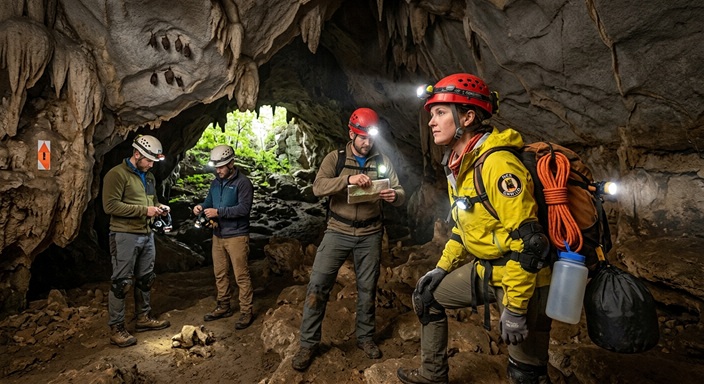
Bats navigate in the dark. You don’t.
That may be the most important thing to remember before entering a cave. A wild cave can go from “I can see just fine” to “I can’t see my hand in front of my face” in an instant.
Your phone flashlight is not a cave light. Neither is the tiny flashlight you keep in the junk drawer. And having just one light is not a backup plan.
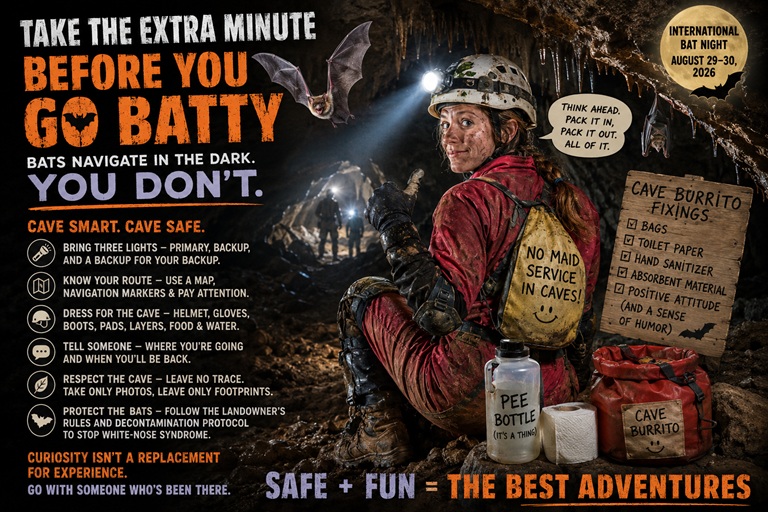
Bring three lights. Your primary light. A backup light. And a backup for your backup. Carry enough batteries or power to keep all three operating for the entire trip, because when your only light dies 1,000 feet underground, the solution isn’t to turn around and walk toward the sunlight. You can’t. There is no light except for the one you bring.
Your first caving trip should not be an adventure in improvisation
If you’ve never gone underground before, go with someone who has. Better yet, connect with a local chapter of the National Speleological Society. The NSS has more than 250 local chapters, known as grottos, and specifically describes them as a way for people who are just starting to learn caving skills and meet experienced cavers.
That’s a much better introduction to caving than watching a few videos on YouTube, picking up some dubious gear at a garage sale and deciding that you look more adventurous than Indiana Jones.
Experienced cavers can teach you things that are difficult to learn from a checklist:
- How to move through tight spaces.
- How to read the cave.
- How to recognize hazards.
- How to navigate.
- How to protect fragile formations.
- And perhaps most importantly, when to turn around.
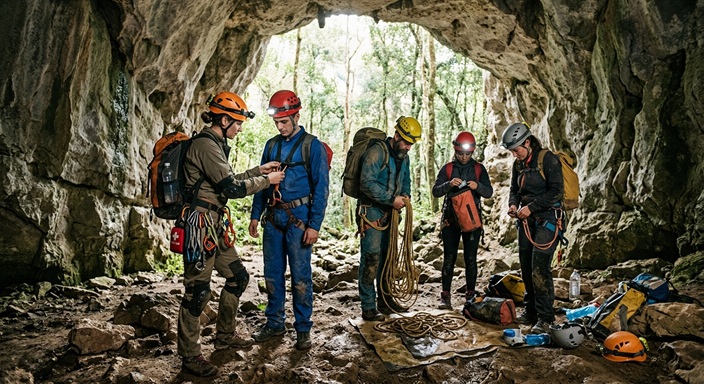
Dress for the cave, not for the parking lot.
It may be a beautiful 80 degree afternoon outside. That doesn’t mean the cave is warm. Wild caves can be cold, wet, muddy, slippery and physically demanding. They can also be hot, have chasms instead of floors, water hazards, breakdown, pits… Conditions vary enormously from one cave to another, so learn what you’re getting into before you enter. If your target cave requires cave diving or vertical skills you don’t have, know that some caves can simply become a creative way to die.
Your clothing and equipment should match the actual cave environment. At a minimum, think about:
- Gloves that provide protection and grip.
- Ankle-high boots with good tread.
- Knee pads and possibly elbow pads.
- Synthetic wicking layers.
- A properly fitted helmet.
- Food and water.
- Three reliable lights.
- A map appropriate for the cave.
And remember what that helmet is actually for. It’s not a fashion accessory. It’s there because caves have ceilings. And ceilings have rocks. And those rocks love to hang around until an unsuspecting caver gets too close and then you discover that rock is hard. Wear a helmet.
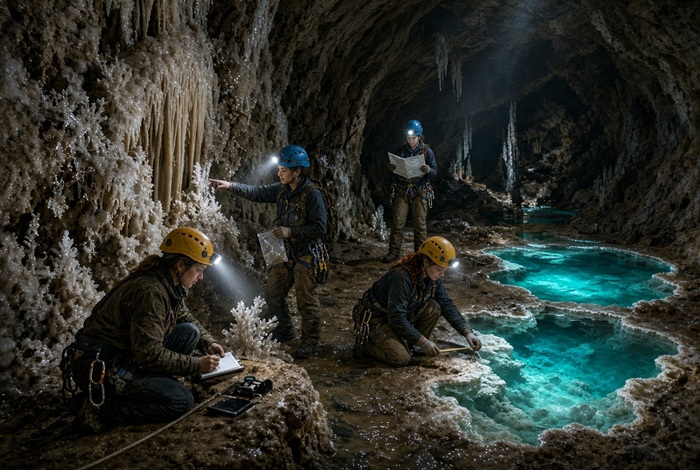
What Goes in Must Come Out: The No-Maid Zone.
Eventually, on even the best planned wild cave trip, nature is going to call and unlike the trailhead, there is no bathroom around the corner. There is also no cleaning crew. There is no maid service in caves. Nobody comes through after your adventure romp with a mop, a bucket and a cheerful little name tag.
Cave environments are often exceptionally poor at dealing with human waste. Leaving anything behind pollutes fragile environments and ruins the cave for everyone. That means if your body has something to output, it leaves the cave with you. All of it.
So before you head underground, think about what happens when your bladder or your digestive system decides it has an agenda of its own.
For shorter trips, use the bathroom before you enter. For longer trips, pack a plan.
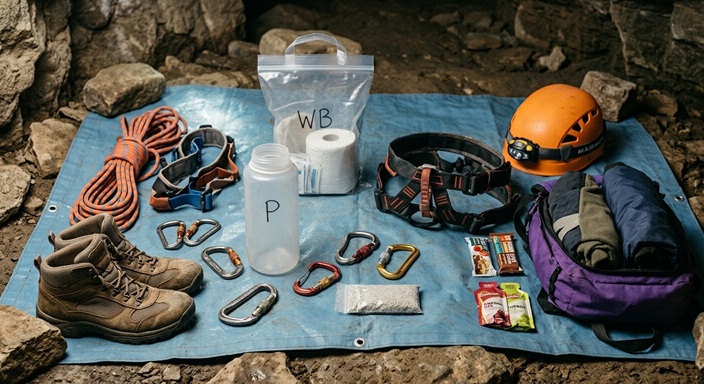
A pee bottle can be one of the simplest solutions for urination, particularly in a cave where finding an appropriate place to relieve yourself may be difficult or environmentally damaging. Label it clearly, keep it accessible and, this is important, make sure you know which bottle is the pee bottle. Because there are some discoveries you really don’t want to make underground.
For solid waste, cavers may use a “cave burrito”, a waste management system that allows human waste and toilet paper to be packed out rather than left in the cave. The exact system should follow the requirements of the cave, land manager and the local caving organization.
Think of the waste management system as a burrito with absolutely no salsa. Typically, you’ll pack a dedicated waste bag kit, affectionately known in the caving community as a “cave burrito”. This treasure includes double-layered heavy-duty zip-top bags, toilet paper, hand sanitizer and a dash of kitty litter or baking soda inside the outer bag to neutralize odor and securely contain everything until you can dispose of it properly.
It might feel a little awkward to discuss, but packing out your waste is standard speleological etiquette. Practice assembling your setup at home first so you aren’t surprised in the dark!
Seriously.
The first time you discover that your carefully packed waste-management system is confusing, awkward or impossible to operate should not be 1,000 feet underground, wearing gloves, covered in mud and holding a headlamp in your teeth.
Because there is no maid service in caves. There is no underground janitor waiting around the next corner.
There’s just you, your cave burrito and the realization that you packed it in, so you’re packing it out. Everything. That’s the deal.
Yes, it’s awkward.
Yes, it’s funny.
And yes, it’s part of being a responsible caver.
A distinguished elderly speleologist would do the exact same thing.
Pack it in.
Pack it out.
Everything.
Leave nothing but footprints.
Because caves are not disposable environments and your bathroom problem shouldn’t become someone else’s adventure, just because you crawled 500 feet underground. #TakeTheExtraMinute before you go underground and make a bathroom plan. Your future self and everyone else in the cave will thank you. Because no search and rescue team wants the description “subject last seen carrying an improvised toilet” to be a part of the mission briefing.
And you might find you like the cave burrito enough that you’ll use it everywhere you go.
Know where you’re going
Getting lost underground is a very different problem from getting lost on a hiking trail.
There may be multiple passages.
There may be intersections.
There may be crawlways that look remarkably similar.
There may be routes that become impassable because of water.
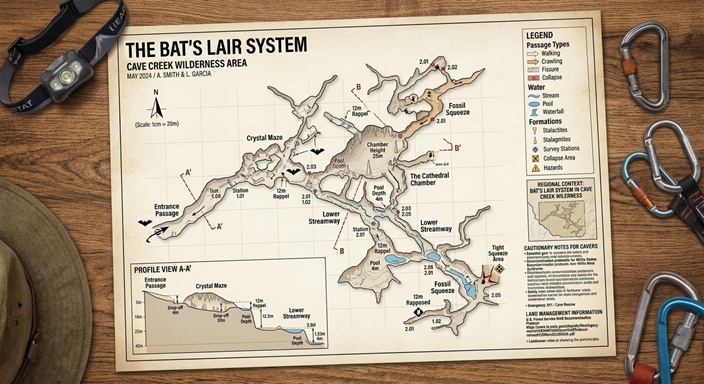
Navigation markers can help, but only when they’re used appropriately. Know the cave’s established navigation practices. Use maps. Pay attention to your route. Don’t assume you’ll remember every turn.
And never assume that because you entered through one hole in the ground, you’ll automatically find that same hole again.
Tell someone on the surface who’s not going with you where you’re going and when you expect to return. Give them enough information to recognize that you are overdue and know who to call for help.
That’s not paranoia. That’s planning. That’s your parachute to get out of the cave.
Leave the cave the way you found it
Caves aren’t theme parks. They’re ecosystems. They’re geological records. They’re archaeological and paleontological resources. And for bats and other creatures, they can be home.
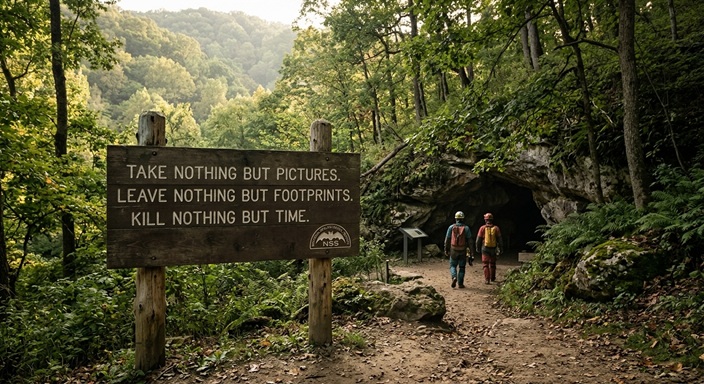
Resist the temptation to touch formations, break things off, move rocks unnecessarily, disturb wildlife or leave anything behind. Take nothing but pictures. Leave nothing but footprints and even those should be minimized where appropriate. Kill nothing but time.
Follow the landowner’s rules and the specific requirements for the cave. Some caves are closed seasonally or permanently. Some require permits. Some contain sensitive wildlife habitats. Some simply should not be entered by inexperienced visitors.
Respect those restrictions. A cave that isn’t open to you isn’t an invitation to find a secret entrance. It’s a boundary for a reason.
The bat in the room: White-Nose Syndrome
This is where the Halloween imagery stops being funny. North American bats are facing a devastating disease known as White-Nose Syndrome, caused by the fungus Pseudogymnoascus destructans. The disease has had a major impact on bat populations across North America.
Cavers can inadvertently help spread the fungus by moving contaminated gear between caves. That’s why decontamination matters. Before entering a cave, know the landowner’s rules and any applicable precautions and restrictions.
If you’re caving in an area where White-Nose Syndrome precautions apply, follow the appropriate decontamination procedures, including the current National White-Nose Syndrome Decontamination Protocol from the U.S. Forest Service and its partner agencies. The current protocol was updated in March 2024.
Don’t assume that because your boots look clean, they’re clean enough. Clean for the bats. WNS fatality rates are north of 95%.
Before you crawl into that dark hole, stop. #TakeTheExtraMinute Ask yourself:
- Do I know where I’m going?
- Do I know how I’m getting back out?
- Do I have three functioning lights?
- Do I have the right clothing and protective equipment?
- Do I have enough food and water?
- Do I have a map and a navigation plan?
- Does someone know where I am and when I should be back?
- Am I following the landowner’s rules?
- Am I protecting the cave and its wildlife?
And if you’ve never done this before:
- Am I going with someone who knows what they’re doing?
Because if the answer to any of those questions is ‘no’, that’s not a challenge. It’s your answer regarding going on this trip. Find an experienced caver. Find a local NSS grotto. Learn the skills. Start with an appropriate cave.
Then go have your adventure.
Safe and fun are not opposites
Caving can be an incredible experience. You can crawl through passages that have existed for millions of years. You can see massive formations that never see sunlight. You can discover an ecosystem that most people will never experience.
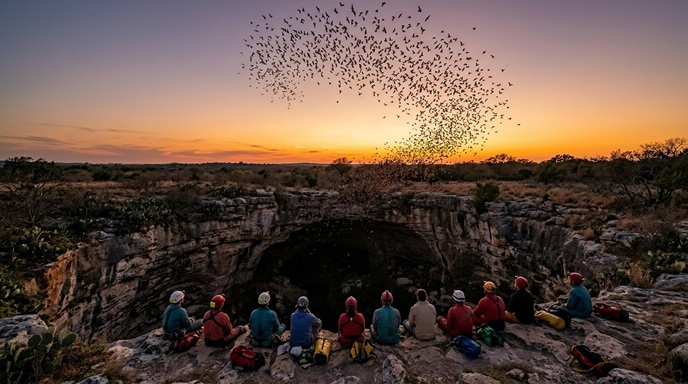
And yes, you might see a bat. Maybe even several. Maybe a swarm. That’s the magic of it.
But the best adventures aren’t the ones where you barely make it out. They’re the ones where you come home muddy, exhausted, grinning like an idiot, already talking about the next trip.
Safe and fun can absolutely coexist. In fact, a little preparation usually makes the fun better, so this International Bat Night, enjoy the bats. Respect the caves. Learn from people who know the underground world.
And before you disappear into the darkness, #TakeTheExtraMinute.
Because bats navigate in the dark.
You don’t.
Bonus trivia: “Blind as a bat” is a misnomer. In addition to top notch hearing and echolocation, bats also possess some of the keenest eyes among mammals and make up almost a quarter of all known mammal species, second only to rodents, which bats are not!
Happy International Bat Night!
Discover more from Tales of Many Things
Subscribe to get the latest posts sent to your email.