
In response to my A Second Look at Life Expectancy: What the 1918 Flu Tells Us About the COVID-19 Pandemic, I received a fascinating question:
“The 1918 flu had no ICU, no mRNA platform, not even a flu shot. We built that in a century. What’s the one biohack we’re missing today that the next 100 years will fix?”
That’s a fantastic question. It’s also, inherently, a trap. Thing is, I have absolutely no idea. Nobody does.
Predicting the future is something humanity has proven spectacularly bad at doing. If you asked a physician in 1918 what the future of medicine looked like a hundred years down the road, they might have speculated about larger sanitariums, better mustard plasters or more refined bloodletting charts. They would not have envisioned a computer algorithm sequencing a viral genome in 48 hours and delivering a synthetic mRNA platform to millions of arms within a year.
Predicting what science will accomplish over the next century is a little like asking a medieval peasant to predict the smartphone. You might get an answer. It might even be entertaining, but there’s a pretty good chance the person will spend most of the conversation trying to figure out why you need a tiny illuminated monastery in your pocket.
So consider what follows to be a thought experiment rather than a prediction, with the mandatory disclaimer that I reserve the right to be generally right and precisely wrong.
That said, I suspect the biggest breakthroughs won’t simply be better versions of the medicine we have today. The fundamental “missing link” in modern medicine isn’t just a better pill or a faster vaccine. The breakthroughs may represent a fundamental change in how we interact with biology. And that’s where things get interesting.
The First Biohack: Stop Waiting Until We’re Sick
Modern medicine is astonishing. It is also, in some ways, remarkably primitive.
Imagine your computer’s antivirus software worked like modern medicine. You get infected with malware. Your computer starts behaving strangely. You wait until it crashes. Then you call a technician. The technician takes a look. He runs a diagnostic. You wait for the results. Two days later someone tells you which virus you have. Then they install a patch.
That would be a terrible antivirus system, yet that’s roughly how medicine works today. You don’t usually go to the doctor because your immune system has detected something interesting. You go because you feel terrible. The fever has arrived. The cough has arrived. The pain has arrived. Something is sufficiently wrong that you can no longer pretend everything is fine. Then we start investigating.
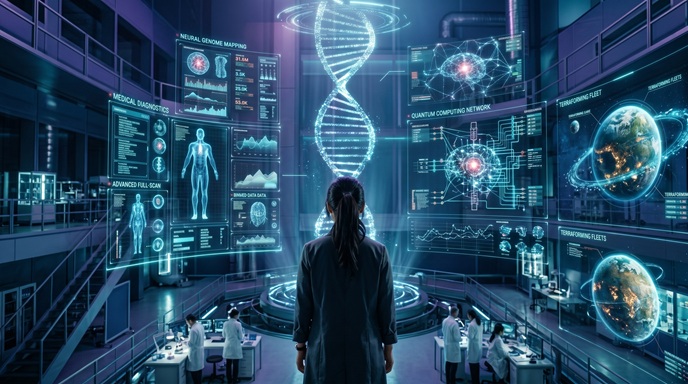
One potential revolution over the next century is not a better clinic, but moving from reactive medicine to continuous biological surveillance. Instead of waiting for symptoms, we could continuously monitor the body for changes in physiology, immune activity, molecular markers, infection, inflammation and other signals. Hours before you ever sneeze, a biological sentinel could potentially detect signs of infection and trigger an early warning and, eventually, a localized therapeutic response.
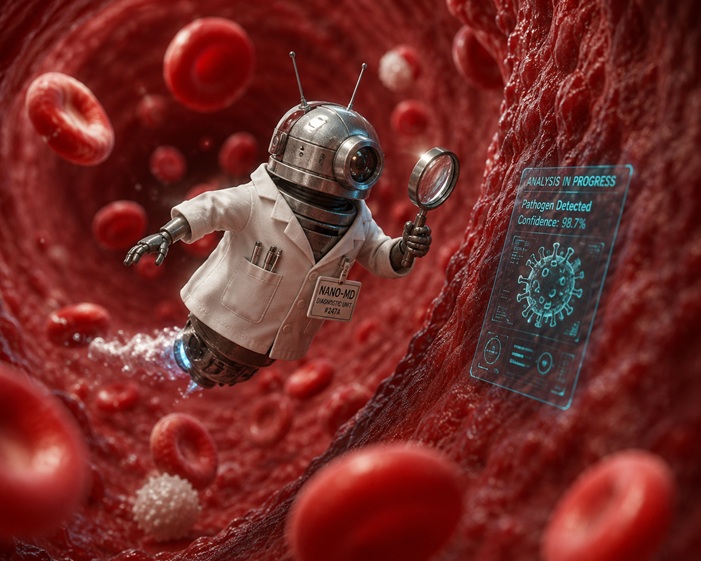
The technology doesn’t necessarily have to look like a microscopic robot swimming around your bloodstream while wearing a tiny lab coat. It could be wearable sensors. It could be increasingly sophisticated diagnostic devices. It could be molecular sensors. It could be some technology we haven’t invented yet because, inconveniently, the future hasn’t released its product roadmap.
The important change is not the gadget. It’s the timing. Imagine detecting an infection hours or days before you become seriously ill. Imagine knowing that your immune system is mounting an abnormal inflammatory response before your lungs are damaged. Imagine detecting a cancerous process when there are a handful of abnormal cells instead of waiting until there is a tumor large enough to introduce itself with a handshake.
The biological equivalent of antivirus software could become one of the most important medical technologies ever developed. In 1918, we couldn’t see the enemy. In 2020, we could identify and sequence it remarkably quickly, but we still didn’t know we were hosting the virus until symptoms flared.
The next step may be making sure we know what’s happening inside us before we feel it. That changes medicine from “You’re sick. Let’s figure out why.” to “Something is changing. Let’s stop it before you get sick.” The next century isn’t about making better medicine for when you’re sick. It’s about making sure the pathogen never gets to set up camp.
That’s a pretty significant upgrade.
The Second Biohack: Teach the Immune System to Stop Overreacting
There is another problem with having an immune system. It is extremely enthusiastic.
Your immune system exists to protect you from things that would very much like to kill you. This is generally useful. Unfortunately, it isn’t always particularly subtle. Sometimes the immune response itself becomes part of the problem.
During the 1918 influenza pandemic, healthy young adults suffered unusually high mortality. One proposed explanation involves an aggressive immune response that contributed to severe inflammation and lung damage. We saw related forms of immune dysregulation during COVID-19. In other words, sometimes the body’s defense system can become part of the disaster.
Severe viral infections can produce overwhelming inflammation and immune dysregulation. The result can be devastating damage to organs and tissues even after the immune system has successfully recognized the threat.
We tend to think of infectious disease as a battle between the pathogen and the patient, but there are three combatants: the pathogen, the immune system and the unfortunate person standing in the middle.
That suggests another potential medical revolution. Instead of simply becoming better at killing pathogens, we could become dramatically better at controlling the host response. Think of it as giving the immune system a volume knob.
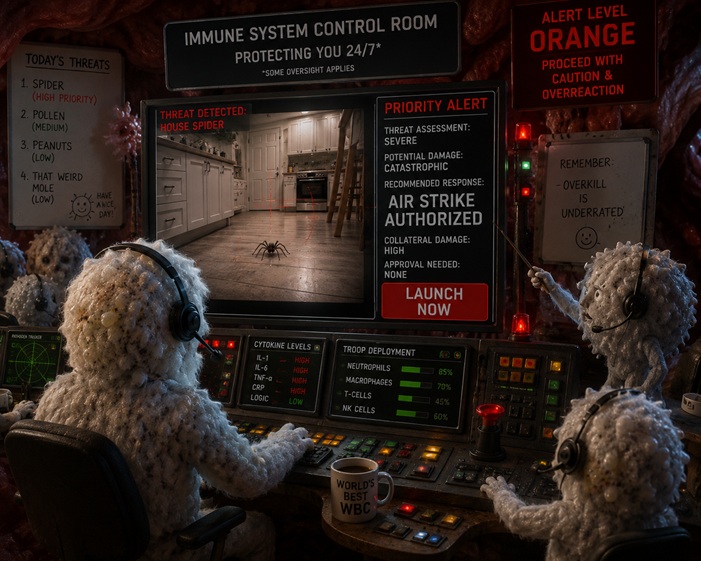
Right now, the immune system occasionally behaves like the guy who sees a spider in the kitchen and responds by calling in an air strike. The future could give doctors much finer control over the response. Turn inflammation up when it is needed. Turn it down when it becomes dangerous. Direct the immune response toward the pathogen. Prevent collateral damage. Maintain enough aggression to kill the invader without turning the patient’s own organs into the battlefield.
This would be a fundamental change in strategy.
Viruses mutate. Bacteria evolve. New pathogens appear. We currently spend billions of dollars trying to target specific pathogens, but viruses mutate rapidly, forcing us to write endless software updates. New vaccines, new boosters, new antivirals.
What we forget is that the human immune system is comparatively stable. The real biohack is mastering immunostasis, developing a precision control dial for the human immune system. Instead of trying to neutralize every novel strain, we upgrade the host hardware.
If we become extraordinarily good at controlling our response to infection, the precise identity of the pathogen may matter less. Instead of endlessly building better weapons against every new biological enemy, we could become much better at controlling the soldiers we already have. We wouldn’t necessarily need to make the immune system stronger. We might simply need to make it smarter.
The Third Biohack: Stop Making Old Bodies Fight New Diseases
This brings us to an even bigger possibility.
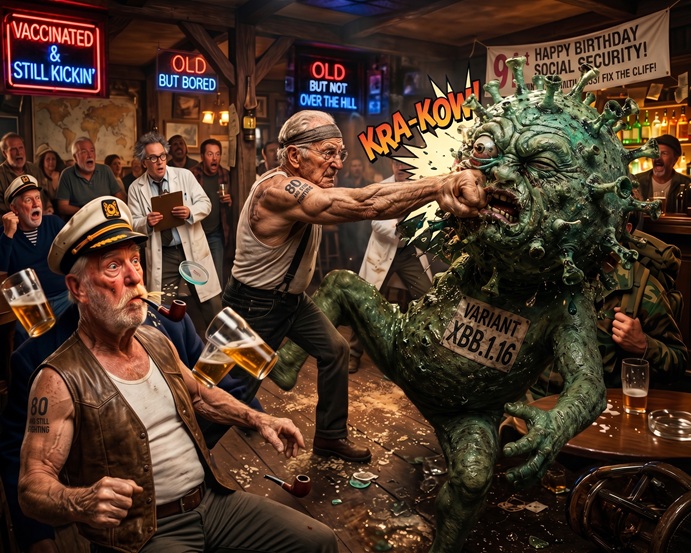
What if one of the greatest advances in infectious disease treatment isn’t an infectious disease treatment at all? What if it’s aging? Consider two people exposed to exactly the same pathogen. One is 20. The other is 80. They don’t arrive at the fight with the same biological equipment and as a result, often face vastly different outcomes. That discrepancy isn’t luck. It’s the result of immunosenescence and decades of accumulated cellular decay.
Age affects immune function, tissue repair, vascular health, cellular resilience, inflammation and countless other systems.
The pathogen may be identical. The battlefield isn’t. This is one reason the future of medicine may ultimately involve repairing the underlying biology of aging itself.
We already have active research into cellular reprogramming, gene editing, senescent cells, regenerative medicine and other approaches to repairing or reversing aspects of biological damage.
I have written about some of these possibilities before in The Age of Re-Engineering: How Science Is Rewriting the Limits of Human Life. As gene editing tools and epigenetic resetting (such as Yamanaka factor manipulation) mature, the goal post shifts.
The ultimate pandemic treatment might not be a better vaccine. It might be making the human body harder to kill in the first place. The ultimate protection against infectious disease might not be a pathogen specific vaccine at all. Imagine maintaining the immune system of a much younger person. Imagine repairing accumulated cellular damage. Imagine restoring tissues that have deteriorated with age. Imagine maintaining vascular systems that haven’t spent eight decades accumulating biological wear and tear. If you can keep the thymus gland operating like that of a 20 year old, an elderly body can fight off novel pathogens with youthful vigor and resilience.
We wouldn’t necessarily be making pathogens weaker. We’d be making their victims stronger. That is a very different approach to medicine. And potentially a much more powerful one.
Then There’s the Fourth Problem
So far, the future looks fantastic. We could continuously monitor our biology. We could control immune responses with extraordinary precision. We could potentially repair some of the damage associated with aging.
Fantastic.
Here is where the optimism runs face first into a brick wall. All of this needs to account for the fact that we’re dealing with humans.
Technology has been advancing at a breathtaking rate. Human social behavior has apparently requested a slower shipping option. This may ultimately be the most difficult problem of all, because the technology required to save lives isn’t enough. People have to trust it. They have to understand it. Governments have to distribute it. Hospitals have to deploy it. Supply chains have to function. Institutions have to communicate. And, perhaps most importantly, people have to agree that reality exists.
In 2020 modern science performed a literal miracle. Researchers designed a synthetic mRNA vaccine sequence in roughly 48 hours and had it deployed at global scale in under a year. It was one of the greatest technological achievements in human history. The science moved extraordinarily quickly.
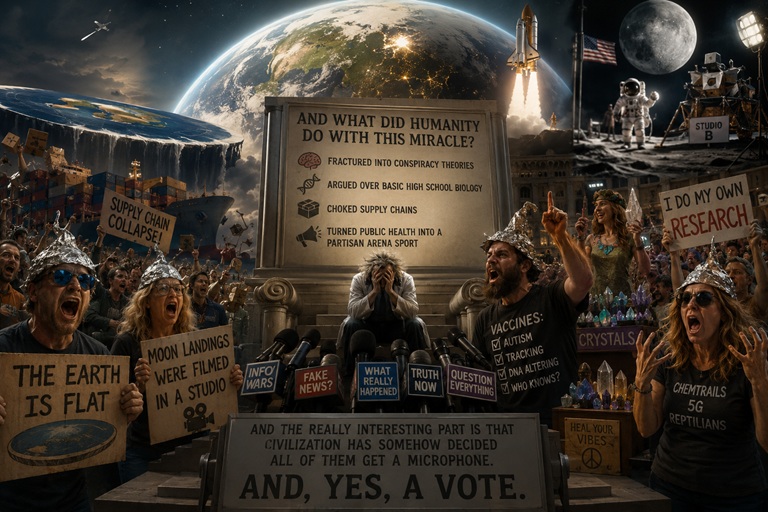
And what did humanity do with this miracle? We fractured into conspiracy theories, argued over basic high school biology, choked supply chains and turned public health into a partisan arena sport.
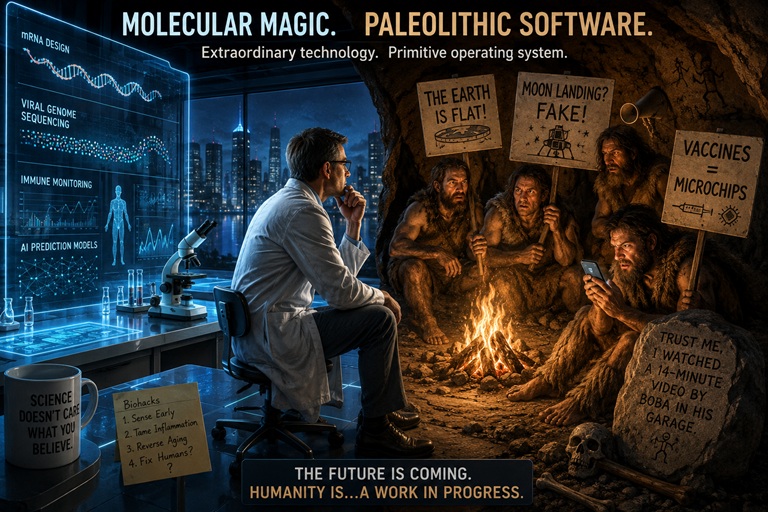
The molecules were fast. The humans were not. And this may be the biggest gap in our technological civilization. We have built extraordinary tools while continuing to manage them with a social operating system that was designed for a species whose primary communication technology was yelling across a campfire.
We can edit genes. We can talk with someone on the other side of the planet instantly. We can manufacture molecules designed to train an immune system against a newly discovered pathogen. And somewhere on the same planet, someone is still absolutely convinced that the Earth is flat. Someone believes the Moon landings were filmed in a studio. Someone believes vaccines are simultaneously designed to cause autism, contain tracking devices, alter DNA and somehow accomplish all of this while being administered by a nurse who gets paid approximately $37.
Humanity contains multitudes. Some of them are spectacularly well informed. Others are wearing aluminum foil hats while selling crystals on Facebook. And the really interesting part is that civilization has somehow decided all of them get a microphone. And, yes, a vote.
The Real Missing Biohack
The single most critical biohack missing today isn’t biological. It’s psychological and institutional. We have engineered 21st century molecular magic, but we are running it on paleolithic social software.
This is why I suspect the most important biohack of the next century may not actually be biological. It may be social. We need better ways to move trustworthy information through society. We need institutions that can communicate uncertainty without destroying credibility. We need systems that can distinguish genuine scientific disagreement from somebody who watched a fourteen minute video made by a guy named Boba in his garage. We need citizens who can understand that changing your mind when new evidence appears isn’t weakness. It’s science. And we need to become better at recognizing the difference between “I don’t understand this” and “therefore it’s a conspiracy”.
I have high confidence that science will figure out continuous molecular sensors, immune modulation and epigenetic resetting over the next few decades. I have almost zero confidence in our ability to cure the human passion for believing that the Earth is flat. Ancient Greeks proved our planet was a sphere. Two and a half millennia later that news had not reached everyone.
I would not be particularly surprised if the first three breakthroughs, or something much more impressive, arrive within the next generation.
Continuous biological monitoring? Plausible.
Precision immune modulation? Plausible.
Substantial rejuvenation of damaged tissues? Increasingly plausible.
Humanity collectively developing the emotional maturity to use all of these technologies responsibly? Well…
Let’s not get carried away. I wouldn’t bet heavily on 2126.
The Technology Keeps Winning Anyway
But there is an important reason not to become cynical. Look at where we started.
In 1918, we didn’t have intensive care medicine as we know it. We didn’t have modern antiviral drugs. We didn’t have influenza vaccines. We didn’t have molecular diagnostics. We didn’t have genomic sequencing. We didn’t have mRNA vaccine platforms. We didn’t understand viruses nearly as well as we do today.
A century later, we have all of those things and much more. None of this happened because humanity suddenly became wise. It happened because people kept experimenting. They made mistakes. They learned. They argued. They occasionally made spectacularly stupid decisions. Then someone built something useful anyway.
That’s the strange thing about technological progress. It doesn’t require us to become better people before it starts making our lives better. We can be irrational, tribal, impatient, gullible and occasionally spectacularly foolish. And we can still invent antibiotics. We can still sequence genomes. We can still develop vaccines in record time. We can still replace failing organs, repair damaged tissues and build machines that can see farther into the universe than our ancestors could have imagined.
It is easy to look at our public discourse and feel despair. Humans evolve biologically at a crawl and socially at a slight stumble. Yet, beneath the noise, the slow relentless iteration of technology continues to stack the deck in our favor. Kevin Kelly, the co-founder of Wired, once put this beautifully: “From reading the news, you learn that things have never been worse. But from reading the olds, you learn that things have never been better.” It is a piece of wisdom that should be carved into the entrance of every research lab on Earth.
That may be the most important lesson here. We are terrible at predicting the future. We are even worse at agreeing on what to do about it. But somehow, generation after generation, we keep building things that would have looked like magic to the people who came before us.
So what is the one biohack we’re missing today that the next hundred years will fix? I don’t know. Maybe it’s a biological firewall. Maybe it’s an immune system volume knob. Maybe it’s cellular rejuvenation. Maybe it’s something so bizarre that nobody has thought of it yet.
That’s the fun part. The future is under no obligation to make sense to us, but I suspect there is one thing we can predict with reasonable confidence. By 2126 humanity will have invented technologies that would astonish us today and humanity will still be arguing about them on the future version of the internet.
Some things, apparently, are immortal.
Discover more from Tales of Many Things
Subscribe to get the latest posts sent to your email.